
A Beautiful Mind (2001)
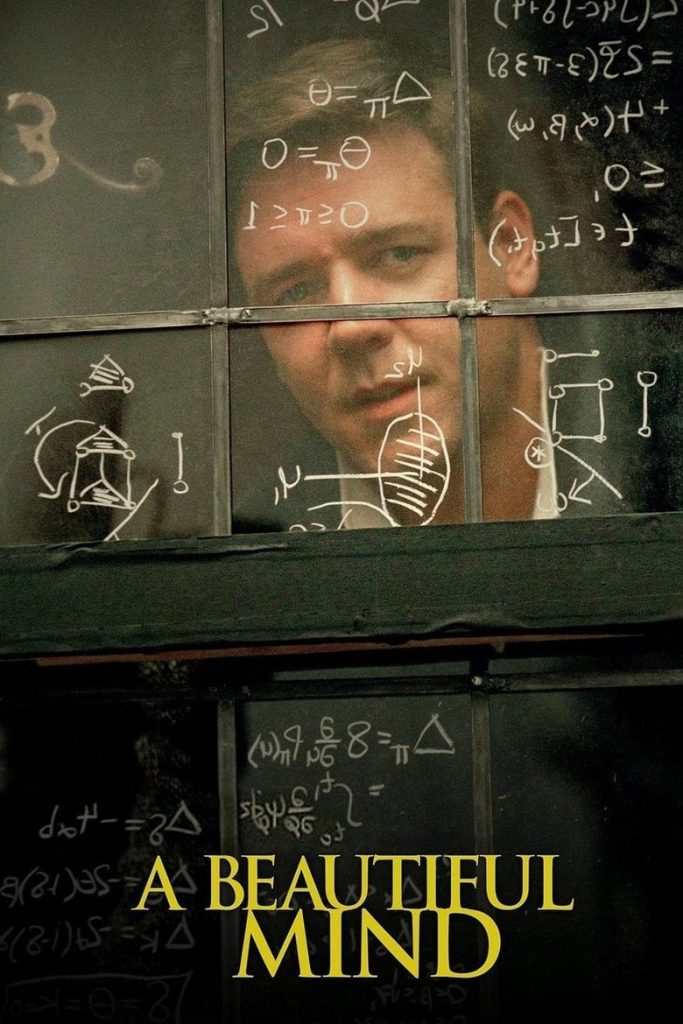
Story overview
A Beautiful Mind tells the story of a brilliant mathematician who achieves early success but struggles with mental health challenges. The film explores his journey through professional triumphs and personal difficulties as he navigates relationships and his own perceptions of reality. It's an emotional drama about perseverance, love, and the human capacity for resilience.
Parent Guide
A thoughtful drama about mental health challenges and resilience, best for mature tweens and teens who can handle emotional intensity and psychological themes.
Content breakdown
Some tense moments and implied threats, but no physical violence or graphic peril.
Psychological themes including hallucinations, paranoia, and mental distress could be unsettling for sensitive viewers.
Occasional mild language, consistent with PG-13 rating.
Romantic relationships and brief suggestive content, but no explicit scenes or nudity.
Social drinking in some scenes, but not a major theme.
Strong emotional themes including mental health struggles, relationship strain, and personal crisis.
Parent tips
This film deals with mature themes including mental illness, paranoia, and the impact of psychological struggles on relationships. While there's no graphic violence or explicit content, the emotional intensity and depiction of delusional thinking may be challenging for younger viewers. The PG-13 rating reflects the serious subject matter and complex psychological themes that require some maturity to process.
Parents should know that the film portrays a character experiencing hallucinations and paranoid delusions, which could be confusing or unsettling for children who don't understand mental health conditions. The story includes moments of emotional distress and relationship strain that might require explanation for younger audiences. The film's runtime of over two hours also requires sustained attention.
Parent chat guide
During viewing, pause if needed to check in about confusing scenes or emotional moments. You might ask questions like 'How do you think the character is feeling right now?' or 'What do you think is real versus imagined in this scene?'
After watching, focus on themes of perseverance, support systems, and understanding differences. Discuss how the film shows that people can face significant challenges while still achieving meaningful things in life, and how love and support can make a difference.
Parent follow-up questions
- What did you like about the movie?
- How did the people in the movie help each other?
- What was your favorite part?
- How do you think the main character felt when he was confused?
- What does it mean to be a good friend?
- What challenges did the main character face?
- How did his family support him?
- What does the movie teach us about being different?
- How did the character show bravery?
- What would you do if a friend was having a hard time?
- How does the film portray mental health challenges?
- What role does love and support play in overcoming difficulties?
- How does the movie show the difference between reality and imagination?
- What does perseverance mean in this story?
- How do you think the character's brilliance affected his life?
- How does the film handle the stigma around mental illness?
- What does the story say about the relationship between genius and mental health?
- How does the film balance hope with the realities of chronic conditions?
- What ethical questions does the treatment approach raise?
- How does the movie challenge our perceptions of reality and success?
🎭 Story Kernel
At its core, 'A Beautiful Mind' explores the thin line between genius and madness, arguing that the human spirit's capacity for love and connection can transcend even the most debilitating mental illness. John Nash's journey isn't just about overcoming schizophrenia; it's about redefining what constitutes a 'real' life. His breakthrough isn't the Nobel Prize, but the moment he learns to ignore his persistent hallucinations, accepting that the 'real' is defined by shared human experience—his wife's touch, his colleagues' respect—not by solitary, paranoid logic. The film posits that the mind's greatest achievement is not solving equations, but choosing which realities to believe in.
🎬 Visual Aesthetics
The film's visual language masterfully mirrors Nash's fractured perception. Early scenes at Princeton are bathed in warm, golden hues, creating an idyllic, almost dreamlike atmosphere that subtly blurs into his delusions. The camera often adopts Nash's subjective viewpoint, making the audience complicit in his paranoia—the government agents feel as real as any other character. As his schizophrenia manifests, the color palette drains, with colder blues and grays dominating the institutional settings. The most powerful visual metaphor is the recurring image of Nash's pen hovering over glass, a fragile barrier between his internal chaos and the external world he's trying to decipher.
🔍 Details & Easter Eggs
💡 Behind the Scenes
Russell Crowe prepared for the role by meeting with John Nash and studying the mannerisms of people with schizophrenia, but he deliberately avoided mimicking Nash's actual speech patterns to create a more accessible character. The Princeton campus scenes were filmed at multiple universities because the real Princeton denied filming permission. Jennifer Connelly, who played Alicia Nash, actually bonded with the real Alicia, who advised her on the emotional nuances of living with a partner with mental illness, adding profound authenticity to her performance.
Where to watch
Choose region:
- Amazon Prime Video
- Amazon Prime Video with Ads
- Amazon Video
- Apple TV
- Google Play Movies
- YouTube
- Fandango At Home
- Spectrum On Demand
Trailer
Trailer playback is unavailable in your region.