
A Trip to Infinity (2022)
Story overview
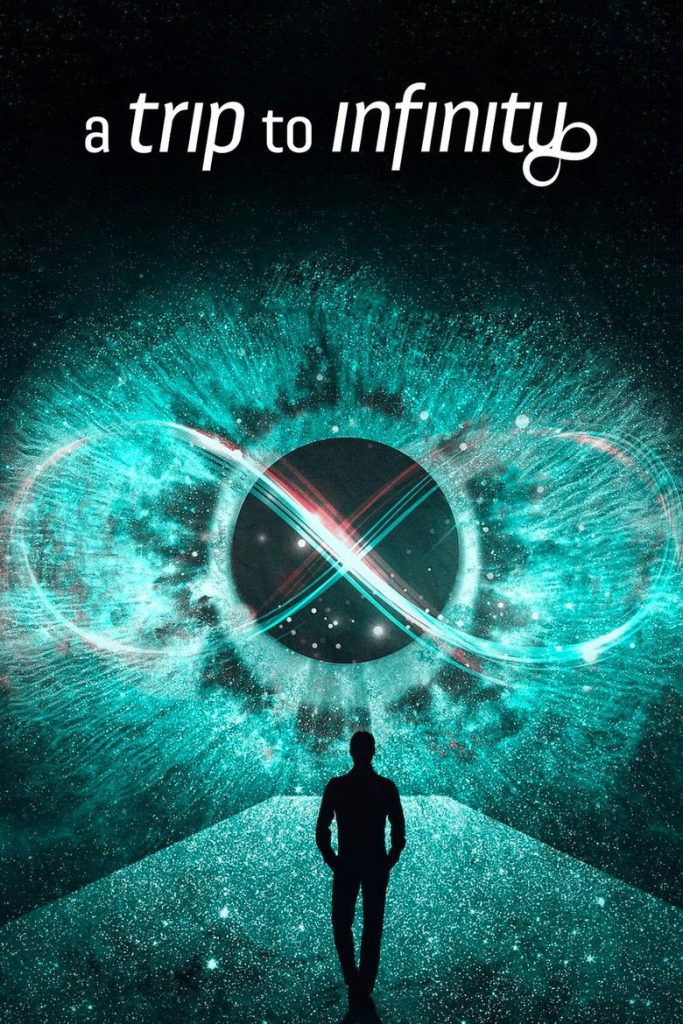
A Trip to Infinity is a 2022 animated documentary that explores the concept of infinity through interviews with scientists and mathematicians. The film uses creative animation from artists worldwide to visualize abstract ideas about the universe, mathematics, and existence. It's an educational journey that encourages curiosity about complex scientific topics.
Parent Guide
Educational documentary exploring mathematical and scientific concepts through animation and expert interviews. Suitable for curious children interested in science.
Content breakdown
No violence, peril, or dangerous situations depicted.
No scary or disturbing content. Some abstract concepts about infinity might be conceptually challenging but not frightening.
No inappropriate language. All dialogue is educational and professional.
No sexual content or nudity.
No depiction of substance use.
Some children might find the scale of cosmic concepts emotionally stirring or intellectually overwhelming, but not distressing.
Parent tips
This documentary is appropriate for most children due to its educational nature and TV-PG rating. The abstract concepts might be challenging for younger viewers, but the animated visuals help make them accessible. Consider watching together to discuss the ideas presented. No concerning content is present.
Parent chat guide
Parent follow-up questions
- What was your favorite picture in the movie?
- Did you see any shapes or colors you liked?
- What does 'big' mean to you?
- What is one thing you learned about numbers or space?
- How did the movie make you feel about how big the universe is?
- What question would you ask a scientist about infinity?
- How do scientists study things they can't see or measure completely?
- What was the most surprising fact you learned?
- How does thinking about infinity change how we see everyday things?
- What philosophical questions does the concept of infinity raise?
- How do different scientific fields approach the idea of infinity differently?
- What are the practical implications of infinite concepts in mathematics or physics?
🎭 Story Kernel
The film's core isn't about solving infinity, but about exploring our human relationship with the incomprehensible. It expresses the fundamental tension between our finite minds and the infinite universe. What drives the narrative is the collision of mathematical abstraction with visceral, emotional experience—how concepts like endlessness, nothingness, and eternity translate from equations to existential dread or wonder. Through scientists, philosophers, and artists, it reveals that infinity is less a mathematical destination and more a mirror reflecting our deepest anxieties about mortality, scale, and meaning in a cosmos that operates on rules beyond human intuition.
🎬 Visual Aesthetics
The visual language masterfully oscillates between clinical clarity and psychedelic abstraction. Crisp interviews and whiteboard explanations ground the concepts, while the film's most striking sequences use CGI animation to visualize mathematical ideas—turning recursive fractals, infinite regressions, and expanding universes into tangible, often unsettling, imagery. A muted, almost sterile color palette during talking-head segments contrasts with vibrant, swirling visuals during abstract explanations, creating a sensory representation of moving from known reality into conceptual frontier. The camera often uses slow zooms into patterns or endless horizons, mimicking the act of contemplating boundlessness itself.
🔍 Details & Easter Eggs
💡 Behind the Scenes
The documentary features interviews with prominent figures like physicist Brian Greene and mathematician Steven Strogatz, but notably avoids a single narrator, instead weaving perspectives to create a collective exploration. Filming occurred across multiple countries, with segments shot at institutes like the Perimeter Institute for Theoretical Physics. The production team collaborated closely with animators to ensure the abstract visualizations were mathematically accurate while remaining accessible, consulting with advisors to balance artistic interpretation with scientific integrity.
Where to watch
Choose region:
- Netflix
- Netflix Standard with Ads
Trailer
Trailer playback is unavailable in your region.