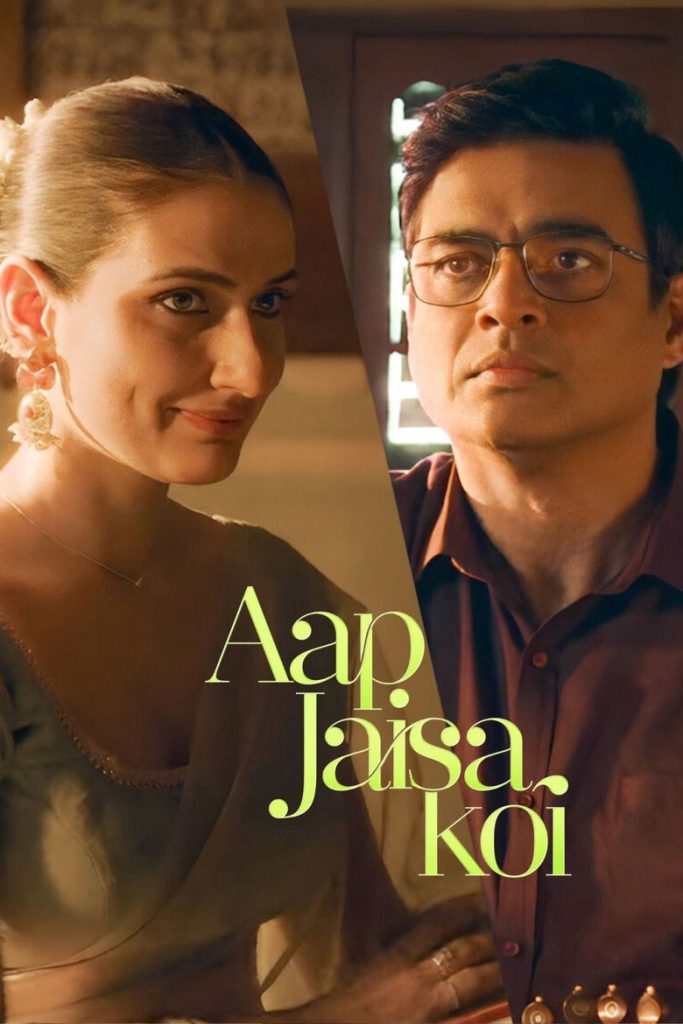
Aap Jaisa Koi (2025)

Released: 2025-07-11 Recommended age: 8+ No IMDb rating yet
Aap Jaisa Koi

Movie details

  • Genres: Romance, Comedy
  • Director: Vivek Soni
  • Main cast: R. Madhavan, Fatima Sana Shaikh, Namit Das, Manish Chaudhary, Ayesha Raza Mishra
  • Country / region: India
  • Original language: hi
  • Premiere: 2025-07-11

Story overview

Aap Jaisa Koi is a 2025 Indian romantic comedy that explores the clash between tradition and modernity. The film follows Shrirenu, who adheres strictly to cultural traditions, and Madhu, who lives freely and unapologetically. When their paths cross, a tender and awkward romance begins to blossom, but their relationship faces challenges from patriarchal societal expectations. Set against a backdrop of cultural norms, the story navigates themes of love, identity, and social pressure with humor and heart.

Parent Guide

A gentle romantic comedy that explores cultural traditions and patriarchy through a developing relationship. Suitable for family viewing with guidance for younger children.

Content breakdown

Violence & peril
None

No physical violence or perilous situations. Conflict is emotional and social rather than physical.

Scary / disturbing
None

No scary or disturbing content. The film maintains a light, comedic tone throughout.

Language
Mild

May include mild expressions or cultural terms related to the Hindi language context. No strong profanity or offensive language.

Sexual content & nudity
Mild

Limited to romantic gestures like holding hands, brief kisses, and affectionate conversations. No explicit sexual content or nudity.

Substance use
None

No depiction of alcohol, tobacco, or drug use.

Emotional intensity
Mild

Emotional moments related to relationship tensions and societal pressure, but handled with humor and resolution. Not emotionally overwhelming for most viewers.

Parent tips

This film deals with themes of patriarchy and traditional gender roles, which may require explanation for younger viewers. The romance is portrayed as sweet and awkward rather than intense, but parents should be prepared to discuss how societal expectations can impact relationships. The comedy elements are gentle and situational, making it accessible for families, but the underlying social commentary might be more meaningful for older children and teens.

Parent chat guide

Use this movie as a springboard to talk about respecting different lifestyles and challenging unfair traditions. For younger kids, focus on the friendship and kindness aspects. For pre-teens and teens, discuss how patriarchy affects both men and women, and explore ways to support equality in relationships. Ask questions like: 'How did Shrirenu and Madhu show respect for each other's differences?' or 'What would you do if you faced pressure to follow traditions you don't agree with?'

Parent follow-up questions

  • Which character did you like best and why?
  • What was your favorite funny part?
  • How did the characters show they cared about each other?
  • What traditions did Shrirenu follow?
  • How was Madhu different from Shrirenu?
  • What made their friendship special?
  • What challenges did the characters face because of their differences?
  • How did patriarchy affect their relationship?
  • What does 'unapologetically' mean when describing Madhu?
  • How does the film critique traditional gender roles?
  • What societal pressures do young people face regarding relationships today?
  • How can we balance respect for tradition with personal freedom?
⚠️ Deep Film Analysis (Contains Spoilers) · Click to Expand
A Bollywood fever dream where disco beats mask a hollow heart.

🎭 Story Kernel

At its core, 'Aap Jaisa Koi' is a cynical exploration of transactional relationships in a rapidly Westernizing 1970s Bombay. The film's central tension isn't a love story but a power struggle disguised as romance. Qurbani (Zeenat Aman) isn't driven by affection but by a desperate bid for financial security and social mobility, seeing the wealthy Ravi (Rishi Kapoor) as her ticket out of poverty. Ravi, in turn, is motivated by the thrill of conquest and the performative rebellion against his conservative family. Their relationship functions as a business negotiation set to music, where every romantic gesture carries an unspoken price tag. The film's resolution—where Qurbani ultimately chooses independence over either man—feels less like empowerment and more like a strategic retreat when both deals prove unfavorable.

🎬 Visual Aesthetics

The film's visual language is a jarring clash between gritty realism and psychedelic fantasy. Director Narendra Bedi frames Bombay's slums and crowded markets with a documentary-like starkness, using handheld shots and natural lighting to emphasize Qurbani's impoverished reality. This contrasts violently with the musical sequences, which explode in saturated disco colors, glittering costumes, and frenetic, kaleidoscopic editing. The camera becomes unmoored during songs like the title track, employing dizzying spins and rapid zooms that mirror the characters' intoxication with Western glamour. This aesthetic schizophrenia isn't accidental—it visually represents the characters' fractured identities, caught between traditional Indian life and the seductive, hollow promise of disco-era modernity. The final shot of Qurbani walking away alone, backlit by a harsh sun, uses stark, high-contrast lighting to underline her isolation.

🔍 Details & Easter Eggs

1
The recurring motif of Qurbani adjusting her cheap, oversized sunglasses isn't just a fashion choice. It visually represents her constantly shifting persona and the fragile barrier she puts between her true self and the world she's trying to infiltrate.
2
In the background of the club scenes, watch the extras. Many are clearly uncomfortable with the Western dance moves, performing them with a stiff, awkward hesitation that mirrors the film's broader anxiety about cultural assimilation.
3
The color of Qurbani's clothing subtly charts her arc. She begins in muted, earthy tones in the slums, shifts to garish, synthetic brights during her 'transformation,' and ends the film in a simple, solid-colored sari—a visual return to a more authentic, if uncertain, self.

💡 Behind the Scenes

The film's iconic title song 'Aap Jaisa Koi' was originally offered to and recorded by Pakistani singer Nazia Hassan when she was just 15 years old, making her a teenage sensation across South Asia. Zeenat Aman, playing Qurbani, was already a major star known for her 'bold' roles, and her casting was considered risky for a sympathetic lead. The disco sequences were heavily inspired by the global success of 'Saturday Night Fever,' but filmed on a fraction of the budget in Bombay studios, resulting in that uniquely chaotic, low-fi Bollywood disco aesthetic. Rumors persist of on-set tension between the film's stylish aspirations and its limited resources, visible in some hastily constructed sets.

Where to watch

Choose region:

  • Netflix
  • Netflix Standard with Ads
SkyMe App
SkyMe Guide Download on the App Store
VIEW