
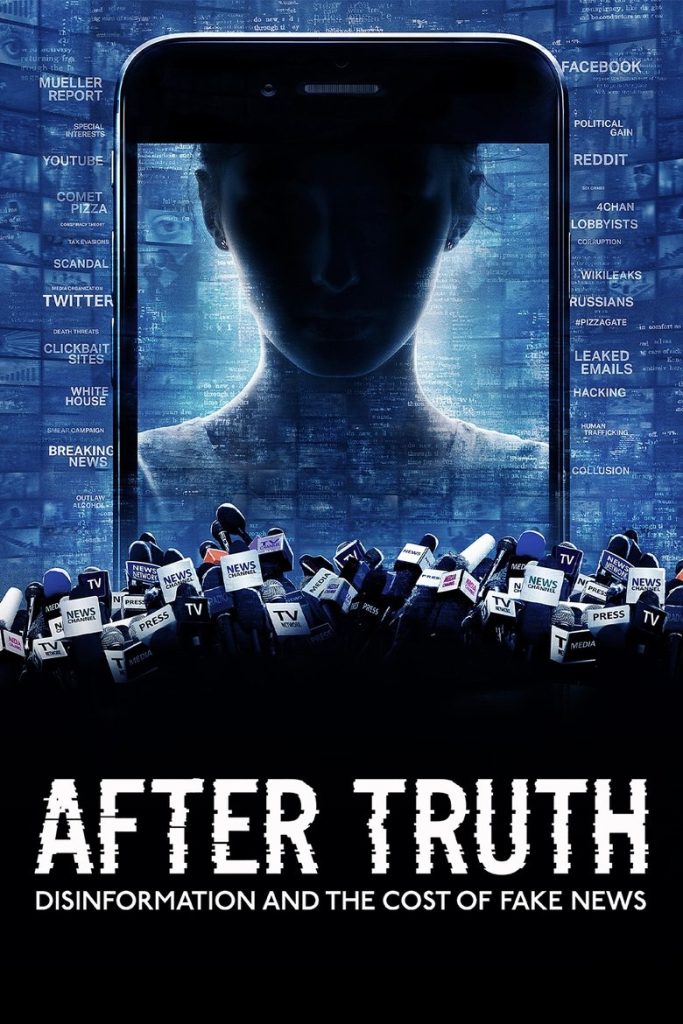
After Truth: Disinformation and the Cost of Fake News (2020)
Story overview
This documentary examines the impact of fake news, disinformation, and conspiracy theories on American society, highlighting real-world consequences for ordinary people through investigative reporting and expert analysis.
Parent Guide
Documentary exploring the serious societal impact of disinformation and fake news. Contains mature themes and discussions of real-world consequences that may be disturbing to younger viewers.
Content breakdown
Discussions of real-world violence and threats that have resulted from disinformation campaigns, but no graphic violent imagery shown.
Content includes disturbing real-life examples of how false information has harmed individuals and communities. Discussions of conspiracy theories and their dangerous consequences.
May contain occasional mild language in interview clips or news footage. No strong profanity expected in documentary narration.
No sexual content or nudity present in this documentary.
No depiction of substance use.
Emotionally intense discussions of real people harmed by disinformation. May provoke anxiety or concern about media manipulation and societal trust.
Parent tips
This documentary deals with mature themes about misinformation in society. It's best suited for older children and teens who can understand complex social issues. Watch together to discuss media literacy and critical thinking.
Parent chat guide
Parent follow-up questions
—
- What does 'fake news' mean?
- Why is it important to tell the truth?
- How can you tell if a news story is true or false?
- What are some ways people spread false information online?
- Why might someone believe something that isn't true?
- What psychological factors make people susceptible to disinformation?
- How do social media algorithms contribute to the spread of fake news?
- What responsibilities do media platforms have in combating misinformation?
- How can we balance free speech with preventing harm from false information?
🎭 Story Kernel
The film is not a documentary about 'fake news' but a forensic examination of the human cost when information becomes weaponized. It expresses the profound vulnerability of our social fabric to narratives engineered for profit and power. The characters—both the perpetrators like conspiracy theorists and the victims like the 'Pizzagate' targets—are driven by primal forces: the creators by a hunger for influence and financial gain, often masked as ideological crusades, and the victims by a desperate, violated need for safety and restored reality. The core engine is the monetization of outrage, showing how platforms algorithmically reward the most emotionally charged falsehoods, turning disbelief into a business model and trauma into viral content.
🎬 Visual Aesthetics
The film employs a stark, almost clinical visual language. It contrasts the glossy, hyper-stimulating interfaces of social media dashboards—filled with inflammatory graphics and rapid-fire clips—with intimate, raw interviews shot in natural light, often in victims' homes. This creates a visual dialectic between the cold, digital realm where falsehoods proliferate and the warm, human world where they inflict real wounds. The color palette is desaturated in the real-world segments, emphasizing gravity, while online footage is lurid and saturated. The camera holds on subjects' faces during painful recollections, refusing to look away from the emotional fallout, making the viewer a witness rather than a passive consumer.
🔍 Details & Easter Eggs
💡 Behind the Scenes
The film is directed by Andrew Rossi, known for immersive documentaries like 'Page One: Inside the New York Times'. It heavily features interviews with key figures from the 'Pizzagate' and 'Seth Rich' conspiracy theories, including the journalists who debunked them and individuals whose lives were upended. Much of the footage of online activity and creator studios was obtained through direct access, providing a rare, unfiltered look into the production pipelines of disinformation. The project was developed in close consultation with media scholars and researchers tracking misinformation networks.
Where to watch
Choose region:
- HBO Max
- HBO Max Amazon Channel
- Amazon Video
- Apple TV Store
- Google Play Movies
- YouTube
- Fandango At Home
Trailer
Trailer playback is unavailable in your region.