
Alien Encounters Declassified (2021)
Story overview
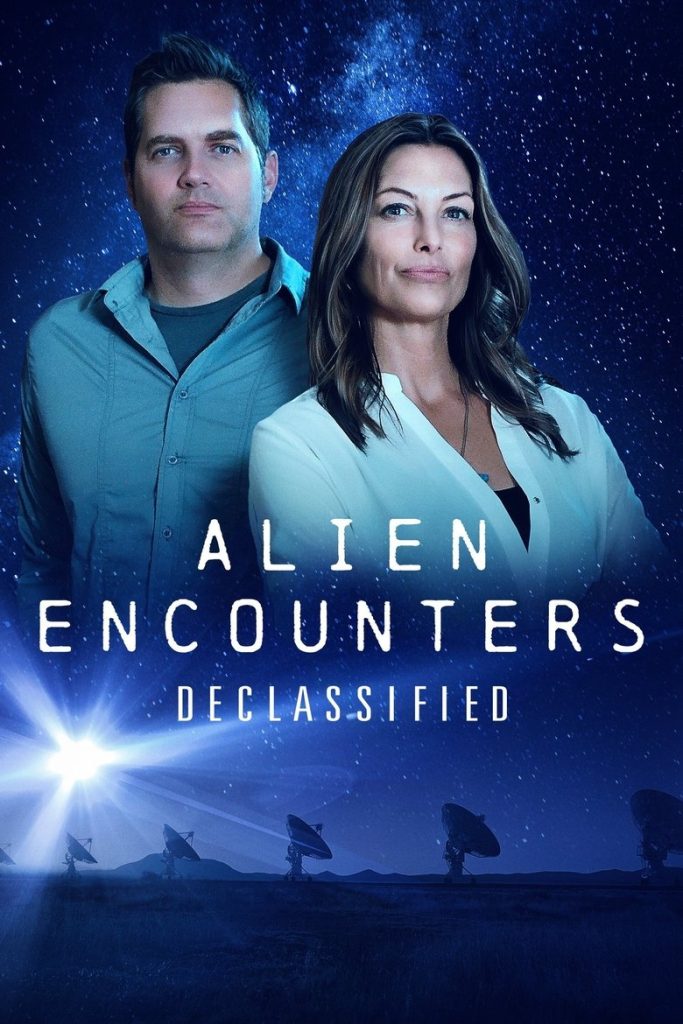
Alien Encounters Declassified is a 2021 documentary TV movie that explores mysterious phenomena and alleged extraterrestrial encounters. It examines declassified government documents, eyewitness accounts, and scientific perspectives on unexplained events. The film presents various theories while maintaining a factual tone typical of investigative documentaries.
Parent Guide
A speculative documentary about alien encounters and government secrets that requires parental guidance for critical media literacy.
Content breakdown
No violent scenes depicted; discusses theoretical scenarios without graphic content.
Discussion of mysterious phenomena and potential alien encounters might unsettle sensitive viewers.
No offensive language expected in documentary format.
No sexual content or nudity in documentary presentation.
No depiction or discussion of substance use.
Thematic discussion of government secrecy and unexplained phenomena may create mild suspense.
Parent tips
This documentary presents speculative content about alien encounters that might confuse or unsettle younger viewers. The discussion of government secrets and unexplained phenomena could raise questions about truth and authority. Consider watching together to help children distinguish between entertainment, speculation, and established facts.
Parent chat guide
Parent follow-up questions
- What was your favorite part of the movie?
- Did you see any spaceships or aliens?
- What do you think is real and what is pretend in the movie?
- What evidence did they show to support their ideas?
- How can we tell if something is a fact or just someone's opinion?
- Why do you think people are interested in aliens and mysteries?
- What techniques did the documentary use to make its points convincing?
- How reliable are eyewitness accounts compared to scientific evidence?
- What responsibility do filmmakers have when presenting unproven theories as mysteries?
- How does this documentary compare to other investigative journalism you've seen?
- What ethical considerations arise when discussing government secrecy and disclosure?
- How might cultural context influence people's interpretation of unexplained phenomena?
🎭 Story Kernel
The film's true subject isn't alien visitation but humanity's psychological and institutional obsession with the unknown. It dissects how the 'declassification' process itself becomes a character—a bureaucratic entity that both reveals and obscures truth, mirroring the very secrecy it claims to dismantle. The driving force isn't a quest for aliens, but a profound human need to categorize the uncategorizable, to force the anomalous into the comforting boxes of government files and scientific reports. The experts and whistleblowers aren't just presenting evidence; they're performing a ritual of belief and skepticism, revealing how our institutions shape narratives to manage collective anxiety about the cosmos.
🎬 Visual Aesthetics
The visual language is a deliberate study in contrast and obfuscation. Clean, sterile interview shots of officials in government offices are juxtaposed with grainy, degraded archival footage—the 'evidence.' The camera often lingers on redacted documents, with black bars visually consuming information, making absence the most powerful image. A muted, almost bureaucratic color palette of grays and blues dominates, punctuated only by the stark green of night-vision footage or the clinical white of lab settings. This isn't flashy sci-fi; it's the aesthetics of the filing cabinet and the evidence locker, making the mundane feel charged with hidden significance.
🔍 Details & Easter Eggs
💡 Behind the Scenes
The production faced significant hurdles accessing certain military archives, a meta-struggle that informed the film's tone. Several interviewees, former intelligence personnel, insisted on being filmed in shadow or with digitally altered voices, a condition the filmmakers incorporated stylistically. Much of the 'archival' UFO footage was sourced from declassified government releases, but the team discovered that the low quality wasn't just due to age—it was often how the material was originally recorded on purpose. The director reportedly used former documentary editors who had worked on investigative journalism projects to structure the narrative, aiming for a tone closer to a political expose than a sci-fi feature.
Where to watch
Choose region:
- HBO Max
- Discovery +