
All in a Nutshell (1949)
Story overview
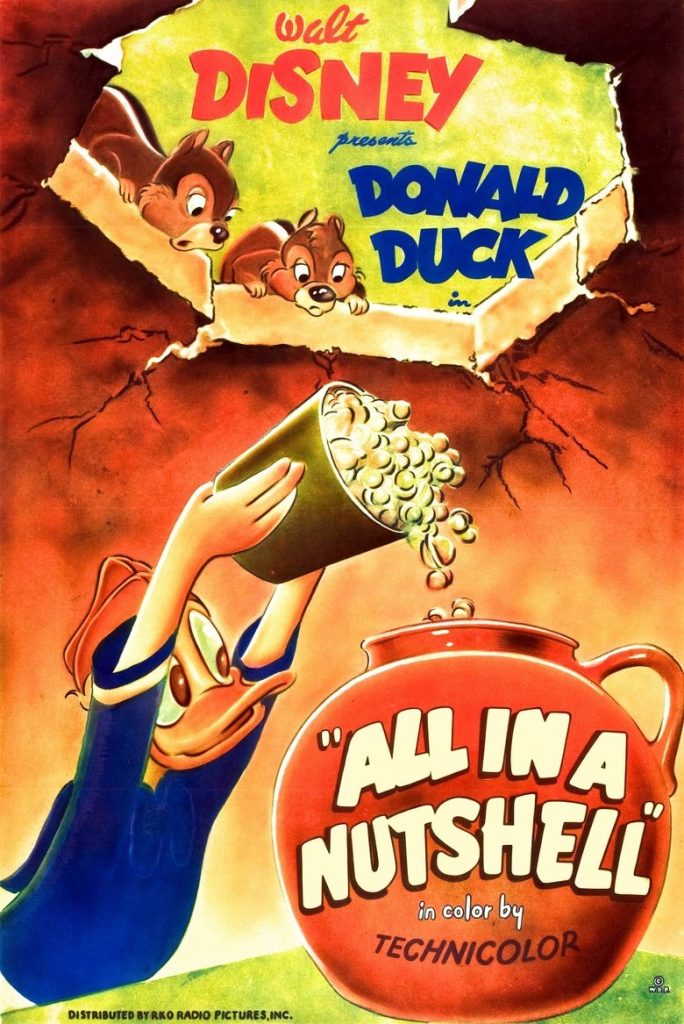
This short animated film features Donald Duck stealing nuts from Chip and Dale for his nut-butter business. The chipmunks devise a plan to get their nuts back by rolling Donald into a nearby lake. The story presents a classic cartoon conflict with slapstick humor and simple rivalry between characters. The resolution involves playful retaliation rather than serious consequences.
Parent Guide
A classic animated short with mild cartoon conflict suitable for most children.
Content breakdown
Cartoon slapstick with characters rolling each other and falling into water. No injuries shown.
No frightening imagery or disturbing content. Conflict is presented humorously.
No inappropriate language. Characters communicate through sounds and gestures.
No sexual content or nudity. Characters are anthropomorphic animals.
No depiction of substance use or references to drugs/alcohol.
Brief frustration and conflict between characters, resolved quickly with humor.
Parent tips
This 7-minute cartoon from 1949 contains mild cartoon violence typical of its era, with characters engaging in slapstick conflict. The theft and retaliation theme provides opportunities to discuss property rights and conflict resolution with children. The animation style and humor are gentle and appropriate for most young viewers, though very sensitive children might find the conflict unsettling.
Parent chat guide
Parent follow-up questions
- How did the chipmunks feel when their nuts were taken?
- What was your favorite part of the cartoon?
- Is it okay to take things that belong to others?
- How did Donald feel at the end?
- What sounds did the animals make?
- Why do you think Donald took the nuts without asking?
- What other ways could the chipmunks have gotten their nuts back?
- How does this cartoon show problem-solving?
- What makes this funny instead of scary?
- Have you ever had something taken from you?
- What does this cartoon teach about consequences for actions?
- How does the animation style affect how we view the conflict?
- What historical context might explain this type of humor?
- How might this story be different if made today?
- What values about property are shown here?
- How does this cartoon reflect mid-20th century entertainment values?
- What commentary does it make about business ethics?
- How does slapstick humor function as conflict resolution in animation?
- What cultural assumptions about property rights are present?
- How might different audiences interpret the characters' actions?
🎭 Story Kernel
The film is less about the literal journey of retrieving a lost heirloom walnut and more about confronting the absurdity of human obsession. The protagonist, a mild-mannered botanist, is driven by a compulsive need for order and completion that borders on pathological. His quest reveals how we often inflate trivial objects with monumental meaning to avoid facing the chaotic, unmanageable aspects of our lives—grief, loneliness, the passage of time. The 'nut' becomes a MacGuffin for existential dread; the real story is the unraveling of a man who discovers his meticulously curated world is just as fragile and hollow as the shell he chases.
🎬 Visual Aesthetics
The cinematography employs extreme close-ups and shallow depth of field, making mundane objects—a grain of dirt, a crack in pavement—feel like vast, alien landscapes. This visual language mirrors the protagonist's myopic worldview. A desaturated, brown-and-gray color palette dominates, punctuated only by the vivid, almost unnatural walnut-brown of the titular object, highlighting its outsized significance. The camera often remains static during moments of high emotional tension, trapping the viewer in the character's stifling perspective. The final wide shot of the vast, empty park where the nut is finally found underscores the anticlimactic pettiness of the entire endeavor.
🔍 Details & Easter Eggs
💡 Behind the Scenes
The lead actor, known for big-budget action roles, reportedly took a 90% pay cut for this indie project, wanting to explore quiet desperation. The entire film was shot in a single public park over 18 days, with the crew often having to wait for pedestrians to clear. The director insisted on using a real, preserved walnut for the prop, which was lost multiple times during filming, ironically mirroring the plot. The minimalist score was composed using only sounds recorded in the park—rustling leaves, distant chatter, creaking benches—processed into melancholic melodies.
Where to watch
Choose region:
- Disney Plus