
All the Way (2016)
Story overview
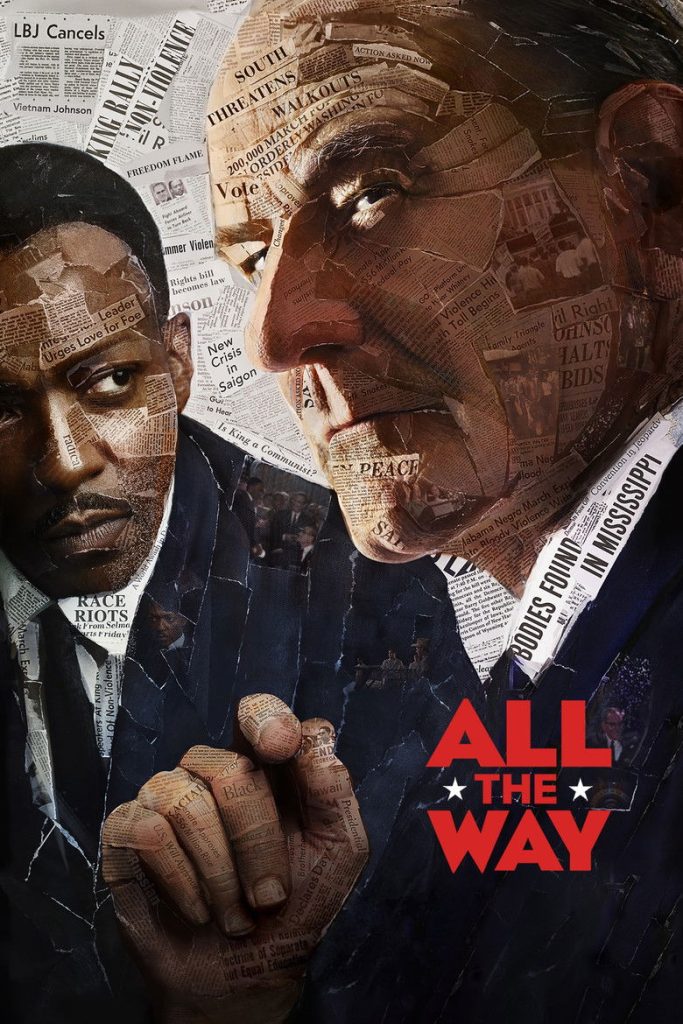
This historical drama depicts President Lyndon B. Johnson's first year in office following President Kennedy's assassination, focusing on his political battles to pass the landmark Civil Rights Act of 1964 while navigating his own presidential campaign. The film portrays the intense political negotiations, racial tensions of the era, and personal struggles of political leadership during a transformative period in American history.
Parent Guide
Educational historical drama suitable for mature middle schoolers and older, focusing on political processes and civil rights history without graphic content.
Content breakdown
Historical references to political violence (Kennedy assassination mentioned but not shown), tense political confrontations, and discussions of racial violence during the Civil Rights era. No physical violence depicted on screen.
Some intense political arguments and discussions of racial discrimination may be unsettling for sensitive viewers. The film deals with serious historical events including assassination and civil rights struggles.
Period-appropriate mild language including occasional political insults and some mild profanity. No strong or frequent offensive language.
No sexual content or nudity. The film focuses entirely on political and historical events.
Social drinking in political settings (cocktails, whiskey), typical of period political dramas. No excessive or glorified substance use.
High-stakes political drama with intense negotiations, moral dilemmas, and historical significance. The film portrays the pressure of presidential leadership and the emotional weight of civil rights legislation.
Parent tips
This film is appropriate for mature middle schoolers and high school students studying American history or government. The political drama contains intense discussions about racial inequality and civil rights, but no graphic violence or explicit content. Parents may want to watch with younger teens to discuss the historical context and political processes depicted.
Parent chat guide
Parent follow-up questions
—
—
- What did you learn about how laws are made?
- Why was the Civil Rights Act important?
- What challenges did President Johnson face?
- How does this film portray political leadership differently than modern politics?
- What historical context is necessary to fully understand this film?
- How does the film balance historical accuracy with dramatic storytelling?
- What contemporary issues relate to the civil rights struggles depicted?
🎭 Story Kernel
At its core, 'All the Way' explores the transactional nature of political power and the erosion of idealism through compromise. The film isn't about whether the Civil Rights Act passes, but about what Lyndon B. Johnson must become to make it happen. Bryan Cranston's Johnson isn't driven by moral conviction but by political calculation—he recognizes civil rights as his legacy opportunity while simultaneously betraying the movement's radical wing. The real tension comes from watching Johnson manipulate everyone: the Southern Democrats he needs, the civil rights leaders he disappoints, and even his own conscience. The film suggests that monumental change requires morally ambiguous architects who understand power's dirty mechanics better than justice's pure ideals.
🎬 Visual Aesthetics
The film employs a claustrophobic visual language that mirrors Johnson's political entrapment. Director Jay Roach uses tight close-ups during key conversations, making every negotiation feel like a confined battle. The color palette shifts subtly—warmer tones during Johnson's moments of domestic intimacy contrast with the cold, institutional blues and grays of the White House. Camera movements are deliberately restrained, with few sweeping shots, emphasizing the bureaucratic grind of governance. Symbolically, Johnson is often framed through doorways or behind desks, visually reinforcing his position as both gatekeeper and prisoner of the Oval Office.
🔍 Details & Easter Eggs
💡 Behind the Scenes
Bryan Cranston originated the role of Lyndon B. Johnson on Broadway before reprising it for this HBO film, spending months studying Johnson's mannerisms and Texas accent. The White House sets were meticulously recreated based on historical photographs from 1964-65, with particular attention to the Oval Office's specific shade of blue-gray. Director Jay Roach insisted on shooting in actual political locations when possible, including using the Texas State Capitol where Johnson began his political career. Anthony Mackie prepared for his role as Martin Luther King Jr. by listening to hundreds of hours of King's speeches and consulting with civil rights historians about King's private demeanor versus his public persona.
Where to watch
Choose region:
- HBO Max
- HBO Max Amazon Channel
- Amazon Video
- Apple TV Store
- Google Play Movies
- YouTube
- Fandango At Home
Trailer
Trailer playback is unavailable in your region.