
Along for the Ride (2022)
Story overview
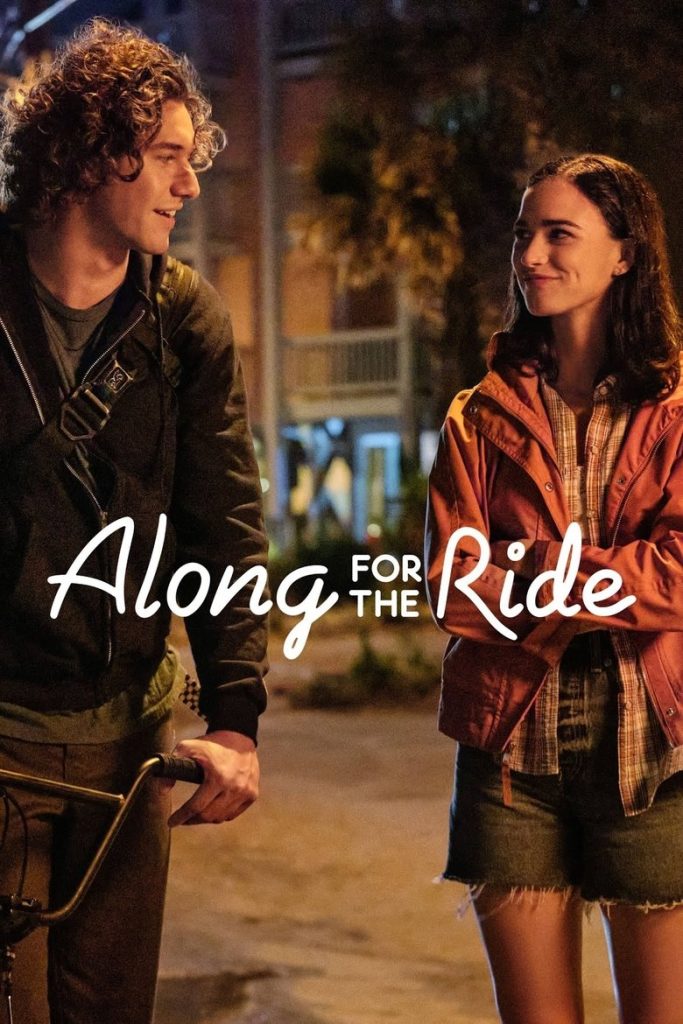
Auden, an academically focused teen, spends her summer before college in a seaside town where she meets Eli, a fellow insomniac. Together, they explore the town at night, helping Auden discover the joys of a carefree teenage life she missed while growing up.
Parent Guide
A gentle coming-of-age story about self-discovery and first love, appropriate for mature tweens and teens with some guidance on romantic content and family themes.
Content breakdown
No violence or perilous situations depicted.
No scary or disturbing content.
Occasional mild language like 'hell' or 'damn'.
Kissing and romantic moments between teens, no nudity or explicit content.
Brief social drinking by adults in background scenes.
Mild emotional moments related to family dynamics and teenage self-discovery.
Parent tips
This coming-of-age romance focuses on self-discovery and first love. Parents should be aware of mild romantic content, brief language, and themes of family dynamics. Suitable for teens and mature tweens with guidance.
Parent chat guide
Parent follow-up questions
—
—
- What did Auden learn about friendship from Eli?
- How did Auden's relationship with her parents change?
- Why is it important to try new things?
- How does the film portray the transition to adulthood?
- What does the film say about balancing academics and social life?
- How do the characters handle family conflicts?
🎭 Story Kernel
The film is less a traditional coming-of-age romance and more a quiet exploration of how we process unresolved trauma. Auden's journey isn't about finding love with Eli—it's about using that connection as a catalyst to confront her parents' divorce and her own self-imposed isolation. Eli's insomnia and nocturnal adventures represent a refusal to participate in the 'daylight' version of life everyone expects, mirroring Auden's academic perfectionism as another form of escape. The real conflict is internal: both characters are running from their pasts, and the coastal town becomes a liminal space where they can finally stop moving. The climax isn't the relationship, but Auden's decision to ride her bike at night—a simple act symbolizing her reclaiming agency and joy outside of others' expectations.
🎬 Visual Aesthetics
The film employs a distinct visual dichotomy between day and night. Daytime scenes are washed in bright, almost overexposed beach-town sunlight, emphasizing the superficial, touristy perfection Auden initially perceives. Nighttime, captured with cooler blues and intimate framing, becomes the film's emotional core—the world feels softer, more honest, and full of possibility. The camera often lingers on quiet moments: hands nearly touching, the rhythmic motion of bicycle wheels, the solitary expanse of the dark beach. This visual patience reflects the characters' internal stillness. Symbolism is subtle: the ever-present ocean represents constant change, while the fixed, glowing ferris wheel hints at cyclical patterns and the fleeting nature of summer.
🔍 Details & Easter Eggs
💡 Behind the Scenes
The film is an adaptation of Sarah Dessen's 2009 novel, with Dessen having significant input into the screenplay. Filming took place in Wilmington, North Carolina, a frequent stand-in for idyllic coastal towns in film. Actor Emma Pasarow, who plays Auden, reportedly learned to ride a bike specifically for the role to capture the character's initial awkwardness authentically. Director Sofia Alvarez intentionally sought a color palette that felt both nostalgic and specific to a hazy summer, working closely with the cinematographer to differentiate the 'feeling' of the day scenes versus the more introspective night sequences.
Where to watch
Choose region:
- Netflix
- Netflix Standard with Ads
Trailer
Trailer playback is unavailable in your region.