
Amadeus (1984)
Story overview
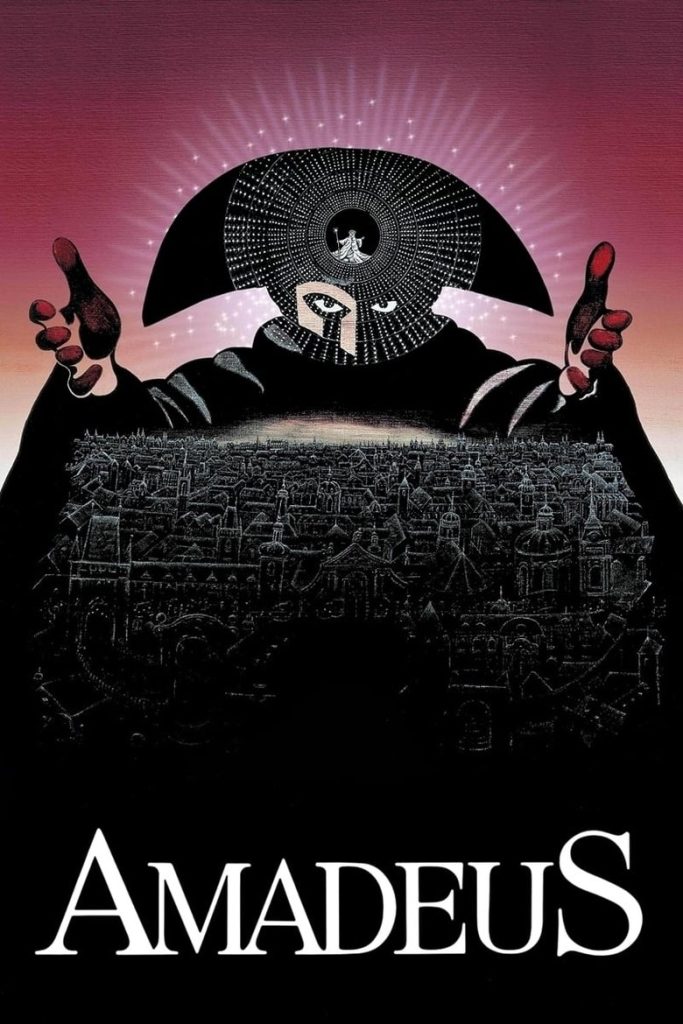
This historical drama explores the intense rivalry between two composers in 18th-century Vienna. The film contrasts the disciplined Antonio Salieri with the brilliant but unconventional Wolfgang Amadeus Mozart, focusing on themes of jealousy, talent, and artistic obsession. It presents a fictionalized account of their relationship through Salieri's perspective as he reflects on his life and career.
Parent Guide
A historical drama with mature psychological themes and emotional intensity, best suited for older children and teenagers who can appreciate its artistic complexity.
Content breakdown
Some tense confrontations and emotional outbursts between characters, but no physical violence or perilous situations.
Psychological intensity, themes of obsession and mental anguish, and some scenes of emotional distress may be unsettling for sensitive viewers.
Period-appropriate language with some mild insults and emotional exchanges, but no strong profanity.
Suggestive dialogue and some scenes with sexual implications, but no explicit content or nudity.
Historical depiction of alcohol consumption in social settings, consistent with the time period portrayed.
Intense psychological drama exploring jealousy, obsession, and emotional turmoil that drives the narrative.
Parent tips
This PG-rated film deals with mature themes including jealousy, obsession, and mental anguish that may be challenging for younger viewers. The 160-minute runtime requires sustained attention, and some scenes depict emotional distress and adult situations. While there's no graphic content, the psychological intensity and historical context make it most suitable for older children and teenagers who can appreciate its artistic merit.
Parent chat guide
Parent follow-up questions
- What instruments did you see in the movie?
- How did the music make you feel?
- What colors did you notice in the clothes people wore?
- Did you see any big buildings or fancy rooms?
- How did the two main characters feel about each other?
- What kind of music did you like best in the movie?
- Why do you think one character was jealous of the other?
- What did you learn about how people lived long ago?
- What does the movie show about how jealousy can affect people?
- How does the film portray the relationship between talent and hard work?
- What historical details did you notice about life in the 1700s?
- Why do you think the story is told from one character's perspective?
- How does the film explore the nature of artistic genius and obsession?
- What commentary does the movie make about legacy and how we remember historical figures?
- How does the film use music to enhance the emotional storytelling?
- What does Salieri's journey reveal about the human need for recognition and meaning?
🎭 Story Kernel
At its core, 'Amadeus' is not a biopic but a profound meditation on the agony of mediocrity in the face of divine genius. Salieri's entire existence is defined by his bargain with God: piety in exchange for musical talent. When Mozart arrives—vulgar, infantile, yet channeling God's own voice through his compositions—it shatters Salieri's worldview. The real conflict isn't between two men, but between Salieri's rigid, transactional faith and the terrifying, amoral nature of true inspiration. Mozart doesn't earn his gift; it flows through him effortlessly, making Salieri's devout striving seem pathetic. The film explores how witnessing unearned perfection can corrode the soul far more effectively than witnessing evil.
🎬 Visual Aesthetics
Forman employs a lavish, painterly aesthetic that contrasts sharply with intimate, almost documentary-style close-ups. The opulent golds and rich velvets of the Viennese court visually cage Salieri in his gilded prison of resentment. Camera work is masterfully subjective; we often see Mozart as Salieri does—as a disruptive, chaotic force. The famous sequence of Salieri transcribing 'Confutatis' uses tight shots on his face and the manuscript, making us feel the physical weight of his envy and the awe of witnessing creation. The use of light is particularly symbolic: Mozart is often bathed in a pure, almost otherworldly light, while Salieri lurks in shadows, a spectator to brilliance.
🔍 Details & Easter Eggs
💡 Behind the Scenes
F. Murray Abraham (Salieri) and Tom Hulce (Mozart) took opposite approaches: Abraham listened to classical music constantly to internalize Salieri's reverence, while Hulce, to capture Mozart's irreverence, listened to rock and roll. The film was shot almost entirely in Prague, using authentic Baroque-era locations because 1980s Vienna was too modern. Hulce based Mozart's distinctive laugh on a donkey's bray. Director Miloš Forman, a Czech native, infused the film with a subtle, personal understanding of artistic genius struggling under a rigid, authoritarian system.
Where to watch
Choose region:
- Amazon Video
- Apple TV
- Google Play Movies
- YouTube
- Fandango At Home
- Plex
Trailer
Trailer playback is unavailable in your region.