
And Starring Pancho Villa as Himself (2003)
Story overview
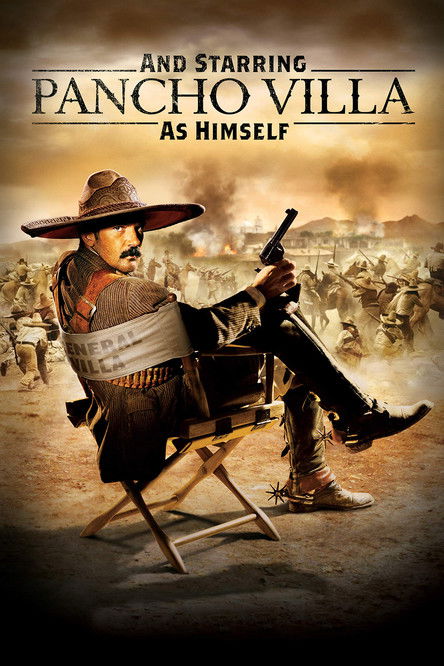
This historical drama depicts Pancho Villa's 1914 revolutionary campaign in Mexico, focusing on his unconventional partnership with Hollywood filmmakers. To finance his war efforts, Villa allows a film company to document his real battles against the Mexican army, creating one of cinema's earliest war documentaries. The story explores the intersection of media, propaganda, and revolution through the perspectives of Villa, the filmmakers, and the soldiers caught in the conflict.
Parent Guide
A historically-based drama with significant war violence and mature themes about media, revolution, and exploitation. Best suited for mature teens who can process the film's complex ethical questions and graphic battle sequences.
Content breakdown
Frequent and realistic war violence including battlefield combat, shootings, explosions, and casualties. Battle scenes show soldiers being shot, falling from horses, and dying. Some close-up violence and blood. Historical executions and military confrontations are depicted with documentary-style realism.
Intense battle sequences with sudden violence and peril. Scenes of wounded and dying soldiers. Themes of betrayal, political violence, and the exploitation of real suffering for commercial gain. The film's documentary approach to real historical violence may be disturbing to sensitive viewers.
Occasional mild profanity and period-appropriate insults. Some Spanish-language dialogue may contain stronger language that isn't translated. No frequent or aggressive strong language.
No sexual content or nudity. The film focuses on political and military themes without romantic subplots or sexual situations.
Period-appropriate social drinking in some scenes. Characters occasionally smoke cigarettes or cigars, consistent with early 20th-century settings. No substance abuse or drunkenness.
High emotional stakes in battle scenes and political conflicts. Themes of sacrifice, betrayal, and the human cost of revolution. The film raises complex questions about truth, exploitation, and historical memory that may provoke thoughtful discussion. Some scenes show the emotional toll of war on soldiers and civilians.
Parent tips
This TV-MA rated film contains realistic war violence and mature themes. Consider previewing or watching with older teens to discuss historical accuracy, media ethics, and revolutionary politics. The film's documentary-style battle scenes may be intense for younger viewers, while its complex narrative about truth, propaganda, and exploitation offers rich discussion material for mature audiences.
Parent chat guide
Parent follow-up questions
—
- What did you notice about how movies were made long ago?
- How do you think the soldiers felt during the battles?
- Why do you think Pancho Villa wanted his battles filmed?
- How does this film show that movies can be used for more than entertainment?
- What differences do you see between how wars were fought then versus now?
- How does the film comment on the ethics of documenting real violence for entertainment?
- What parallels exist between this early war documentary and modern conflict coverage?
- How does the film explore the tension between historical truth and cinematic storytelling?
- What does the film suggest about who controls historical narratives?
🎭 Story Kernel
At its core, 'And Starring Pancho Villa as Himself' explores the commodification of revolution and the birth of modern propaganda. The film isn't about Villa's military campaigns but about how his image becomes currency. What drives Villa isn't just Mexican liberation but his growing awareness that controlling his narrative might be more powerful than controlling territory. The American filmmakers are driven by profit and spectacle, while Villa evolves from a subject to a collaborator to ultimately a victim of the very mythology he helped create. The movie asks: who owns a revolution's story when cameras are present from the beginning?
🎬 Visual Aesthetics
The film employs a deliberate visual duality: gritty, handheld documentary-style footage for the actual revolution contrasts sharply with the staged, glamorous Hollywood sequences being filmed within the movie. The color palette shifts from Mexico's earthy browns and dusty yellows to the artificial, brighter tones of film sets. Camera movements become more controlled during 'filming' scenes, highlighting the constructed nature of historical narratives. The most powerful visual motif is the recurring shot of Villa watching himself on primitive film—a man seeing his own legend being manufactured in real time.
🔍 Details & Easter Eggs
💡 Behind the Scenes
Antonio Banderas prepared for the role by studying actual surviving footage of Pancho Villa, who was one of the first revolutionary leaders to actively collaborate with filmmakers. The production filmed in multiple Mexican states where the real events occurred. Director Bruce Beresford intentionally cast actors who could speak both Spanish and English authentically to capture the cultural clash. The film's title comes from actual movie posters from 1914 that featured Villa's name above the title—making him arguably cinema's first 'action star' based on real violence.
Where to watch
Choose region:
- HBO Max
- HBO Max Amazon Channel
- Amazon Video
- Apple TV Store
- Google Play Movies
- YouTube
- Fandango At Home
Trailer
Trailer playback is unavailable in your region.