
Apocalypse in the Tropics (2025)
Story overview
This documentary examines the growing influence of evangelical Christian leaders on Brazilian politics, featuring interviews with key political figures and a prominent televangelist.
Parent Guide
Documentary exploring political and religious themes in Brazil through interviews and analysis.
Content breakdown
No violent or perilous content shown.
Some discussions about political power struggles and religious influence may be conceptually challenging for younger viewers.
No offensive language noted in the description.
No sexual content or nudity.
No substance use shown.
Intellectual discussions about democracy and religion may create thoughtful engagement rather than emotional intensity.
Parent tips
This documentary explores complex political and religious themes in Brazil. It may be suitable for mature middle schoolers and up who can understand discussions about democracy, theocracy, and political influence. The content is primarily talking-head interviews and analysis without graphic material.
Parent chat guide
Parent follow-up questions
—
—
- What did you learn about Brazil from this film?
- What is a documentary and how is it different from other movies?
- How does this film portray the relationship between religion and politics?
- What techniques did the filmmaker use to present different perspectives?
- How might political influence from religious groups affect democracy?
🎭 Story Kernel
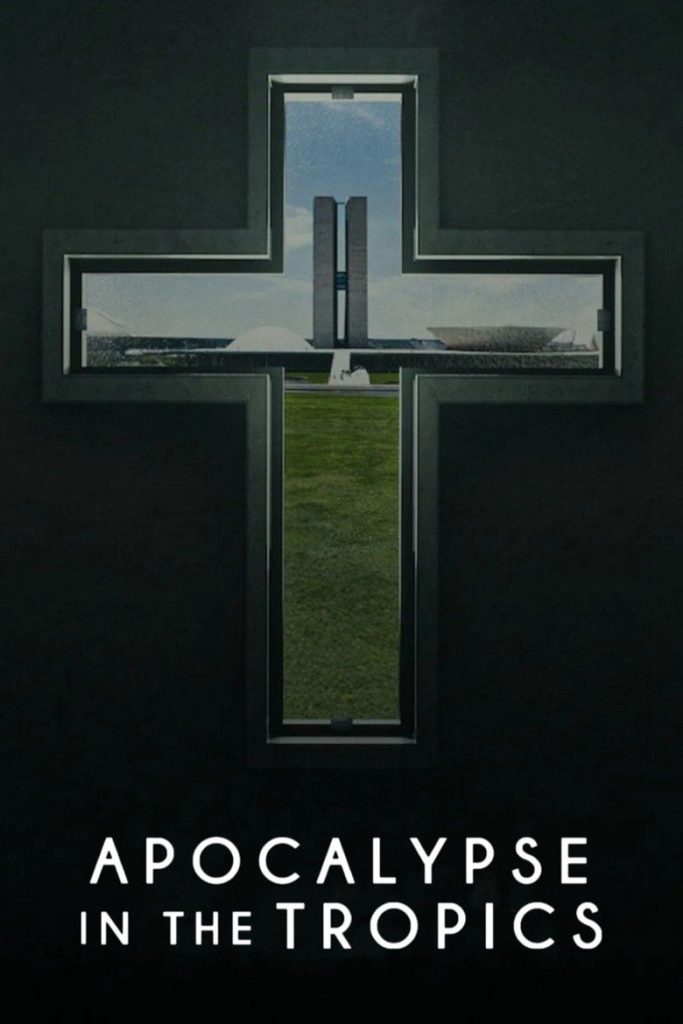
Petra Costa examines the seismic shift in Brazil’s political landscape, where the separation of church and state has dissolved into a symbiotic theocracy. The film focuses on the rise of the evangelical movement, specifically through the influence of televangelist Silas Malafaia and his alliance with Jair Bolsonaro. It isn't just a political documentary; it is an exploration of how religious fervor is weaponized to dismantle democratic institutions from within. Costa portrays a nation caught in a prophetic fever dream, where the promise of a heavenly kingdom justifies the erosion of civil liberties. By tracking the movement from the fringes to the center of power, the film reveals how the 'Apocalypse' is used as a rhetorical tool to maintain a state of perpetual crisis, ensuring that the faithful remain mobilized against perceived secular demons.
🎬 Visual Aesthetics
The cinematography employs a stark contrast between the monumental, modernist lines of Brasília’s government buildings and the cavernous, neon-lit interiors of Brazil’s mega-churches. Costa uses sweeping aerial shots to illustrate the sheer scale of religious gatherings, making the individual appear swallowed by a collective spiritual identity. There is a recurring visual motif of 'the void'—the empty spaces in the halls of power versus the overflowing pews—suggesting a vacuum of secular leadership being filled by charismatic authority. The editing seamlessly weaves archival news footage with intimate, fly-on-the-wall observations of political maneuvering, creating a sense of claustrophobia. The visual language suggests that the tropical landscape is no longer a paradise but a stage for a biblical drama, where light and shadow are used to emphasize the moral dualism preached by the film’s subjects.
🔍 Details & Easter Eggs
💡 Behind the Scenes
Petra Costa began working on this project shortly after the release of her Oscar-nominated 'The Edge of Democracy.' She secured rare, high-level access to both the Bolsonaro administration and the inner circles of evangelical power, filming over several years of intense political upheaval. The documentary premiered at the 81st Venice International Film Festival in 2024. It is often cited by critics as the final installment in a thematic trilogy regarding the fragility of Brazilian democracy, following 'Elena' and 'The Edge of Democracy,' focusing on the cultural and religious roots of the country's current polarization.
Where to watch
Choose region:
- Netflix
- Netflix Standard with Ads
Trailer
Trailer playback is unavailable in your region.