
Atlantis: The Lost Empire (2001)
Story overview
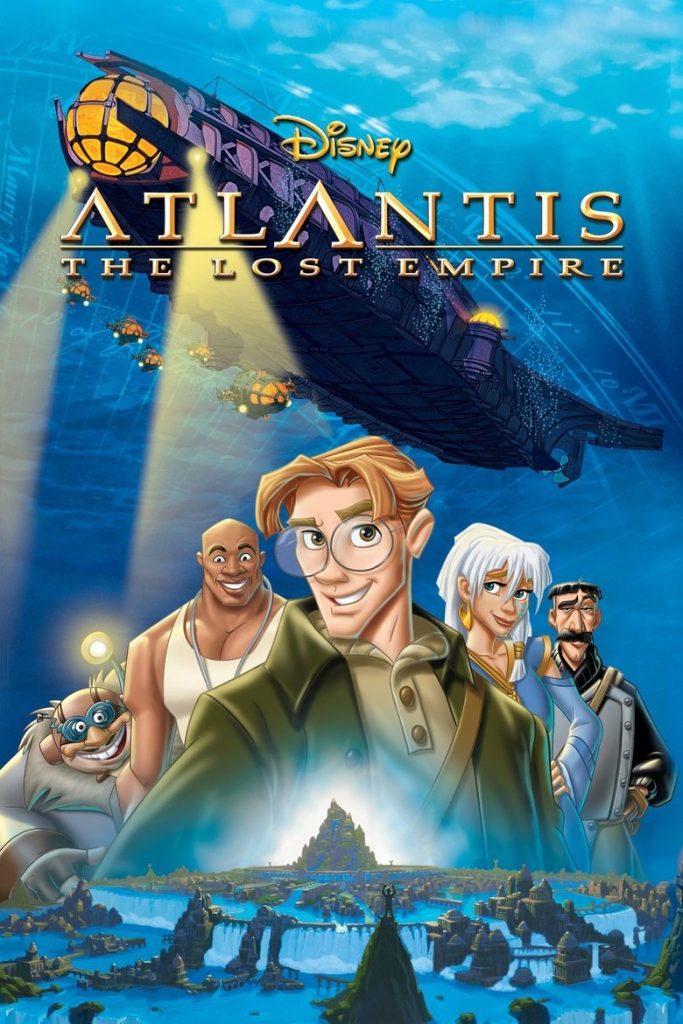
Atlantis: The Lost Empire follows Milo Thatch, a young linguist who joins a team of explorers on a daring expedition to find the legendary sunken continent of Atlantis. The journey involves underwater exploration, ancient technology, and encounters with the mysterious Atlantean civilization. The film blends adventure, discovery, and themes about preserving culture and history.
Parent Guide
An animated adventure with moderate action violence and peril, suitable for most children ages 8 and up with parental guidance for younger viewers.
Content breakdown
Action sequences include explosions, mechanical threats, underwater peril, and confrontations between characters. Some characters are in life-threatening situations, but injuries are not graphic.
Some intense scenes with dark underwater settings, large mechanical creatures, and moments of suspense. The animation style keeps it less realistic, but younger children might find certain sequences frightening.
No strong language or profanity noted in typical family-friendly animated style.
No sexual content or nudity present.
No depiction of alcohol, drugs, or tobacco use.
Scenes of betrayal, loss of loved ones, and cultural destruction create emotional moments. Characters experience fear, excitement, and determination throughout the adventure.
Parent tips
This animated adventure includes some intense action sequences with peril, explosions, and confrontations that might be too much for very young viewers. There are scenes of underwater danger, mechanical threats, and moments where characters face life-threatening situations. The PG rating reflects this moderate action violence and some scary imagery, but overall it's presented in a family-friendly style typical of animated adventures.
Parents should note that while there's no strong language, sexual content, or substance use, the emotional intensity can be high during key dramatic moments. The film explores themes of betrayal, loss, and cultural preservation that might prompt questions from older children. The animation style is engaging but includes some darker visual elements in the underground and underwater settings.
Parent chat guide
After the movie, ask what they found most exciting or surprising about the adventure. Discuss how the characters worked together (or didn't) and what they learned about Atlantis. This is a good opportunity to talk about how movies can inspire interest in history, languages, and archaeology.
Parent follow-up questions
- What was your favorite part of the adventure?
- How did the explorers travel underwater?
- What did you think about the big machines?
- Was anything scary or exciting?
- What colors did you see in Atlantis?
- What made Milo a good explorer?
- Why was finding Atlantis important?
- How did the team work together?
- What challenges did they face underwater?
- What did you learn about different languages?
- What does the movie show about preserving ancient cultures?
- How did the technology in Atlantis compare to ours?
- What motivated the different characters on the expedition?
- What ethical questions does the exploration raise?
- How does the animation style help tell this adventure story?
- How does the film portray the ethics of exploration and cultural discovery?
- What commentary might the film be making about technology versus tradition?
- How are leadership and teamwork depicted differently among the characters?
- What historical or mythological elements did you recognize in the Atlantis portrayal?
- How does the visual design contribute to the film's themes of ancient versus modern?
🎭 Story Kernel
Beneath its adventure veneer, 'Atlantis' is a critique of cultural imperialism disguised as exploration. Milo Thatch isn't driven by pure curiosity but by validation—proving his grandfather right to a world that dismissed him. The true conflict emerges when Rourke's expedition reveals its capitalist core: they don't want to understand Atlantis, they want to extract its power source. The Atlanteans aren't mystical guardians but a colonized people defending their last resource. The film's real tension isn't finding the city but deciding whether to preserve or plunder it, making Milo's choice to protect it a rejection of Western exploitation narratives.
🎬 Visual Aesthetics
The film visually contrasts two worlds through deliberate aesthetic choices. Surface scenes use muted browns and grays, with angular, industrial designs reflecting early 1900s technology. Once submerged, Atlantis explodes in bioluminescent blues and organic curves inspired by Art Nouveau and Mayan architecture. Action sequences employ dynamic, almost anime-inspired camera sweeps during the Leviathan attack, creating visceral momentum. The crystal technology glows with warm golds against cool backgrounds, visually marking it as both life source and conflict catalyst. This palette division reinforces the theme: old world versus new, extraction versus symbiosis.
🔍 Details & Easter Eggs
💡 Behind the Scenes
This was Disney's first PG-rated animated film, pushing boundaries with more intense action. The voice cast included Michael J. Fox as Milo, who recorded his lines separately due to Parkinson's treatments, requiring clever editing. Directors Kirk Wise and Gary Tsubota deliberately avoided musical numbers to maintain a serious adventure tone, a departure from Disney norms. The Atlantean language was fully developed by linguist Marc Okrand, who also created Klingon, with a complete grammar and vocabulary. Production designer David Goetz drew inspiration from Jules Verne illustrations and real underwater ecosystems.
Where to watch
Choose region:
- Disney Plus
- Amazon Video
- Apple TV
- Google Play Movies
- YouTube
- Fandango At Home
Trailer
Trailer playback is unavailable in your region.