Atlas (2024)
Story overview
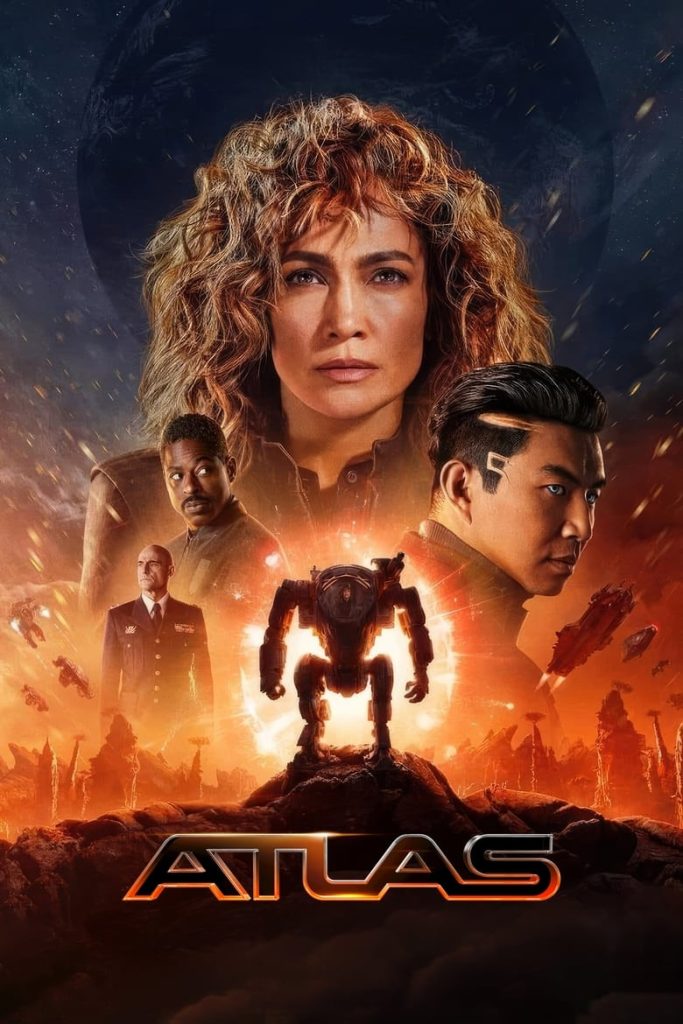
Atlas is a 2024 science fiction action film directed by Brad Peyton, starring Jennifer Lopez as a counterterrorism analyst who deeply distrusts artificial intelligence. When a mission to capture a rogue robot goes wrong, she must confront her fears and rely on AI technology to survive. The film explores themes of trust, technology, and human-machine relationships in a futuristic setting with action sequences and suspenseful moments.
Parent Guide
Atlas is a sci-fi action film with moderate intensity, suitable for mature children and teens with parental guidance. The PG-13 rating reflects action violence, some intense sequences, and brief strong language. The film's themes of trust in technology and human-AI relationships provide good discussion opportunities.
Content breakdown
Sci-fi action violence includes robot battles, explosions, hand-to-hand combat, and weapon use. Characters face perilous situations including spacecraft malfunctions and threats from rogue AI. Some scenes may be intense for younger viewers, but no graphic gore is shown.
Some suspenseful moments with rogue AI threats and tense survival situations. The concept of out-of-control technology might be unsettling for sensitive viewers, but no horror elements or jump scares are prominent.
Brief strong language includes occasional uses of 'hell' and 'damn.' No frequent or aggressive profanity.
No sexual content, nudity, or romantic situations beyond brief professional interactions.
No depiction of alcohol, drugs, or tobacco use.
Moderate emotional intensity from survival situations, character conflicts, and themes of trust versus fear. Some tense moments but balanced with action and resolution.
Parent tips
Atlas is rated PG-13 for sequences of sci-fi action violence, some intense peril, and brief strong language. Parents should note: 1) Moderate action violence includes robot battles, explosions, and combat scenes that may be intense for younger viewers. 2) Some frightening moments with rogue AI and perilous situations. 3) Brief strong language appears occasionally. 4) No sexual content or nudity. 5) Minimal substance use. Best suited for ages 10+ with parental guidance for younger children.
Parent chat guide
Parent follow-up questions
- What was your favorite robot in the movie?
- How did the characters help each other?
- What colors did you see in the spaceships?
- Why was Atlas afraid of AI at first?
- What made the mission go wrong?
- How did the characters solve problems together?
- What are the ethical questions about AI that the movie raises?
- How does the film show the balance between human control and machine intelligence?
- What would you do if you had to trust technology you didn't understand?
- How does Atlas reflect current debates about AI ethics and regulation?
- What commentary does the film make about human dependence on technology?
- How realistic are the AI capabilities shown in the film compared to current technology?
🎭 Story Kernel
Atlas explores the precarious intersection of human trauma and artificial intelligence, centering on Atlas Shepherd’s deep-seated technophobia. The film is less about the external threat of the rogue AI Harlan and more about the internal struggle of a woman forced to synchronize her mind with the very technology she blames for her family's destruction. It examines the concept of neural syncing as a metaphor for emotional vulnerability and trust. By requiring a high sync rate to survive, the narrative argues that true strength comes from opening oneself to others—even if that other is a digital consciousness named Smith. The story ultimately posits that the evolution of AI is not inherently villainous, but rather a reflection of the intentions and emotional states of its human creators, demanding a reconciliation between logic and empathy.
🎬 Visual Aesthetics
Director Brad Peyton leans heavily into the mecha subgenre, utilizing a claustrophobic yet high-tech aesthetic within the ARC suit. The visual language contrasts the sterile, cold interiors of the human fleet with the vibrant, bioluminescent, yet hostile environment of the planet GR-39. The cinematography emphasizes the scale of the mecha-suit relative to the environment, creating a sense of isolation. Symbolism is found in the physical interface of the neural link; the visual representation of the sync process serves as a digital manifestation of Atlas’s psychological barriers breaking down. The CGI work on Smith’s optical sensors and the fluid movements of the suit are designed to humanize the machine, shifting the visual focus from a cold weapon of war to a protective, expressive companion that mirrors Atlas’s own emotional journey.
🔍 Details & Easter Eggs
💡 Behind the Scenes
Atlas marks another collaboration between director Brad Peyton and producers who specialize in high-concept action, following his work on San Andreas and Rampage. Jennifer Lopez not only starred but also produced the film under her Nuyorican Productions banner. The film's production involved extensive blue-screen work to simulate the alien world of GR-39, with Lopez spending a significant portion of the shoot isolated inside the physical cockpit of the mecha-suit to capture the genuine feeling of confinement. Simu Liu, known for his heroic roles, took a villainous turn as Harlan, requiring a performance that balanced robotic precision with superiority.
Where to watch
Choose region:
- Netflix
- Netflix Standard with Ads
Trailer
Trailer playback is unavailable in your region.