Back to the Future (1985)
Story overview
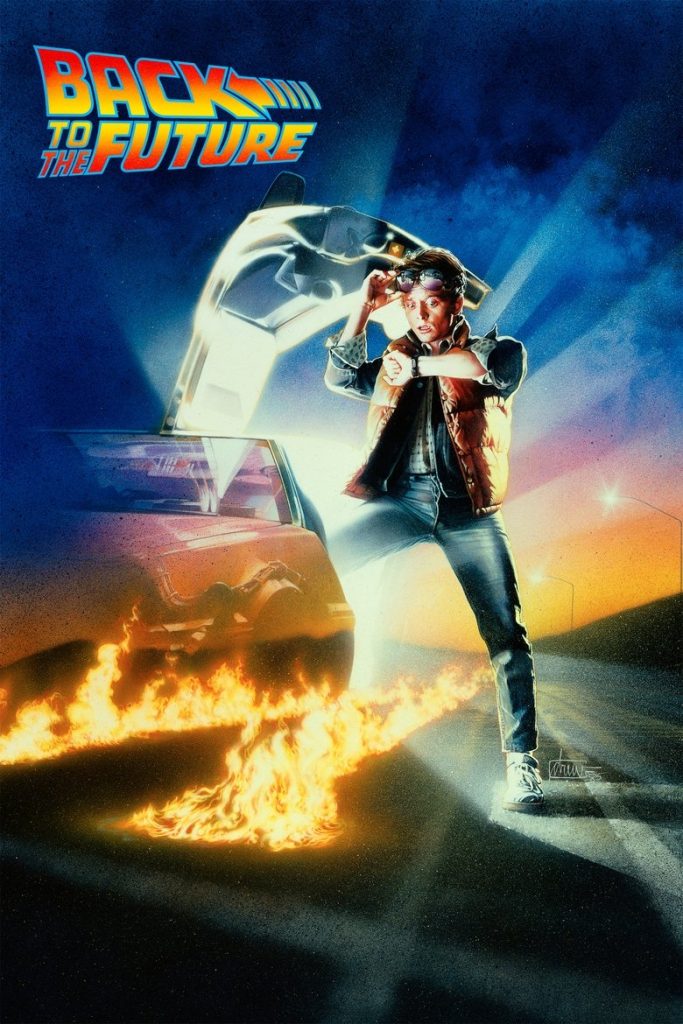
Back to the Future is a 1985 adventure-comedy about a teenager who accidentally travels back in time to 1955. While in the past, he disrupts his parents' first meeting and must fix history to ensure his own existence. With help from an eccentric inventor friend, he works to reunite his parents and return to his own time. The film explores themes of family, consequences, and the nature of time.
Parent Guide
A classic time-travel adventure with positive messages about family and responsibility, best for viewers who can understand the basic time-travel concept.
Content breakdown
Some comedic peril including car chases, a character being threatened with a weapon, and tense situations. No graphic violence.
Some tense moments related to time travel consequences and a character's potential disappearance. Mild suspense throughout.
Some mild profanity and insults. One use of a racial slur (clearly portrayed as wrong).
Romantic tension and kissing. Some flirtatious behavior and mild sexual innuendo.
Brief social drinking by adults. No substance abuse depicted.
Moderate tension around the time-travel premise and whether the main character will succeed. Emotional moments involving family relationships.
Parent tips
This PG-rated film contains some mild language, comedic peril, and scenes with romantic tension. There's a brief scene where a character is called a racial slur (though the film clearly portrays this as wrong), and some dated gender stereotypes that parents may want to discuss. The time travel concept and some tense moments might be confusing or slightly scary for younger viewers.
Overall, the film has positive messages about family, courage, and taking responsibility for one's actions. The main character demonstrates problem-solving skills and learns valuable lessons about his parents as real people. The comedic tone helps balance the more intense moments.
Parent chat guide
After watching, talk about how the main character learned about his parents as teenagers. Discuss what it means to take responsibility for mistakes and how small actions can have big consequences. You might also talk about how media has changed since 1985 and compare the portrayal of family relationships then versus now.
Parent follow-up questions
- What was your favorite part of the movie?
- How did Marty feel when he was in the past?
- What was funny in the movie?
- What did you learn about families?
- Would you want to travel in time like Marty?
- Why was it important for Marty to get his parents together?
- What would you do if you traveled back in time?
- How did Marty show bravery in the movie?
- What mistakes did Marty make and how did he fix them?
- What did you think about how people lived in 1955 compared to now?
- What does this movie teach us about consequences?
- How does the movie show that parents were once teenagers too?
- What ethical questions does time travel raise?
- How did the characters change or grow during the story?
- What aspects of 1955 life seemed different from today?
- How does the film handle the paradoxes of time travel?
- What commentary does the movie make about nostalgia and idealizing the past?
- How are gender roles portrayed in the 1955 scenes versus 1985?
- What does the film suggest about destiny versus personal choice?
- How does the relationship between Marty and Doc represent different generations working together?
🎭 Story Kernel
At its heart, 'Back to the Future' is a film about the malleability of identity and the anxiety of adolescence, disguised as a sci-fi adventure. Marty McFly's journey to 1955 forces him to confront his parents' youthful insecurities, mirroring his own struggles with confidence and ambition. The movie posits that history isn't fixed but is shaped by small, courageous acts—like standing up to a bully or asking someone to dance. It's less about changing the past and more about understanding that the people we idolize (or resent) as adults were once just as lost and scared as we are. The core drive is Marty's need to ensure his own existence, which paradoxically requires him to empower his father, George, to become the man Marty never knew he could be.
🎬 Visual Aesthetics
The film's visual language masterfully contrasts eras through production design and color. 1955 is bathed in warm, saturated hues—sunny skies, pastel cars, and cozy diners—evoking a nostalgic, almost idealized Americana. 1985, by comparison, feels cooler and more muted, with grayer tones and sharper edges, reflecting a more cynical modernity. Camera work emphasizes kinetic energy, especially in the DeLorean's time-travel sequences, where practical effects like flaming tire tracks and lightning strikes create a tangible sense of wonder. Symbolism is subtle but effective: the clock tower looms over Hill Valley as a constant reminder of time's passage, while the fading photograph of Marty's family visually tracks the stakes of his mission with urgent clarity.
🔍 Details & Easter Eggs
💡 Behind the Scenes
Eric Stoltz was originally cast as Marty McFly and filmed for several weeks before being replaced by Michael J. Fox, due to creative differences over the character's tone. Fox famously shot his scenes at night after finishing his day on 'Family Ties,' leading to a grueling schedule. The iconic DeLorean was chosen for its futuristic, spaceship-like gull-wing doors, despite the car's real-world reputation for mechanical issues. The film's climax required building a full-scale clock tower set, and the lightning strike was achieved using a massive electrical charge, with careful timing to ensure actor safety.
Where to watch
Choose region:
- Amazon Video
- Apple TV
- Google Play Movies
- YouTube
- Fandango At Home
- FlixFling
- Spectrum On Demand
- Pluto TV
Trailer
Trailer playback is unavailable in your region.