
Bao (2018)
Story overview
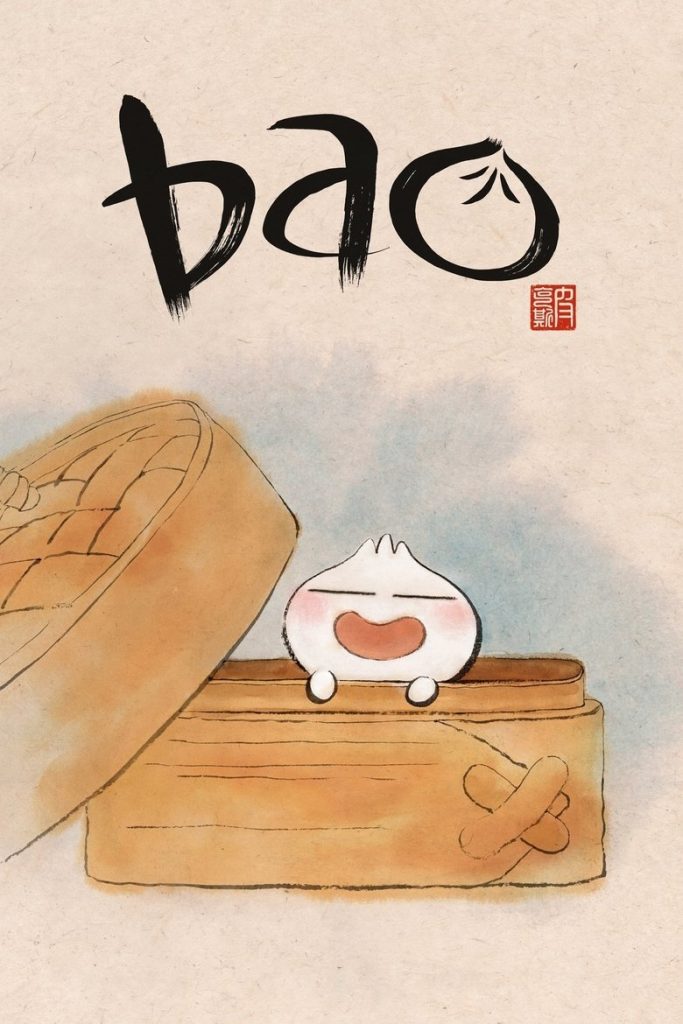
Bao is a short animated film about a Chinese mother experiencing empty nest syndrome after her son grows up and leaves home. When one of her handmade dumplings magically comes to life as a cheerful dumpling boy, she gets a second chance at motherhood. The film explores themes of family, letting go, and the emotional journey of parenthood through this whimsical fantasy premise.
Parent Guide
A gentle, family-friendly short film about parental love and letting go, suitable for all ages.
Content breakdown
No violence or physical danger present.
Brief moments of emotional tension when characters experience separation, but resolved positively.
No offensive language.
No sexual content or nudity.
No substance use depicted.
Themes of separation and empty nest syndrome may evoke emotional responses, particularly for parents or sensitive children.
Parent tips
This gentle film is appropriate for all ages but contains emotional themes that may resonate differently with various age groups. Younger children will enjoy the cute dumpling character and simple story, while older viewers may appreciate the deeper themes of parental love and separation. The film's short runtime makes it easy to watch and discuss together.
Parents should be aware that the film deals with feelings of loss and separation when children grow up, which might prompt questions from sensitive viewers. The fantasy elements are mild and non-threatening, presented in a warm, family-friendly style. The G rating accurately reflects its suitability for general audiences.
Parent chat guide
For younger children, focus on the basic emotions: happiness when the dumpling appears, worry when it grows up, and relief at the ending. For older children and teens, you can explore deeper themes like why parents sometimes have trouble letting go and how families change over time.
Consider sharing your own experiences with family changes or separation to help children connect the story to real life. The film's magical elements provide a gentle way to approach potentially difficult topics.
Parent follow-up questions
- What was your favorite part of the dumpling's story?
- How did the mother show she loved the dumpling?
- What foods do we make together as a family?
- How did you feel when the dumpling wanted to go play with friends?
- What makes you feel safe and loved at home?
- Why do you think the mother was lonely at the beginning?
- How did the dumpling change as it grew up?
- What does it mean to 'let go' of someone you love?
- How do families show love in different ways?
- Have you ever felt like you wanted more independence like the dumpling?
- What does 'empty nest syndrome' mean, and how does the film show it?
- How does the fantasy dumpling help explain real family relationships?
- Why might parents have mixed feelings when their children grow up?
- What responsibilities come with growing more independent?
- How can families stay connected even when members are apart?
- How does the film use food and cooking as symbols of love and culture?
- What does the film suggest about the cycle of parenting and letting go?
- How might different generations interpret this story differently?
- What cultural values about family are presented in the film?
- How do fantasy elements help explore real emotional experiences?
🎭 Story Kernel
At its core, 'Bao' is a devastatingly precise allegory for empty nest syndrome and the suffocating nature of parental love. The film explores the immigrant mother's profound loneliness after her son leaves home, manifesting in the magical creation of a dumpling-child. Her overprotective nurturing—feeding, sheltering, and ultimately consuming the bao when it seeks independence—isn't about food but about control. The shocking moment she eats the bao isn't literal cannibalism but represents how parental anxiety can metaphorically 'devour' a child's autonomy. The resolution, where the real son returns and shares actual dumplings, suggests healing comes through releasing control and finding new forms of connection.
🎬 Visual Aesthetics
Director Domee Shi employs a meticulous visual language where food becomes emotional currency. The kitchen's warm, golden lighting contrasts sharply with the sterile blues of the outside world where the bao ventures. Close-ups on the mother's hands—kneading dough, chopping vegetables—emphasize her labor of love as both nurturing and controlling. The bao itself is animated with childlike elasticity, its doughy body absorbing emotions literally through tears and smiles. Most striking is the shift to surreal horror when the mother eats the bao: the lighting turns dramatic red, shadows elongate, and the camera adopts Dutch angles, visually breaking from the film's domestic realism into psychological nightmare.
🔍 Details & Easter Eggs
💡 Behind the Scenes
Director Domee Shi based 'Bao' on her own experiences as the only child of Chinese immigrants in Toronto, often calling her mother 'bao' as a term of endearment. The film's development involved extensive research into Chinese dumpling-making techniques, with animators visiting Toronto's Chinatown markets. Shi insisted on authentic details like the specific wrist motion for pleating dumplings. The mother character's design was inspired by Shi's own mother, particularly her expressive eyes and practical haircut. At 8 minutes, it remains Pixar's shortest film but took nearly five years to complete due to its complex emotional storytelling and food animation challenges.
Where to watch
Choose region:
- Disney Plus
- Apple TV
- Google Play Movies
- YouTube
- Fandango At Home
Trailer
Trailer playback is unavailable in your region.