
Bicycle Thieves (1948)
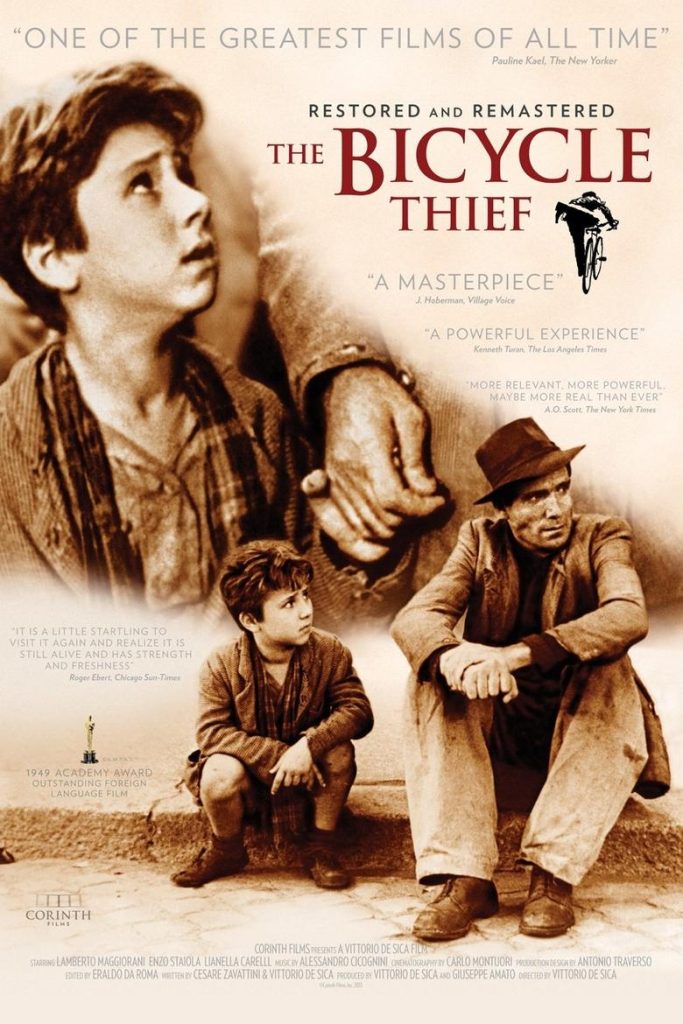
Story overview
This classic Italian film follows Antonio, an unemployed man in post-war Rome who finally finds work requiring a bicycle. On his first day, his bicycle is stolen, threatening his new job and family's livelihood. With his young son's help, Antonio desperately searches the city for the thief, facing moral dilemmas and the harsh realities of poverty along the way. The film portrays the bond between father and son against a backdrop of social struggle.
Parent Guide
A classic drama about poverty and moral choices in post-war Italy, best for mature children who can handle emotional intensity and complex themes.
Content breakdown
Some tense confrontations and a scene where a character is briefly grabbed. No physical violence shown.
Emotional distress of characters facing poverty and desperation. The bleak social setting might be unsettling for sensitive viewers.
No offensive language noted in the film's description.
No sexual content or nudity mentioned in the film's description.
No substance use mentioned in the film's description.
Strong themes of poverty, desperation, and moral conflict. The father's emotional struggle and the film's serious tone create significant emotional weight.
Parent tips
This film offers a powerful look at poverty, desperation, and moral choices in post-war Italy. While there's no graphic content, the emotional weight of the father's struggle and the bleak social setting may be intense for younger viewers. The film's black-and-white cinematography and subtitles (if watching in Italian) might require some adjustment for children used to modern films, but the universal themes of family and perseverance remain accessible.
Parents should know this is a neorealist drama that doesn't have a traditionally happy Hollywood ending. The film presents complex moral situations where characters make difficult choices under pressure. This provides excellent material for discussions about ethics, economic hardship, and how people respond to desperate circumstances.
Parent chat guide
After watching, focus on the relationship between father and son and how they support each other. Discuss how the film shows people making difficult choices when they feel trapped by circumstances. You could compare the historical setting to modern times, talking about how families face challenges differently today.
Parent follow-up questions
- How did the boy help his daddy?
- What was your favorite part of the movie?
- How do you think the daddy felt when he lost his bicycle?
- What would you do if something important to you got lost?
- Did you like watching the daddy and son together?
- Why was the bicycle so important to the father's job?
- How did the father and son work together to solve their problem?
- What would you have done differently if you were in their situation?
- How do you think poverty affected the characters' choices?
- What did you learn about life in Italy after the war?
- What moral dilemmas did the characters face during their search?
- How did the film show the relationship between father and son changing?
- What does the film suggest about desperation and ethical choices?
- How did the historical setting influence the characters' lives?
- What message do you think the film was trying to convey about society?
- How does the film use realism to convey its social commentary?
- What does Antonio's journey reveal about human dignity under economic pressure?
- How does the father-son relationship evolve throughout their ordeal?
- What contemporary parallels can you draw from the film's themes of poverty and desperation?
- How does the film's ending comment on social systems and individual morality?
🎭 Story Kernel
The film explores how economic desperation strips away human dignity and morality. Antonio Ricci's quest for his stolen bicycle isn't about transportation—it's about his family's survival in a system where one missing object can destroy a life. The real tragedy unfolds as Antonio, initially portrayed as a victim of circumstance, gradually becomes what he hunts: a thief. His transformation reveals how poverty doesn't just create victims but forces people to victimize others. The final shot of father and son walking away in tears shows how the system has stolen more than a bicycle—it's stolen their innocence and hope.
🎬 Visual Aesthetics
De Sica employs stark neorealist cinematography that feels documentary-like yet profoundly emotional. The camera follows Antonio through Rome's actual streets, using deep focus to show his small figure against the overwhelming city. The bicycle itself becomes a visual motif—first as salvation when polished, then as obsession when lost. Key moments use close-ups on faces to reveal internal devastation, particularly in the final scene where Bruno's tear-streaked face reflects his shattered faith in his father. The natural lighting and location shooting create an authenticity that makes the tragedy feel immediate rather than theatrical.
🔍 Details & Easter Eggs
💡 Behind the Scenes
Director Vittorio De Sica cast non-professional actors to enhance authenticity—Lamberto Maggiorani was actually a factory worker, and Enzo Staiola (Bruno) was discovered on the street. The film was shot on location in postwar Rome using minimal equipment, often incorporating real bystanders' reactions. Despite winning an Oscar, it faced initial criticism in Italy for its bleak portrayal of poverty. The bicycles used were period-appropriate but required constant maintenance during filming due to Rome's rough postwar streets.
Where to watch
Choose region:
- Amazon Prime Video
- HBO Max
- Criterion Channel
- Amazon Prime Video with Ads
- Amazon Video
- Apple TV
- Google Play Movies
- YouTube
- Fandango At Home
- Amazon Prime Video Free with Ads
- Kanopy
Trailer
Trailer playback is unavailable in your region.