
Bird Karma (2018)
Story overview
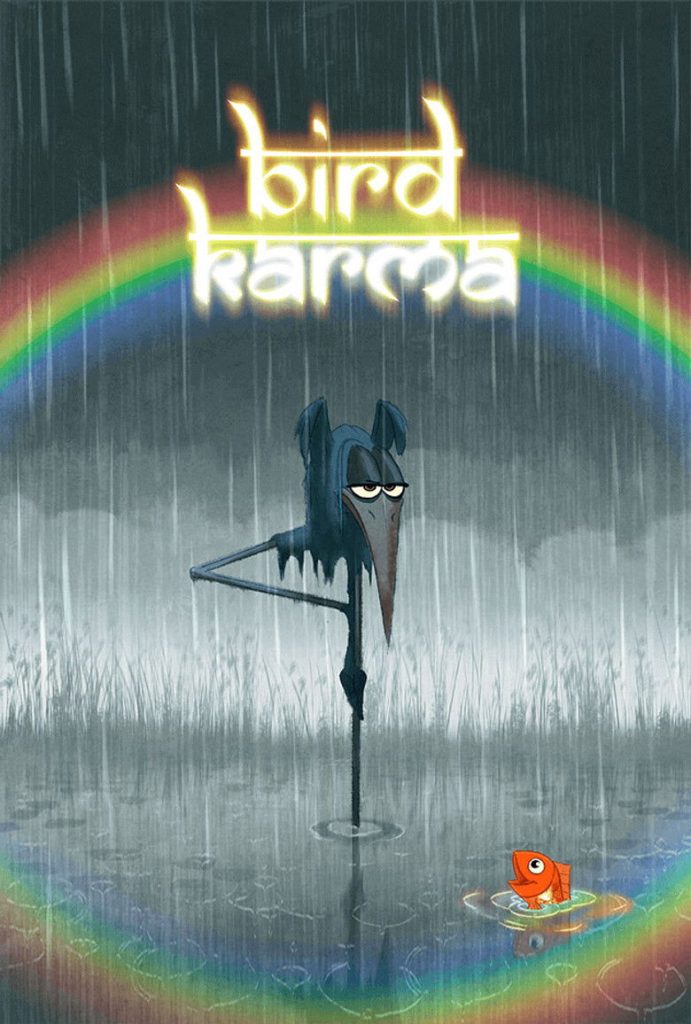
Bird Karma is a 5-minute animated short film from 2018 that tells the story of a long-legged bird who experiences pure joy, becomes consumed by greed, and accidentally discovers the negative consequences of wanting too much. This colorful and whimsical tale explores themes of happiness, desire, and moderation through visual storytelling without dialogue.
Parent Guide
This is a completely safe, G-rated animated short with no concerning content. Perfect for all ages, it teaches a positive lesson about greed and consequences through beautiful animation without dialogue.
Content breakdown
The bird experiences a minor consequence from its greed (getting stuck or tangled), but this is presented in a cartoonish, non-threatening way with no injury or pain shown.
Nothing scary or disturbing. The animation is bright, colorful, and whimsical throughout.
No dialogue or language of any kind in this wordless animated short.
No sexual content or nudity. The bird is animated in a simple, cartoon style.
No substance use of any kind.
Mild emotional journey as the bird goes from joy to greed to consequence, but all presented in a gentle, cartoonish manner appropriate for young children.
Parent tips
This G-rated animated short is completely appropriate for all ages with no concerning content. At just 5 minutes long, it's perfect for young attention spans. The film teaches a valuable lesson about greed and consequences through visual storytelling that children can easily understand. Consider watching together and discussing the bird's journey from happiness to greed to consequences.
Parent chat guide
Parent follow-up questions
- What colors did you see in the movie?
- How did the bird move?
- What made the bird happy at the beginning?
- What happened when the bird wanted too much?
- Why do you think the bird changed from being happy to wanting more?
- What was the consequence of the bird's greed?
- How could the bird have avoided the problem?
- What does 'too much is not enough' mean to you?
- What does this film teach about moderation versus excess?
- How does the animation style help tell the story without words?
- What real-life situations might be similar to the bird's experience?
- Why do you think the filmmaker chose to make this story about an animal?
- How does this short film use visual metaphors to explore human nature?
- What commentary might the film be making about consumer culture?
- How effective is the non-verbal storytelling in conveying complex themes?
- What artistic choices stood out to you in the animation style?
🎭 Story Kernel
At its core, 'Bird Karma' is a wordless meditation on the inescapable cycles of nature and desire. The long-legged bird is driven by pure, instinctual hunger—a beautifully animated embodiment of primal need. Its pursuit of the fish isn't malicious, but a fundamental act of survival. The film's true expression lies in the sudden, ironic reversal: the bird's moment of triumphant consumption becomes its fatal undoing. This isn't a moral fable about 'bad behavior,' but a stark observation of ecological interdependence. The fish, initially prey, transforms into an agent of karmic balance through the very object (the pearl) that represented the bird's success. Desire leads to attainment, which leads directly to consequence, in a closed loop as elegant and ruthless as nature itself.
🎬 Visual Aesthetics
The visual language is a masterclass in expressive, minimalist 2D animation. The camera often adopts the bird's perspective, with low-angle shots emphasizing its towering, graceful silhouette against the vibrant wetland backdrop. The color palette is lush and saturated—emerald greens, azure waters, and the bird's stark white and black plumage—making the sudden intrusion of the dark, murky underwater world and the gleaming pearl visually jarring. The action is a silent ballet: the bird's stalking is rendered with patient, deliberate movements, while the fishing sequence is a burst of chaotic, splashing energy. Symbolism is direct yet powerful: the pristine pearl represents pure, unobtainable desire, its luminescence contrasting with the natural, muddied environment.
🔍 Details & Easter Eggs
💡 Behind the Scenes
'Bird Karma' is a 2018 animated short film produced by DreamWorks Animation and directed by William Salazar, a veteran animator on films like 'The Prince of Egypt.' Notably, it was animated almost entirely by Salazar himself over a period of 18 months, giving it a uniquely cohesive artistic vision. The film is completely dialogue-free, relying solely on music, sound design, and visual storytelling. It was created as part of DreamWorks' shorts program, which aims to give artists a platform for personal, experimental storytelling outside the main studio pipeline. The lush, watercolor-inspired backgrounds were digitally painted to mimic traditional media, creating a timeless, fable-like aesthetic.
Where to watch
Choose region:
- Peacock Premium
- Peacock Premium Plus