
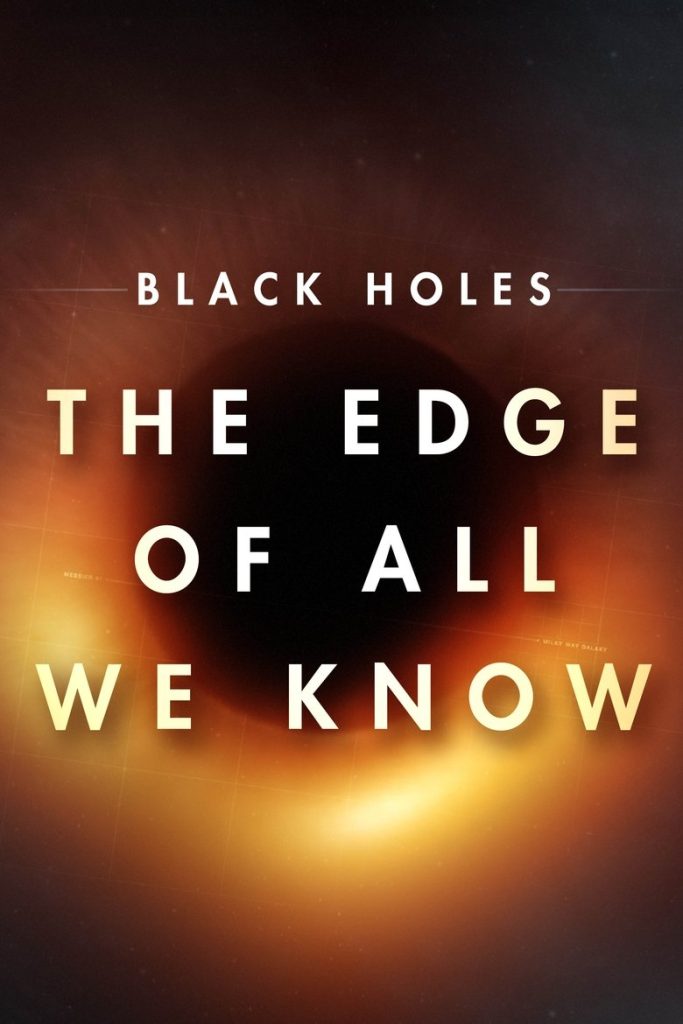
Black Holes: The Edge of All We Know (2020)
Story overview
This documentary explores the scientific quest to understand black holes, combining real-world observation with theoretical physics and philosophical inquiry. It follows two main threads: the Event Horizon Telescope project that captured the first image of a black hole in 2019, and Stephen Hawking's theoretical work on black hole paradoxes. The film uses interviews, footage from observatories worldwide, and expressive animation to make complex scientific concepts accessible.
Parent Guide
Educational documentary about black hole science with no concerning content. Suitable for curious children with interest in space and science.
Content breakdown
No violence, danger, or peril depicted. The film focuses entirely on scientific research and theoretical physics.
Some animated sequences showing black holes and space phenomena might be slightly intense for very young or sensitive children, but nothing is graphic or frightening. The scientific discussion of black holes' destructive power is presented academically.
No offensive or inappropriate language. All dialogue is scientific and educational.
No sexual content or nudity of any kind.
No depiction or discussion of substance use.
Some emotional moments related to Stephen Hawking's work and legacy, and the excitement of scientific discovery. The film conveys wonder and intellectual curiosity rather than strong emotions.
Parent tips
This is an educational documentary suitable for curious children interested in space and science. The scientific concepts are presented clearly but may require parental explanation for younger viewers. No concerning content exists, but the abstract nature of black holes and theoretical physics might be challenging for some ages. Consider watching together to discuss the fascinating science.
Parent chat guide
Parent follow-up questions
- What did you see in the pictures of space?
- What colors did you see in the movie?
- What do you think a black hole looks like?
- What was the biggest telescope in the movie?
- Why do scientists want to take pictures of black holes?
- What did Stephen Hawking study about black holes?
- How did scientists work together to take the black hole picture?
- What is the 'black hole paradox' mentioned in the film?
- Why are black holes important to understand?
- How does the film illustrate the scientific method in action?
- What philosophical questions does the film raise about knowledge and reality?
- How might understanding black holes help us understand other aspects of physics?
🎭 Story Kernel
This documentary isn't really about black holes—it's about the human obsession with making the incomprehensible comprehensible. The film follows two parallel quests: the Event Horizon Telescope team's attempt to capture the first image of a black hole's shadow, and Stephen Hawking's theoretical work on the information paradox. What drives these scientists isn't just curiosity but a fundamental need to impose order on chaos, to prove that even at the edge of reality, our mathematics and cameras can still make sense of things. The tension between these approaches—empirical observation versus theoretical abstraction—becomes the film's true subject, questioning whether we're discovering reality or creating it through our instruments.
🎬 Visual Aesthetics
The film employs a striking visual dichotomy: crisp, sterile laboratory shots contrast with breathtaking cosmic visualizations that feel almost spiritual. When depicting the Event Horizon Telescope's work, the camera lingers on mundane details—server racks, coffee cups, exhausted faces in control rooms—creating intimacy with the scientific process. Then it explodes into cosmic CGI that's both scientifically accurate and artistically sublime, using deep blues and fiery oranges to visualize theoretical concepts. The most powerful visual choice is the repeated motif of circular forms—from telescope dishes to black hole simulations—creating a visual rhythm that mirrors the film's thematic focus on cycles, horizons, and the boundaries of knowledge.
🔍 Details & Easter Eggs
💡 Behind the Scenes
The Event Horizon Telescope collaboration involved over 200 researchers across 60 institutions, with data collected simultaneously from telescopes on four continents. The film crew had unprecedented access to Stephen Hawking during his final years, capturing some of his last scientific discussions. The cosmic visualizations were created in consultation with the actual scientists, making them both artistic interpretations and scientifically accurate representations. Much of the footage was shot over five years, following the researchers through failed attempts before their historic 2019 success.
Where to watch
Choose region:
- Netflix
- Netflix Standard with Ads
- Amazon Video
- Google Play Movies
- YouTube
Trailer
Trailer playback is unavailable in your region.