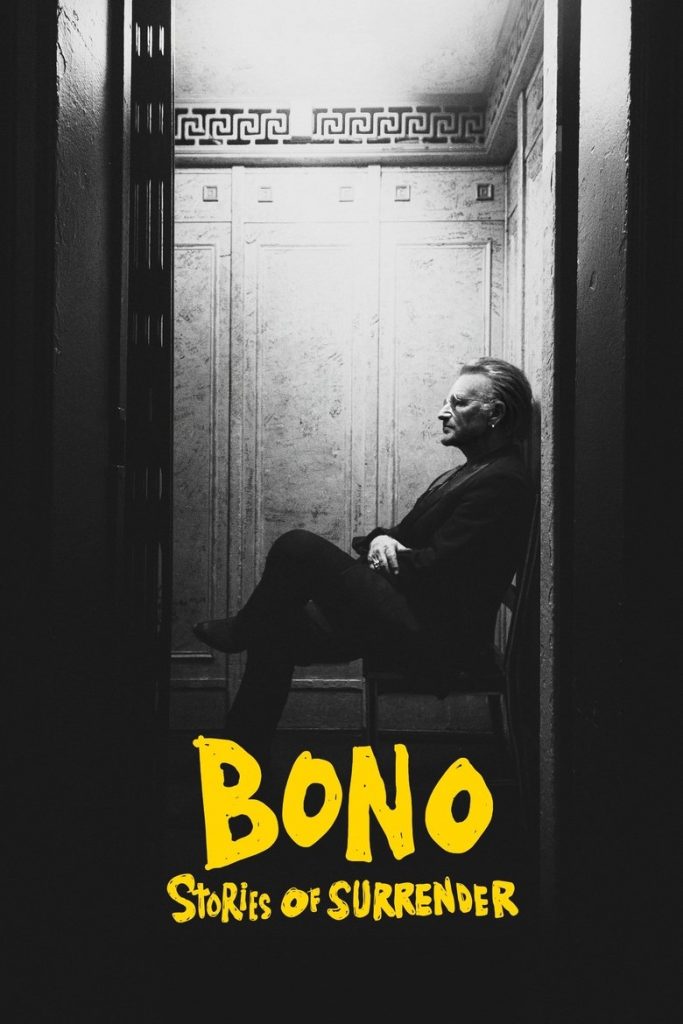
Bono: Stories of Surrender (2025)

Released: 2025-05-16 Recommended age: 8+ IMDb 7.2
Bono: Stories of Surrender

Movie details

  • Genres: Documentary, Music
  • Director: Andrew Dominik
  • Main cast: Bono, Jacknife Lee, Kate Ellis, Gemma Doherty
  • Country / region: United States of America
  • Original language: en
  • Premiere: 2025-05-16

Story overview

This documentary offers an intimate portrait of Bono, the U2 frontman, as he reflects on pivotal moments in his life through storytelling, music, and personal anecdotes. It explores his roles as a son, father, husband, and activist, blending behind-the-scenes footage with reflective narration to provide insight into his personal growth and artistic journey.

Parent Guide

A family-friendly documentary that provides an inspiring look at Bono's life, with no concerning content but some emotional depth that may require guidance for younger viewers.

Content breakdown

Violence & peril
None

No violence, peril, or aggressive scenes are present in this documentary.

Scary / disturbing
None

No scary or disturbing imagery; the content is reflective and narrative-driven.

Language
None

No strong or offensive language is used; the dialogue is respectful and focused on storytelling.

Sexual content & nudity
None

No sexual content or nudity; the film maintains a family-appropriate tone throughout.

Substance use
None

No depiction or discussion of substance use; the focus is on personal and artistic themes.

Emotional intensity
Mild

Some emotional discussions about family, loss, and activism may be poignant but are handled sensitively, suitable for ages 8+ with parental support.

Parent tips

This film is suitable for families with children aged 8 and up, focusing on themes of family, creativity, and social activism. It contains no violence, strong language, or explicit content, but younger viewers may find some emotional discussions or abstract concepts challenging. Consider watching together to discuss Bono's messages about perseverance and making a difference.

Parent chat guide

Use this documentary to talk with your kids about how personal experiences shape identity, the importance of family and activism, and the creative process in music. For younger viewers, highlight Bono's positive messages; for teens, delve into deeper themes like social responsibility and artistic expression. Ask open-ended questions to encourage reflection on their own values and interests.

Parent follow-up questions

  • What was your favorite part of the music?
  • How do you think Bono helps people?
  • What does it mean to be a good friend or family member?
  • What did you learn about Bono's life from the documentary?
  • How does music help tell stories?
  • Why is it important to stand up for what you believe in?
  • How do Bono's personal experiences influence his music and activism?
  • What challenges did he face, and how did he overcome them?
  • What can we learn from his approach to creativity and social issues?
  • Discuss the balance Bono shows between his public persona and private life.
  • How does the documentary explore themes of identity and legacy?
  • What impact do you think artists have on social and political movements?
⚠️ Deep Film Analysis (Contains Spoilers) · Click to Expand
U2's frontman strips away stadium anthems to reveal the quiet, messy man behind the sunglasses.

🎭 Story Kernel

The film is not a victory lap but a confession booth. It expresses the profound tension between Bono the global activist/rock star and Paul Hewson the Dublin son still wrestling with childhood grief. The driving force isn't career ambition, but a lifelong, desperate search for surrender—not to fame, but to vulnerability, to faith, to the memory of his mother. The narrative arc moves from performing identity to dismantling it, asking what remains when the persona is shed. It's a story about the cost of carrying the world's hopes while privately nursing a very local, personal hurt.

🎬 Visual Aesthetics

The visual language is intimate and claustrophobic, a stark contrast to U2's arena-scale spectacle. Director Morgan Neville employs tight, lingering close-ups on Bono's face, often in stark, shadowy theaters or bare rooms, making the film feel like a series of therapy sessions. The color palette is muted—earthy tones and deep shadows—emphasizing introspection over glamour. Archival footage is used not for nostalgia, but as counterpoint, highlighting the jarring disconnect between the public roar and the private man speaking softly to the camera. The camera's stillness forces us to sit with his discomfort.

🔍 Details & Easter Eggs

1
Early on, Bono subtly touches his wedding ring while discussing his father's volatile temper, a non-verbal tether to the stable love that contrasts his childhood narrative.
2
When recounting his mother's funeral, the camera holds on a single, stark empty chair in the theater, visually echoing the absence that defines so much of his story.
3
In a scene discussing the 'Joshua Tree' era's excess, the framing deliberately cuts off the top of his head, a subtle visual metaphor for the 'big head' and lost grounding he describes.

💡 Behind the Scenes

The film is adapted from Bono's live stage show 'Stories of Surrender,' performed at New York's Beacon Theatre. Director Morgan Neville, known for documentaries like '20 Feet from Stardom,' shot the film over a brief period, aiming to capture the raw, unrehearsed quality of the stage performance. The sparse, theatrical sets were designed to travel with the stage show, meaning the film's minimalist aesthetic is a direct translation of its theatrical origins, not a stylistic choice made for cinema.

Where to watch

Choose region:

  • Apple TV
  • Apple TV Amazon Channel

Trailer

Trailer playback is unavailable in your region.

SkyMe App
SkyMe Guide Download on the App Store
VIEW