
Brave Little Tailor (1938)
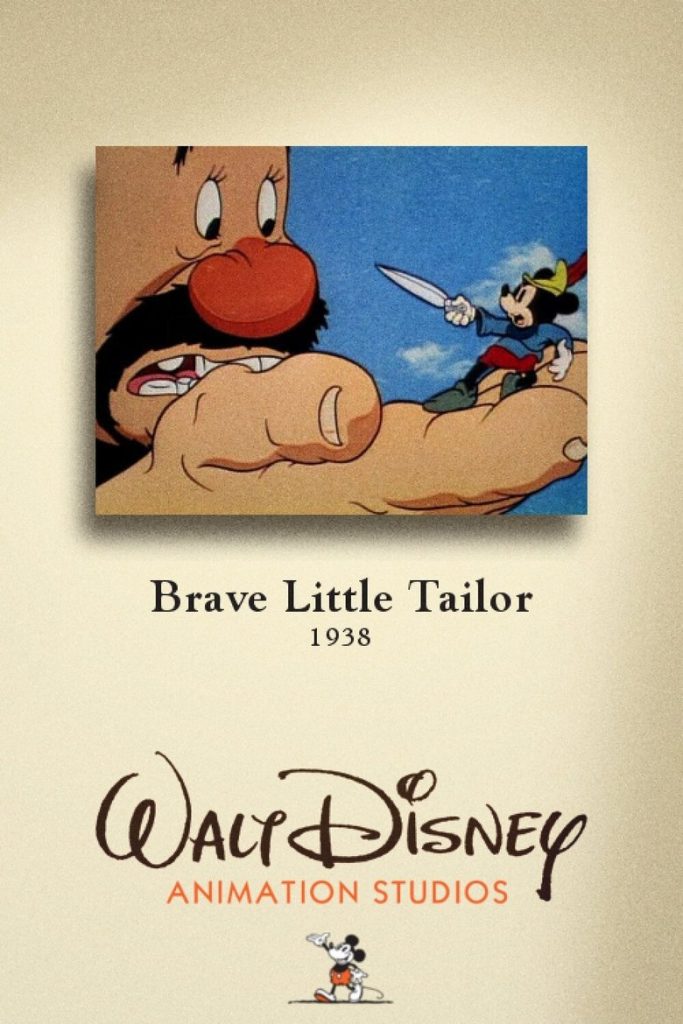
Story overview
This classic animated short features Mickey Mouse as a tailor who accidentally becomes a hero. When he boasts about killing seven flies with one blow, the townspeople misunderstand and think he defeated giants. Mickey is then tasked with confronting a real giant who threatens the kingdom, leading to a comedic adventure. The story plays on misunderstandings and exaggerated fears while showcasing Mickey's cleverness in a tight spot.
Parent Guide
A classic Disney short with mild cartoon peril and positive messages about cleverness and misunderstandings.
Content breakdown
Cartoon-style peril with a giant chasing Mickey; no injuries shown. Mickey uses non-violent tricks like tying the giant's shoelaces together.
The giant is large and loud, which might briefly startle very young viewers, but he's portrayed as clumsy rather than truly frightening.
No objectionable language; dialogue is simple and appropriate for all ages.
No sexual content or nudity.
No substance use depicted.
Brief moments of tension when Mickey faces the giant, but humor and quick resolution keep emotions light.
Parent tips
This 1938 Disney short is a gentle, humorous take on the classic 'giant-slayer' tale. At just 9 minutes, it's perfect for young viewers with short attention spans. The cartoon-style violence is mild and comedic—Mickey uses clever tricks rather than actual combat to outwit the giant. Parents should note that the giant might appear intimidating to very young children due to his size and loud voice, but he's portrayed more as clumsy than truly menacing.
The film's central theme of misunderstanding (the townspeople misinterpreting Mickey's boast) provides a good opportunity to discuss how rumors can spread and cause problems. The resolution emphasizes quick thinking and resourcefulness over brute force, which are positive messages for children. Since it's from the 1930s, some animation styles and humor might feel dated, but the core story remains accessible.
Parent chat guide
After watching, discuss how Mickey's small boast led to a big misunderstanding. Ask: 'What would you do if people thought you could do something you couldn't?' For younger children, you might focus on feelings: 'Was Mickey scared? How did he handle it?' The short runtime makes it easy to watch twice—once for fun, then again to spot details like how the animators show the giant's size difference.
Parent follow-up questions
- What was your favorite part of Mickey's adventure?
- How did the giant look and sound?
- What would you do if you met a giant?
- Was Mickey brave?
- What made you laugh in the story?
- Why did the townspeople think Mickey could fight giants?
- How did Mickey solve his problem without fighting?
- What does 'boasting' mean? Why can it cause trouble?
- Have you ever been in a situation where people misunderstood you?
- What would you have done in Mickey's place?
- How does the film use exaggeration for humor?
- What does this story say about how rumors spread?
- Why do you think stories about 'little vs. big' are so common?
- How might this story be different if made today?
- What qualities helped Mickey succeed besides bravery?
- How does this short reflect storytelling conventions of its time (1938)?
- What might the giant symbolize in terms of facing exaggerated fears?
- How does the film balance comedy with mild tension?
- In what ways does Mickey use intelligence over strength?
- How does the animation style contribute to the tone?
🎭 Story Kernel
At its heart, 'Brave Little Tailor' explores the theme of perceived versus actual power. Mickey Mouse, initially a humble tailor, accidentally becomes celebrated for killing 'seven with one blow'—referring to flies, not giants. The film cleverly dissects how reputation and bravado can create reality. Mickey's journey isn't about physical conquest but about the psychological armor of confidence. When faced with a real giant, his cleverness and quick thinking—using the giant's own strength against him—demonstrate that intelligence and courage often triumph over brute force. The narrative celebrates the underdog who wins through wit rather than warfare, making it a timeless fable about resourcefulness.
🎬 Visual Aesthetics
The animation employs a vibrant, hand-drawn aesthetic characteristic of Disney's Golden Age, with a rich color palette that contrasts the cozy, warm interiors of the tailor shop against the stark, imposing landscapes of the giant's domain. Camera movements are dynamic, using dramatic zooms and pans to emphasize Mickey's small stature against the giant's overwhelming size. Action sequences are choreographed with rhythmic precision, particularly in the climactic battle where Mickey's agility is highlighted through fluid, exaggerated motions. Symbolism is subtle but present—the oversized scissors Mickey wields symbolize his trade turned weapon, while the giant's clumsy movements visually represent brute force without finesse.
🔍 Details & Easter Eggs
💡 Behind the Scenes
'Brave Little Tailor' was released in 1938 as part of Disney's Silly Symphonies series, directed by Bill Roberts. It marked one of Mickey Mouse's last major appearances in the theatrical shorts before his popularity waned slightly in the 1940s. The voice actor for Mickey, Walt Disney himself, performed the role, adding a personal touch to the character's confident delivery. Animation techniques included early experiments with multi-plane camera effects to create depth in scenes like the giant's approach. The film was loosely based on the Brothers Grimm fairy tale 'The Valiant Little Tailor,' but Disney's version injected more humor and streamlined the plot for an eight-minute runtime.
Where to watch
Choose region:
- Disney Plus