
Brother Bear (2003)
Story overview
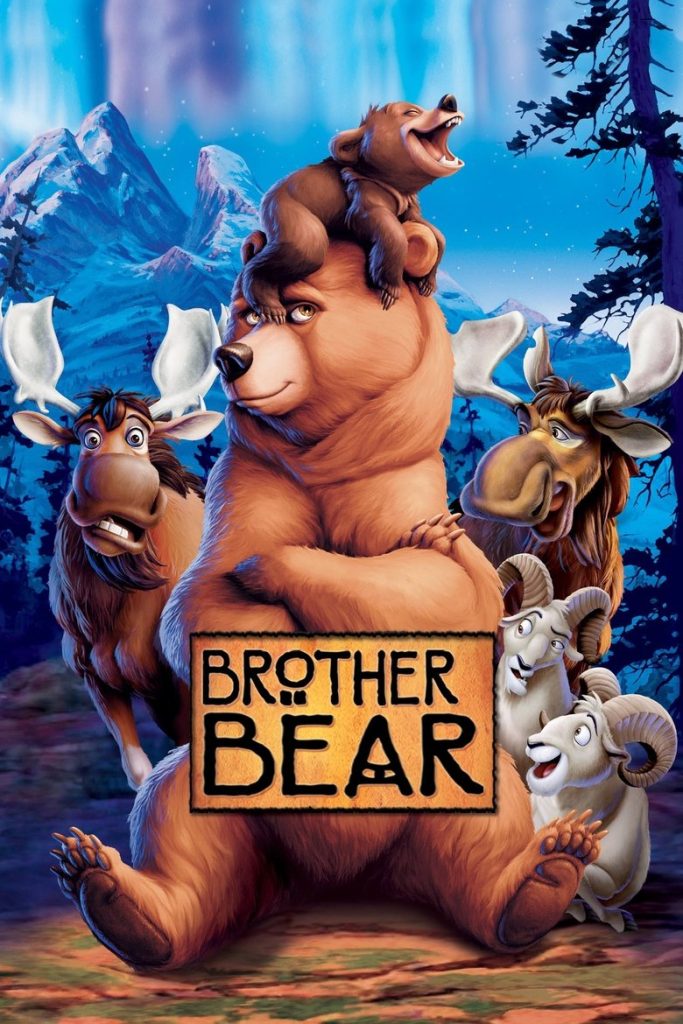
Brother Bear is a heartwarming animated adventure about a young boy named Kenai who undergoes a magical transformation into a bear. Through his journey, he learns to see the world from a different perspective and discovers the importance of empathy, family, and understanding. Along the way, he encounters various forest animals and forms unexpected friendships that help him grow.
Parent Guide
A gentle animated adventure with positive messages about empathy and understanding, suitable for most children with mild emotional moments.
Content breakdown
Some mild peril involving wildlife encounters and tense moments, but no graphic violence.
Magical transformation and some intense emotional moments might be slightly unsettling for very young children.
No offensive language; family-friendly dialogue throughout.
No sexual content or nudity.
No depiction of substance use.
Themes of loss, transformation, and reconciliation create some emotional moments, but handled gently.
Parent tips
Brother Bear is a gentle, G-rated film suitable for most children, focusing on themes of empathy, transformation, and understanding others' perspectives. The movie contains mild peril and emotional moments, such as the main character's transformation and some tense wildlife encounters, but these are handled in a family-friendly way. Parents should be aware that the story deals with loss and reconciliation, which might prompt questions from sensitive viewers.
Parent chat guide
Parent follow-up questions
- What was your favorite animal in the movie?
- How do you think the bear felt when he met new friends?
- What does it mean to be kind to others?
- Can you pretend to be a bear like Kenai?
- What colors did you see in the forest?
- Why do you think Kenai had to become a bear?
- How did Kenai's feelings change during his journey?
- What does 'walking in someone else's footsteps' mean to you?
- Which character taught the best lesson about friendship?
- How do animals and people communicate differently in the story?
- What does the transformation symbolize in the story?
- How does the movie show the importance of seeing things from another's perspective?
- What challenges did Kenai face in understanding the bears' world?
- How does the film address themes of family and belonging?
- What would you have done differently in Kenai's situation?
- How does the film explore the concept of empathy through Kenai's journey?
- What commentary does the movie make about human-animal relationships?
- How does the transformation serve as a metaphor for personal growth?
- In what ways does the story challenge traditional views of 'enemies'?
- How do the film's themes relate to real-world issues of understanding and tolerance?
🎭 Story Kernel
At its core, 'Brother Bear' is a profound exploration of empathy through literal transformation. The plot isn't just about revenge and redemption; it's about the forced dismantling of perspective. Kenai doesn't choose to understand bears—he's made into one. The film argues that true understanding requires becoming the 'other,' a radical idea for an animated feature. His journey from hunter to brother isn't a moral awakening he seeks, but one thrust upon him by the spirits, questioning whether empathy can ever be genuinely learned or must be experienced from the inside out. The driving force is this magical coercion toward compassion.
🎬 Visual Aesthetics
The film's visual language is cleaved in two by Kenai's transformation. The human world is rendered in a muted, almost desaturated palette of blues, greys, and browns, with sharp angles and confined compositions reflecting a limited worldview. After becoming a bear, the film blossoms into widescreen format and a vibrant, saturated color spectrum—lush greens, glowing auroras, and warm sunlight. This isn't just a technical shift; it's a perspectival one. The camera adopts lower, more grounded angles, making the world feel vast and interconnected. The Northern Lights aren't just pretty; they're the visual manifestation of the spiritual thread connecting all life.
🔍 Details & Easter Eggs
💡 Behind the Scenes
The film's production was notably complex. It was originally conceived in the late 1990s and underwent significant story changes. Phil Collins, who wrote and performed the songs, was brought on early, with some sequences animated to fit his music. The voice of the moose Rutt was provided by Rick Moranis, who came out of a semi-retirement from acting specifically for this role. A major technical challenge was the switch to widescreen aspect ratio after Kenai's transformation, requiring different animation and composition techniques for the two halves of the film to create the dramatic perceptual shift.
Where to watch
Choose region:
- Disney Plus
- Amazon Video
- Apple TV
- Google Play Movies
- YouTube
- Fandango At Home
Trailer
Trailer playback is unavailable in your region.