
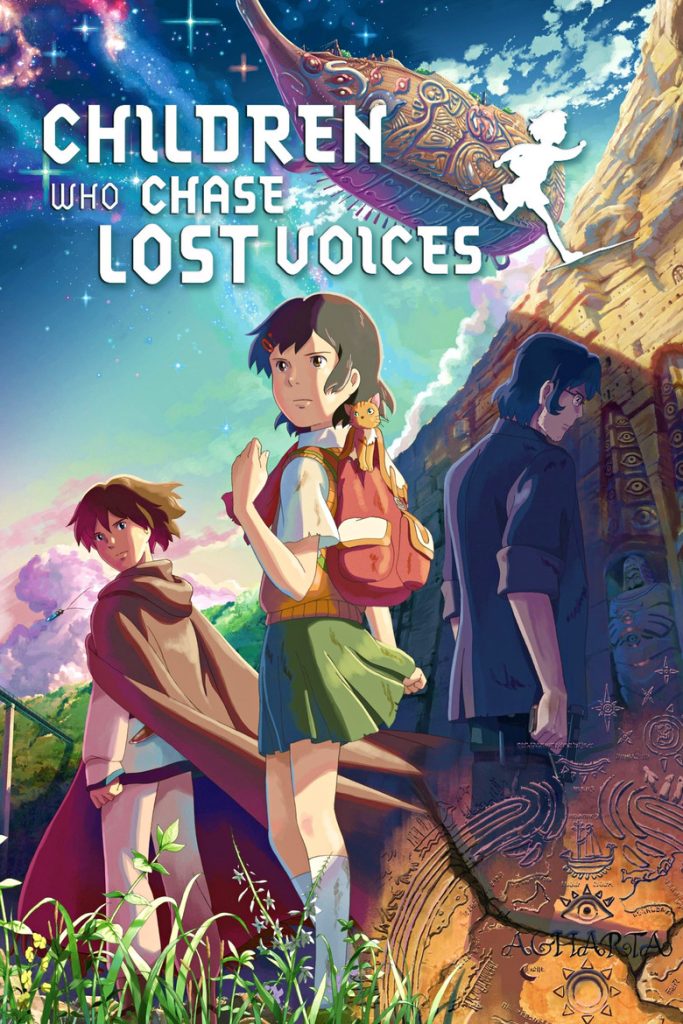
Children Who Chase Lost Voices (2011)
Story overview
Children Who Chase Lost Voices is a 2011 Japanese animated fantasy adventure that follows young Asuna, who discovers a mysterious world after being saved by a boy named Shun. She embarks on a journey with her teacher to the land of Agartha, encountering both wonder and danger along the way. The film explores themes of loss, grief, and the beauty and cruelty of the world through Asuna's emotional adventure.
Parent Guide
A visually stunning fantasy adventure with emotional depth about loss and discovery, best for mature children 10+ with parental guidance.
Content breakdown
Fantasy violence including monster attacks, perilous situations, and life-threatening scenarios in a mythical setting. No graphic injury details.
Frightening monster designs, intense emotional scenes involving loss and grief, and atmospheric tension in fantasy settings.
No concerning language noted in the provided information.
No sexual content or nudity indicated.
No substance use depicted.
Strong themes of parental loss, grief, and emotional journey. Characters face mortality and difficult goodbyes.
Parent tips
This film deals with mature themes of loss, grief, and mortality that may be emotionally challenging for younger viewers. While visually beautiful, it contains fantasy peril, monster encounters, and scenes that could be frightening or sad. The TV-14 rating reflects moderate emotional intensity and fantasy violence that may not be suitable for children under 8-10 without parental guidance.
Parents should be aware that the story centers on a child coping with parental loss and features characters facing life-threatening situations in a fantasy setting. The 116-minute runtime and philosophical themes may require breaks for younger viewers. Consider watching together to help process the emotional content.
Parent chat guide
Focus conversations on the film's themes of courage in facing the unknown and finding beauty in difficult experiences. Help children distinguish between fantasy adventure elements and real-world situations. Encourage them to share what parts made them feel curious, scared, or hopeful.
Parent follow-up questions
- What was your favorite part of the movie?
- How did you feel when Asuna was exploring new places?
- What would you do if you found a special radio like Asuna's?
- What makes a good friend in the movie?
- What colors or pictures did you like best?
- What did Asuna learn on her adventure?
- How do you think Asuna felt about her father?
- What would you ask the characters if you could talk to them?
- What was brave about what Asuna did?
- How did the music in the movie make you feel?
- What does the movie show about dealing with loss?
- How do the fantasy elements help tell a real story about emotions?
- What choices would you make differently than the characters?
- What does the movie say about courage and curiosity?
- How does the animation style affect how you experience the story?
- How does the film explore the balance between beauty and pain in life?
- What philosophical questions does the journey to Agartha raise?
- How do the characters' motivations reflect real human experiences?
- What cinematic techniques enhance the emotional impact?
- How does the film handle the theme of saying goodbye?
🎭 Story Kernel
The film's core is not adventure but the psychology of loss. Asuna's quest to resurrect her mother, and Shin's to save his brother, are driven by a refusal to accept death's finality. This exposes the film's true theme: the selfishness inherent in deep love. The mythical land of Agartha represents not just a physical place, but the dangerous emotional territory we enter when we try to bargain with fate. The climax reveals the brutal truth—true healing requires letting go, not retrieving. Morisaki's parallel quest as an adult underscores that this struggle transcends age; grief can arrest development, making adults chase ghosts as desperately as children.
🎬 Visual Aesthetics
Makoto Shinkai's signature hyper-detailed realism grounds the fantasy. The surface world is painted in cool, melancholic blues and greys, reflecting Asuna's loneliness. In stark contrast, Agartha erupts in warm, saturated golds, ambers, and deep greens, visually coding it as both beautiful and perilously seductive. The camera often adopts low-angle shots, making the landscapes feel overwhelmingly majestic and the characters small within them. The action is less about spectacle and more about weight and consequence—the Quetzalcoatl's flight feels laborious, and battles are brutal and short, emphasizing the realm's ancient, unforgiving nature.
🔍 Details & Easter Eggs
💡 Behind the Scenes
This was director Makoto Shinkai's first feature-length film conceived as a fantasy-adventure, marking a deliberate departure from his earlier romantic dramas. The film's original Japanese title, 'Hoshi o Ou Kodomo', translates more literally to 'Children Who Chase Stars', adding a layer of poetic yearning lost in the English translation. The lush score was composed by Tenmon, a frequent Shinkai collaborator, who used a full orchestra to create the epic, melancholic soundscape that defines the film's emotional tone.
Where to watch
Choose region:
- HBO Max
- HBO Max Amazon Channel
- Amazon Video
- Apple TV
- Google Play Movies
- YouTube
- Fandango At Home
Trailer
Trailer playback is unavailable in your region.