
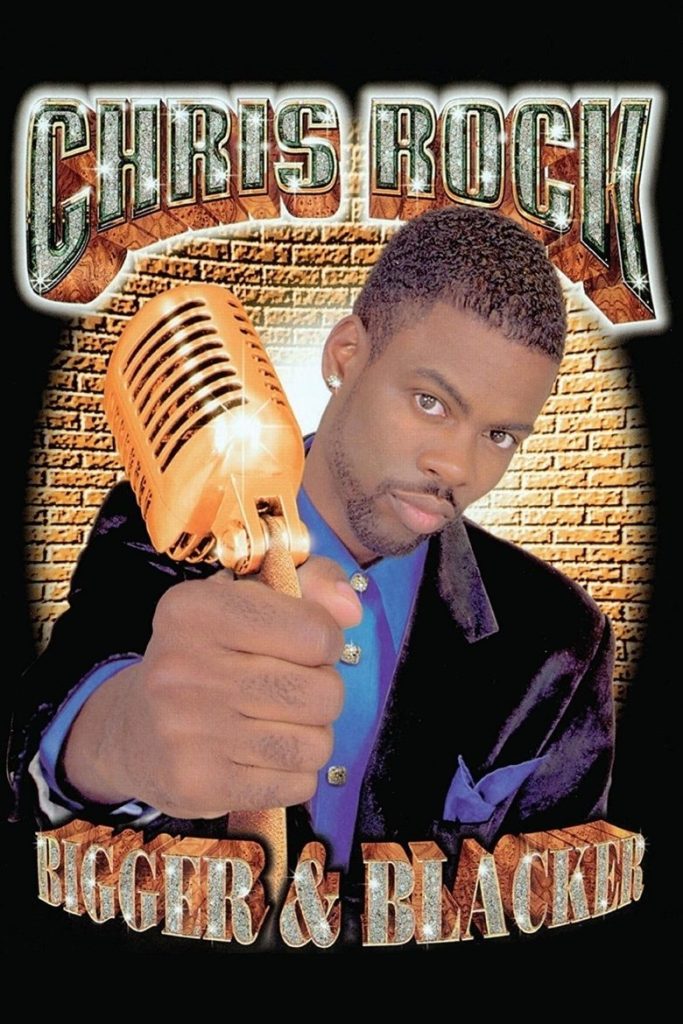
Chris Rock: Bigger & Blacker (1999)
Story overview
Chris Rock: Bigger & Blacker is a 1999 stand-up comedy special featuring Chris Rock performing at the historic Apollo Theater in Harlem, New York. The special showcases Rock's sharp observational humor and social commentary on topics like relationships, race, politics, and everyday life. As a TV-MA rated comedy special, it contains mature content intended for adult audiences.
Parent Guide
TV-MA stand-up comedy special with mature content intended for adult audiences only.
Content breakdown
Stand-up comedy performance without violent content.
No scary or disturbing imagery in this comedy special.
Contains strong language and adult-oriented dialogue typical of mature stand-up comedy.
Contains adult discussions of sexual themes and relationships.
May contain references to adult substance use in comedic context.
Comedic performance with occasional intense social commentary.
Parent tips
This is a stand-up comedy special with a TV-MA rating, indicating it's specifically designed for mature audiences. The content includes strong language, adult themes, and discussions of mature topics that are not appropriate for children or younger teens. Parents should be aware that this is not family entertainment and contains material that requires viewer discretion.
Parent chat guide
Parent follow-up questions
- What makes something funny to you?
- Can you tell me about a time you laughed really hard?
- What's your favorite silly thing to do?
- How do you know when something is a joke?
- What makes you feel happy and giggly?
- What kinds of jokes do you think are appropriate for kids your age?
- How can you tell if something is meant for adults instead of children?
- What makes a comedian different from someone just telling stories?
- Why do you think some shows have age ratings?
- How do you decide what TV shows are right for you to watch?
- What do you think makes comedy special for adults different from family comedy?
- How can humor be used to talk about serious topics?
- What should you do if you encounter media that seems too mature for you?
- Why do you think some comedians use strong language in their acts?
- How can you be a critical viewer of comedy shows?
- How does Chris Rock use humor to comment on social issues?
- What's the difference between offensive humor and social commentary?
- How do comedians balance entertainment with making serious points?
- What responsibilities do media creators have regarding their audience?
- How can you appreciate comedy while recognizing its limitations as social analysis?
🎭 Story Kernel
The movie is less a traditional narrative and more a raw, unfiltered expression of Black American anxiety at the turn of the millennium. What drives Chris Rock is the urgent need to articulate the absurd, often violent, contradictions of navigating a society that simultaneously commodifies and fears Blackness. The real story is the tension between his public persona—the brash, successful comedian—and the private, weary observer of systemic injustice. He uses humor not just for laughs, but as a diagnostic tool and a survival mechanism, exposing the psychological toll of racism, economic disparity, and cultural appropriation with a clarity that feels both cathartic and exhausting.
🎬 Visual Aesthetics
The visual language is stark, intimate, and confrontational. Filmed in a single, tight shot on a minimalist stage at the historic Apollo Theater, the camera focuses relentlessly on Rock, creating a sense of direct, unmediated address. The color palette is dominated by the deep red of the curtain and Rock's simple black suit, emphasizing the heat and gravity of his words. There are no cutaways or audience reactions to provide relief; the viewer is forced to sit with his observations. This visual austerity mirrors the content's lack of sugar-coating, making the performance feel like a urgent, late-night confession or a public tribunal.
🔍 Details & Easter Eggs
💡 Behind the Scenes
The special was directed by Keith Truesdell and filmed in 1999 at the Apollo Theater in Harlem. It was Rock's second HBO comedy special and is often cited as a career-defining work. The iconic red curtain and sparse set were deliberate choices to keep the focus entirely on the material. Notably, the special was released just a year after the murder of James Byrd Jr. and the same year as the police shooting of Amadou Diallo, events which palpably inform the material's raw anger about racial violence. Rock has said he wrote and refined the material over months of touring, treating it more like a theatrical play than a standard stand-up set.
Where to watch
Choose region:
- HBO Max
- HBO Max Amazon Channel
- Amazon Video
- Apple TV
- Google Play Movies
- YouTube
- Fandango At Home