
Cinderella III: A Twist in Time (2007)
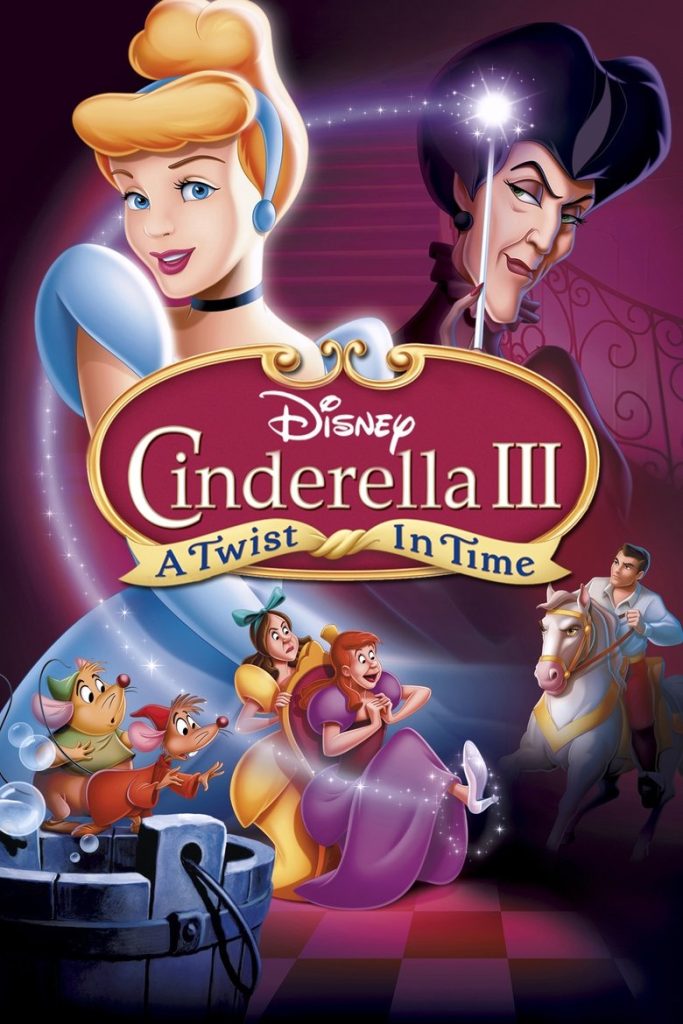
Story overview
In this 2007 animated sequel, Cinderella's wicked stepmother Lady Tremaine steals the Fairy Godmother's wand and rewrites history, erasing Cinderella's happy ending. Cinderella must navigate this altered reality where she's back to being a servant and Prince Charming is about to marry her stepsister Anastasia. With courage and determination, Cinderella works to restore the timeline and reclaim her true love against magical obstacles and family manipulation.
Parent Guide
A gentle, family-friendly animated sequel with positive messages and minimal concerning content. Suitable for most children with parental guidance for very sensitive viewers.
Content breakdown
Cartoonish magical confrontations with wands zapping characters (no injuries). Mild peril as characters face magical obstacles. The stepfamily's meanness is verbal/emotional rather than physical.
Some magical transformations might startle very young children. The stepmother is villainous but not truly frightening. No genuinely scary imagery.
No profanity or offensive language. Characters use mild insults like 'foolish' or 'ridiculous.'
No sexual content. Characters kiss briefly. Ballgowns and formal wear are modest and age-appropriate.
No depiction of alcohol, drugs, or tobacco use.
Mild emotional moments when Cinderella faces setbacks or rejection. Happy ending provides emotional resolution. Separation anxiety themes are minimal.
Parent tips
This G-rated Disney sequel offers positive messages about perseverance, kindness, and staying true to oneself. The magical time-travel plot may be confusing for very young children. The stepfamily's meanness is cartoonish rather than truly frightening. Good for family viewing with opportunities to discuss how we treat others and the importance of honesty.
Parent chat guide
Parent follow-up questions
- Which character was your favorite?
- What was the prettiest dress you saw?
- Can you dance like they did at the ball?
- Why do you think Lady Tremaine wanted to change the past?
- How did Cinderella show bravery?
- What would you do if you had a magic wand for one day?
- Do you think the stepsisters were truly bad or just influenced by their mother?
- How does this version of Cinderella compare to the original story?
- What lessons about family relationships does this movie show?
- How does this sequel handle the 'damsel in distress' trope compared to the original?
- What commentary does the film make about rewriting history or altering memories?
- How do the fantasy elements serve the story's themes of agency and choice?
🎭 Story Kernel
At its core, 'Cinderella III' explores the terrifying power of regret and the fragility of happiness. This isn't about magic versus evil—it's about memory versus manipulation. Anastasia's redemption arc reveals that even Disney's most cartoonish villains can experience genuine transformation when given agency beyond their original narrative constraints. The time-travel mechanic serves as a brilliant metaphor for how we rewrite our personal histories, with the wicked stepmother literally editing Cinderella's past to suit her present ambitions. What drives these characters isn't fairy godmother magic, but raw human desperation: Lady Tremaine's fear of returning to poverty, Anastasia's hunger for validation, and Cinderella's determination to protect what she's earned rather than what was given.
🎬 Visual Aesthetics
The animation maintains Disney's direct-to-video aesthetic but cleverly uses color psychology to track character development. Notice how Anastasia's palette shifts from harsh pinks and purples to softer blues as she reforms. The time-travel sequences employ a distinctive swirling vortex effect that visually echoes the film's theme of disrupted narratives. Camera work becomes noticeably more dynamic during action sequences—particularly the climax where characters literally race against time. Symbolism appears in subtle details: the glass slipper's reflections change depending on who holds it, and the castle's architecture becomes increasingly distorted as the timeline unravels.
🔍 Details & Easter Eggs
💡 Behind the Scenes
This film marked several firsts for Disney: it was the first direct-to-video sequel to receive a theatrical-style premiere at the El Capitan Theatre. Voice actor Tress MacNeille performed dual roles as both the Fairy Godmother and Lady Tremaine, creating fascinating vocal parallels between the film's magical opposites. The production team studied 1950s Cinderella animation cells to maintain visual continuity while allowing for technological updates. Interestingly, the time-travel concept emerged from writers wanting to explore 'what if' scenarios without contradicting the original film's canon.
Where to watch
Choose region:
- Disney Plus
- Amazon Video
- Apple TV Store
- Google Play Movies
- YouTube
- Fandango At Home
Trailer
Trailer playback is unavailable in your region.