
Coherence (2014)
Story overview
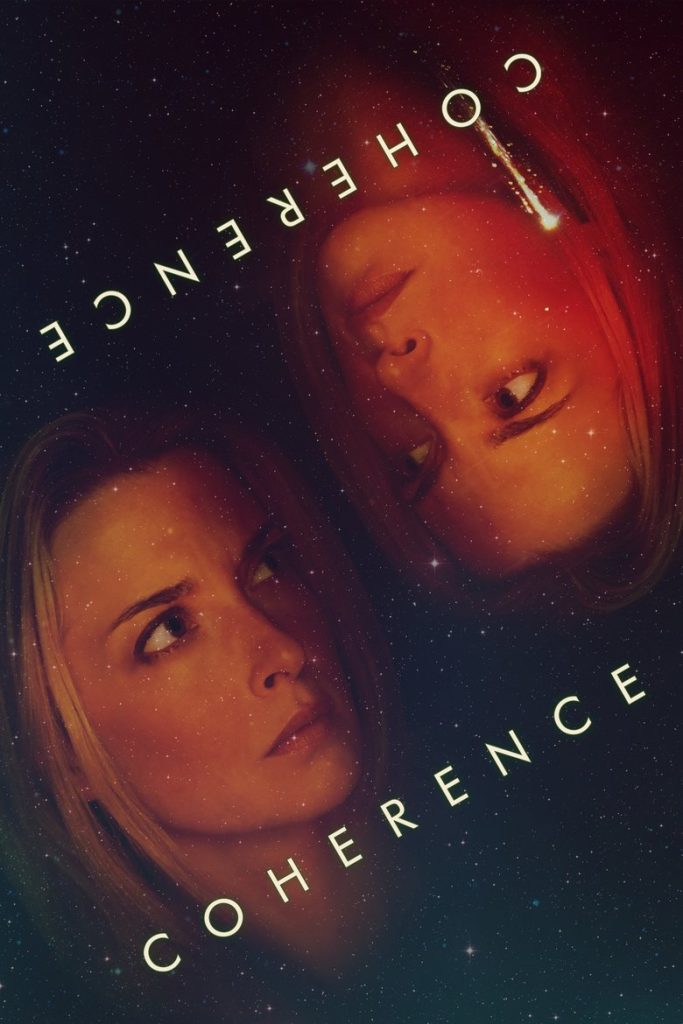
Coherence is a 2014 science fiction thriller about a group of friends who gather for a dinner party on the night a comet passes overhead. Strange events begin to unfold, causing reality to fracture and creating unsettling doppelgängers. The film explores themes of identity, choice, and the nature of reality through psychological tension rather than action.
Parent Guide
A psychological thriller exploring identity and reality through cerebral tension rather than graphic content.
Content breakdown
Some tense confrontations and arguments between characters, but no physical violence shown.
Psychological tension from reality fracturing and doppelgängers; unsettling concepts rather than jump scares.
Occasional mild profanity in tense situations.
No sexual content or nudity present.
Social drinking at a dinner party setting.
High psychological tension and anxiety as reality becomes unstable.
Parent tips
Coherence is a cerebral thriller that relies on psychological tension and mind-bending concepts rather than violence or jump scares. The film contains no graphic content, but its unsettling premise and themes of fractured reality may be confusing or disturbing for younger viewers. Parents should consider their child's ability to handle abstract, philosophical concepts and subtle psychological horror before viewing.
Parent chat guide
Parent follow-up questions
- Did you see any scary monsters in the movie?
- What colors did you see in the movie?
- Were the people in the movie being nice to each other?
- Did you see any stars or comets?
- What was your favorite part of the movie?
- How would you feel if you met someone who looked just like you?
- Why do you think the characters were confused about what was happening?
- What would you do if strange things started happening at a party?
- How did the characters try to solve their problem?
- What makes someone who they are - how they look or how they act?
- What do you think the comet represented in the story?
- How did the characters' relationships change as things got stranger?
- What would you do differently if you were in their situation?
- Why do you think the filmmakers chose to make the movie feel so realistic?
- How does this movie compare to other science fiction stories you know?
- What philosophical questions about identity does the film raise?
- How does the film use its limited setting to create tension?
- What commentary might the film be making about modern relationships?
- How does the film's structure reflect its themes of fractured reality?
- What would be the ethical implications if the events in the film were real?
🎭 Story Kernel
At its core, 'Coherence' explores the terrifying fragility of identity when faced with infinite possibility. The comet's passing doesn't create the alternate realities—it merely reveals the quantum superposition that was always there, like lifting a veil on Schrödinger's cat. The characters aren't driven by external threats but by their own desperate attempts to maintain narrative coherence in a universe that offers none. Their descent into paranoia and violence stems from the fundamental human need to believe we're unique, special, and in control—assumptions the film systematically dismantles. Each choice fractures reality further, proving that free will in a multiverse is both everything and nothing.
🎬 Visual Aesthetics
The film's visual language masterfully mirrors its thematic chaos through deceptive simplicity. Handheld camerawork and natural lighting create documentary-like intimacy that makes the surreal feel disturbingly plausible. The color palette shifts subtly from warm dinner-party yellows to cold, paranoid blues as reality fractures. Most brilliantly, the camera often lingers just outside conversations, mimicking our own position as observers trying to piece together the collapsing narrative. The single suburban setting becomes a labyrinth through editing and perspective shifts—doors and windows frame characters like specimens in a cosmic experiment. Visual cues are deliberately ambiguous, forcing viewers to question what they're seeing alongside the characters.
🔍 Details & Easter Eggs
💡 Behind the Scenes
The entire film was shot in just five nights with a micro-budget, using the director's own house as the primary location. Actors received only their character's notes and daily pages rather than a full script, creating genuine confusion and discovery. Many dialogue moments were improvised based on scenario cards given to actors minutes before filming. The glowing sticks were actual emergency glow sticks from a 99-cent store. James Ward Byrkit directed, wrote, and co-edited the film, originally conceiving it as a contained experiment in narrative physics rather than a commercial project.
Where to watch
Choose region:
- Amazon Prime Video
- Peacock Premium
- Philo
- Night Flight Plus
- Fandor Amazon Channel
- Screambox Amazon Channel
- Cineverse
- Amazon Prime Video with Ads
- Peacock Premium Plus
- Pluto TV
- Tubi TV
- Amazon Video
- Apple TV
- Google Play Movies
- YouTube
- Fandango At Home
Trailer
Trailer playback is unavailable in your region.