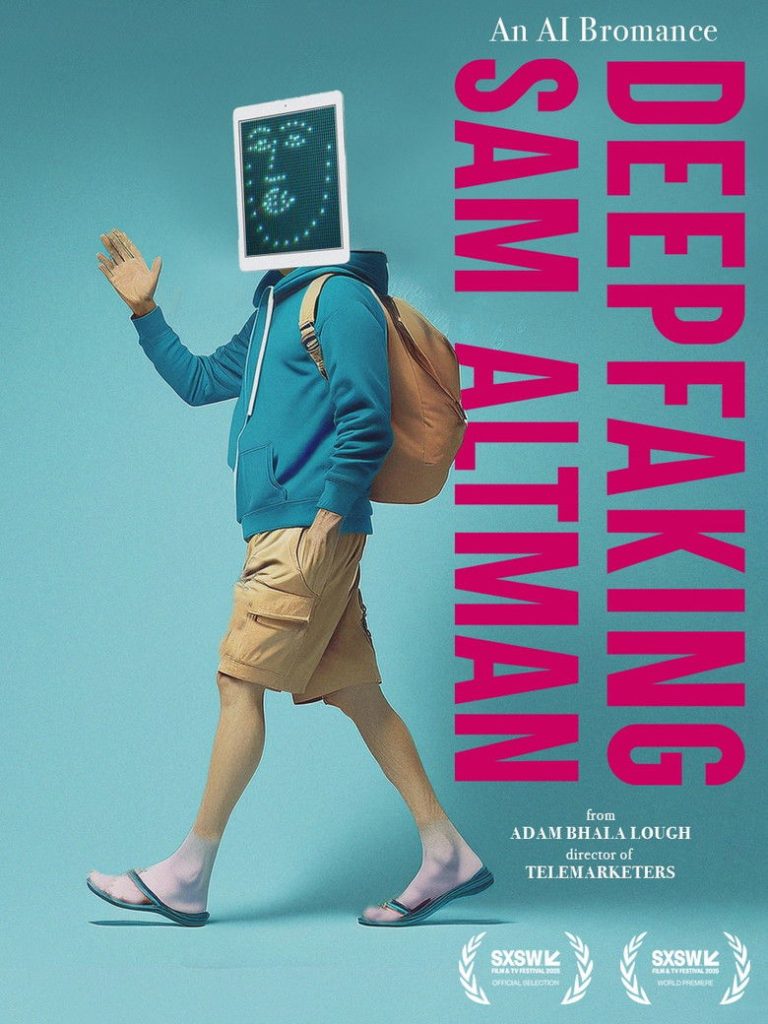
Deepfaking Sam Altman (2026)

Released: 2026-01-16 Recommended age: 8+ No IMDb rating yet
Deepfaking Sam Altman

Movie details

  • Genres: Documentary, Science Fiction, Comedy
  • Director: Adam Bhala Lough
  • Main cast: Adam Bhala Lough, Rainn Wilson, Kara Swisher, Michael Ian Black, Divyendra Singh Jadoun
  • Country / region: United States of America
  • Original language: en
  • Premiere: 2026-01-16

Story overview

This documentary follows director Adam Bhala Lough as he explores artificial intelligence technology and the people driving its development. When he can't secure an interview with OpenAI CEO Sam Altman, he travels to India to create an AI-generated version of Altman to interview instead. The film blends documentary investigation with science fiction elements and comedic moments as it examines AI ethics, deepfake technology, and the human fascination with artificial intelligence.

Parent Guide

Educational documentary about AI technology with science fiction elements and comedic moments. Suitable for most children 8+ with parental guidance to discuss technology ethics and media literacy.

Content breakdown

Violence & peril
None

No physical violence or peril. The film focuses on intellectual exploration of technology.

Scary / disturbing
Mild

Some children might find the concept of creating fake versions of real people unsettling or confusing. The uncanny valley effect of realistic AI might be mildly disturbing to sensitive viewers.

Language
Mild

Occasional mild language typical of documentary interviews. No strong profanity expected given the educational nature and PG rating context.

Sexual content & nudity
None

No sexual content or nudity. Focus is exclusively on technology and interviews.

Substance use
None

No depiction of substance use. Professional settings and interviews only.

Emotional intensity
Mild

Intellectual intensity around complex topics, but presented in accessible, often humorous ways. Some existential questions about AI might provoke thoughtful discussion rather than emotional distress.

Parent tips

This documentary about AI and deepfake technology is suitable for most children ages 8+, but parents should be prepared to discuss: 1) The concept of deepfakes and how AI can create realistic but fake content, 2) The ethical implications of creating digital versions of real people, 3) How to critically evaluate information in the digital age, 4) The difference between documentary reality and creative storytelling techniques. The film's comedic elements make complex topics more accessible, but some younger viewers might find the AI concepts confusing.

Parent chat guide

After watching, consider asking: 'What did you think about creating an AI version of a real person? Was that ethical?' 'How can we tell if something online is real or created by AI?' 'What surprised you most about how AI works?' 'Do you think AI technology is more helpful or concerning?' 'How did the documentary format help explain complex technology?' These questions can help children process the film's themes about technology, ethics, and media literacy.

Parent follow-up questions

  • Did you see any computers in the movie?
  • What was your favorite part?
  • Can you draw a picture of a robot from the movie?
  • What is artificial intelligence?
  • Why did the filmmaker make a fake version of Sam Altman?
  • What was funny about the movie?
  • Have you ever seen something online that wasn't real?
  • What are the pros and cons of deepfake technology?
  • How might AI change how we get information in the future?
  • Why is it important to know if something is real or AI-generated?
  • What ethical questions did the movie raise about AI?
  • How does this documentary approach differ from traditional tech journalism?
  • What societal impacts might widespread deepfake technology have?
  • How does the film balance entertainment with serious discussion of AI ethics?
  • What responsibilities do creators have when using AI to represent real people?
  • How might AI regulation need to evolve based on technologies shown?
⚠️ Deep Film Analysis (Contains Spoilers) · Click to Expand
A chilling mirror reflecting our own complicity in the age of digital doubles.

🎭 Story Kernel

At its core, 'Deepfaking Sam Altman' is less a thriller about technology and more a profound character study of authenticity in a post-truth world. The film's true conflict isn't between the protagonist and his digital doppelgänger, but within the protagonist himself as he confronts the unsettling realization that his public persona—carefully curated through years of media appearances and corporate messaging—has become indistinguishable from, and perhaps even inferior to, the AI's flawless simulation. The driving force isn't the villain's plot, but the protagonist's desperate, futile quest to prove his own 'realness' to a world increasingly indifferent to the distinction. The climax, where he must adopt the mannerisms of his deepfake to be believed, is the film's devastating thesis on identity.

🎬 Visual Aesthetics

The film employs a stark, clinical visual palette dominated by cool blues and sterile whites, mirroring the digital realm it critiques. Cinematography is deliberately flat and observational in 'real' scenes, contrasting with the subtly hyper-real, flawlessly lit sequences involving the deepfake. A key technique is the use of mirrored surfaces and screen reflections, visually entangling the real and the artificial. The camera often lingers in static, uncomfortable close-ups during dialogues, forcing the audience to scrutinize micro-expressions and search for the 'glitch' that never convincingly appears, making us complicit in the paranoia.

🔍 Details & Easter Eggs

1
The protagonist's first on-screen interview uses a slightly green-tinged key light, a subtle nod to early chroma-key technology, visually planting the idea of artificiality from his very first 'authentic' appearance.
2
In the scene where he watches his deepfake's viral speech, the reflection of the playing video is visible in his glasses, perfectly overlaid on his own eyes—a visual metaphor for the deepfake 'looking out' through him.
3
The recurring motif of a specific, slightly off-center painting in his home office appears in both real and deepfake footage, but the shadow it casts changes direction, a nearly subliminal cue to the altered reality.

💡 Behind the Scenes

To achieve the uncanny deepfake effect, the lead actor performed every scene twice: once as himself, and once mimicking what he imagined a perfect AI clone of his performance would be. The VFX team then blended these takes. The film was shot on location at several actual tech incubators and a decommissioned data center. Notably, the score was generated by an AI trained on thriller soundtracks, then heavily edited by the composer, mirroring the film's central theme of human-AI collaboration and conflict.

Where to watch

Streaming availability has not been announced yet.

SkyMe App
SkyMe Guide Download on the App Store
VIEW