
Donnie Darko (2001)
Story overview
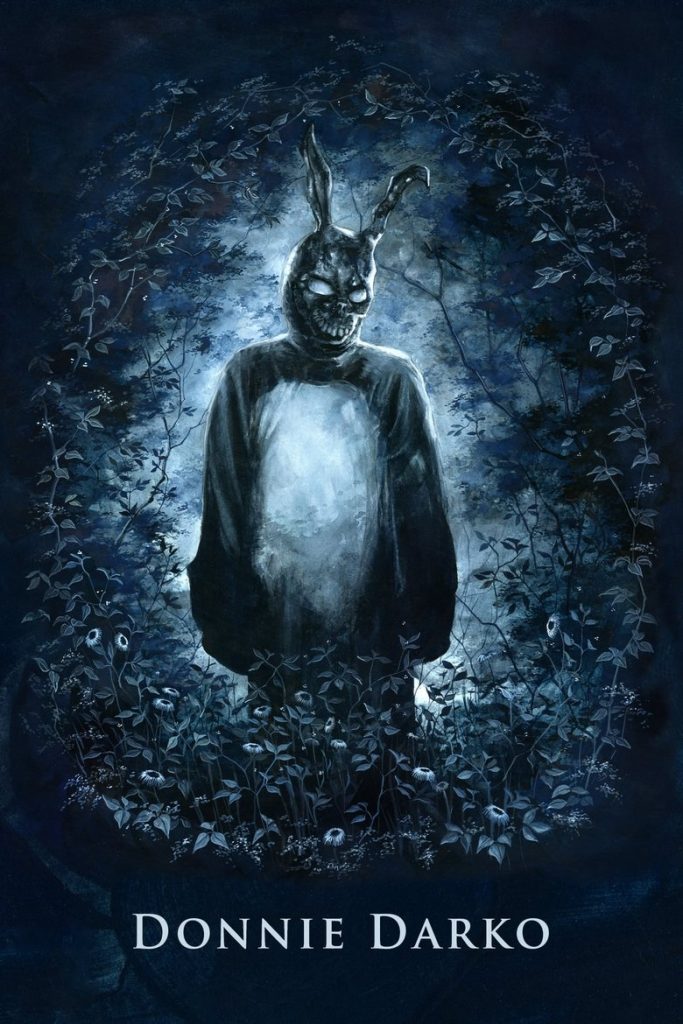
Donnie Darko is a 2001 psychological thriller that blends fantasy, drama, and mystery elements. The story follows a troubled teenager who experiences strange visions of a large rabbit figure that warns him about an impending apocalyptic event. As Donnie navigates these surreal experiences, the film explores themes of time travel, mental health, and existential questions. The narrative unfolds in a complex, non-linear fashion that challenges viewers to interpret its ambiguous plot.
Parent Guide
A complex psychological thriller with mature themes about mental health, existential questions, and apocalyptic scenarios. Requires significant cognitive engagement and emotional maturity.
Content breakdown
Contains some violent scenes including property destruction, confrontations, and perilous situations. No graphic gore, but tension and threat are present throughout.
Features disturbing imagery including a frightening rabbit figure, apocalyptic visions, and themes of mental instability. Psychological horror elements may be intense for sensitive viewers.
Contains frequent strong language including profanity and crude references throughout the film.
Contains some sexual references and discussions, but no explicit nudity or graphic sexual scenes.
Contains some references to substance use and brief scenes with alcohol, but not a central focus of the film.
High emotional intensity dealing with themes of depression, anxiety, existential fear, and psychological distress. The protagonist's mental health struggles are central to the plot.
Parent tips
This film is rated R for strong language, some violence, and mature thematic elements. It deals with complex psychological concepts, including mental illness, existential dread, and apocalyptic themes that may be disturbing for younger viewers. The non-linear storytelling and ambiguous ending require significant cognitive engagement and may confuse viewers who prefer straightforward narratives.
Parents should be aware that the film contains scenes with intense emotional content and disturbing imagery related to mental health struggles. The protagonist's experiences with hallucinations and visions of a frightening rabbit figure could be particularly unsettling for sensitive viewers. This film is best suited for mature teenagers who can handle its challenging themes and narrative complexity.
Parent chat guide
Discuss the film's treatment of difficult emotions like anxiety, depression, and existential fear. This can be an opportunity to talk about healthy coping mechanisms and when to seek help for mental health concerns. Emphasize that while the film uses fantastical elements, real mental health issues should be addressed with professional support when needed.
Parent follow-up questions
- What was your favorite part of the movie?
- How did the movie make you feel?
- What colors did you see in the movie?
- Can you tell me about one character?
- What was something funny or happy in the movie?
- What did you think about the rabbit character?
- How would you describe Donnie to someone who hasn't seen the movie?
- What parts of the movie were confusing to you?
- What do you think the movie was trying to teach us?
- How did the music and sounds make you feel during different scenes?
- What themes about growing up did you notice in the film?
- How does the movie show that people can be dealing with problems we can't see?
- What do you think the time travel elements represent in the story?
- How does the film balance realistic and fantastical elements?
- What questions about the plot are you still thinking about?
- How does the film explore the relationship between mental health and reality?
- What commentary does the film make about societal pressures on teenagers?
- How do the film's nonlinear elements affect your interpretation of the story?
- What philosophical questions about fate and free will does the film raise?
- How does the film use ambiguity to engage viewers in active interpretation?
🎭 Story Kernel
At its core, 'Donnie Darko' is less about time travel and more about the terrifying, beautiful burden of existential awareness. Donnie isn't just a troubled teen; he's a metaphysical anomaly, a 'living receiver' who perceives the corrupt Primary Timeline and the unstable Tangent Universe. His 'insanity' is actually a hyper-lucidity that allows him to see the world's rot—from Jim Cunningham's hypocritical 'fear and love' philosophy to the passive cruelty of his community. The film explores the paradox of free will within a predetermined universe: Donnie must consciously choose the self-sacrificial path the universe has engineered for him, making his final act not one of despair, but of profound, tragic agency to restore order.
🎬 Visual Aesthetics
The film's visual language masterfully externalizes Donnie's fractured psyche. The 1988 suburban setting is rendered in a hyper-real, slightly sickly palette—all muted pastels and fluorescent lights—creating a world that feels both nostalgic and deeply uncanny. Slow-motion sequences, like the school hallway shots, give mundane actions a portentous, dreamlike weight. The camera often lingers on Donnie's isolation within frames, emphasizing his dislocation. Frank the Bunny's design is genius: part menacing animatronic, part worn plush toy, it visually bridges childhood nightmare and cosmic horror. The use of wide shots in empty spaces, like the flooded school, underscores the eerie, hollow reality of the Tangent Universe.
🔍 Details & Easter Eggs
💡 Behind the Scenes
Jake Gyllenhaal was not the first choice; the role was nearly given to another actor, but director Richard Kelly fought for him. The iconic bunny suit, Frank, was a last-minute creation by the art department using an existing Halloween costume and a fiberglass mask, costing only a few thousand dollars. Drew Barrymore, who plays teacher Karen Pomeroy, was also an executive producer; her involvement helped secure the film's financing. Many of the suburban scenes were shot in Richard Kelly's actual hometown in Virginia, lending an authentic, personal texture to the setting.
Where to watch
Choose region:
- Netflix
- Amazon Prime Video
- Hulu
- fuboTV
- Criterion Channel
- Netflix Standard with Ads
- Amazon Prime Video with Ads
- Shout! Factory Amazon Channel
- The Roku Channel
- Pluto TV
- Shout! Factory TV
- Amazon Prime Video Free with Ads
- Tubi TV
- Amazon Video
- Apple TV
- Google Play Movies
- YouTube
- Fandango At Home
Trailer
Trailer playback is unavailable in your region.