
Don’s Fountain of Youth (1953)
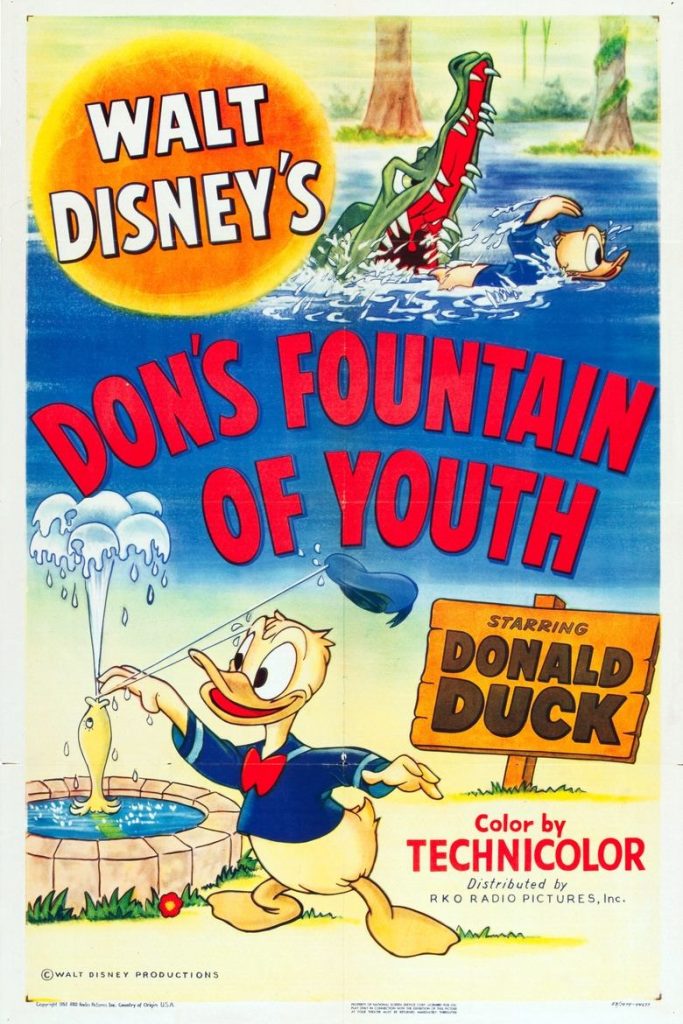
Story overview
This short animated film follows Donald Duck and his nephews during a trip. Frustrated that the children are only interested in reading comics, Donald plays a trick by pretending to drink from a 'fountain of youth' and acting like a baby. The situation becomes complicated when he encounters a protective mother alligator and her babies, leading to a hasty escape with his nephews. The story combines lighthearted humor with mild peril in a classic cartoon style.
Parent Guide
A classic Disney cartoon with mild slapstick humor and brief peril suitable for most children.
Content breakdown
Cartoon-style peril with a protective alligator chasing characters; no actual violence occurs.
The mother alligator might be momentarily intense for very young viewers, but the scene is brief and resolved humorously.
No inappropriate language; typical cartoon sounds and expressions.
No sexual content or nudity.
No substance use depicted.
Mild frustration and brief excitement during the chase scene; overall lighthearted tone.
Parent tips
This 1953 animated short features classic cartoon slapstick humor and mild peril that may be entertaining for children familiar with vintage Disney animation. Parents should be aware that Donald Duck's trick involves deception toward his nephews, which could prompt discussions about honesty and family relationships. The encounter with the mother alligator creates brief moments of tension, but the resolution is quick and non-violent, typical of cartoons from this era.
The film's short runtime (6 minutes) makes it suitable for young viewers with limited attention spans. Since it's an older animation, the visual style and pacing may differ from modern cartoons, which could either intrigue or disinterest contemporary children. The 'Approved' certification indicates it was considered appropriate for general audiences at the time of release.
Parent chat guide
After watching, discuss how Donald tried to trick his nephews and ask how they think the nephews felt. You could also talk about why the mother alligator was protective of her babies and compare it to how parents protect their children. For older children, you might discuss how cartoons from different time periods have different styles of humor and storytelling.
Parent follow-up questions
- What was your favorite part of the cartoon?
- How did Donald Duck try to trick the little ducks?
- What sounds did the animals make?
- Was it funny when Donald acted like a baby?
- How did they get away from the alligator?
- Why do you think Donald was upset about the comics?
- What does 'fountain of youth' mean?
- How did the animation look different from cartoons today?
- Was it fair for Donald to trick his nephews?
- What would you have done if you were one of the nephews?
- What does this cartoon show about family relationships?
- How does the humor compare to modern animated shows?
- Why might parents from 1953 have found this appropriate for children?
- What message might the filmmakers have wanted to share?
- How does the short format affect the storytelling?
- How does this reflect attitudes toward children's entertainment in the 1950s?
- What animation techniques can you identify from this era?
- How does the portrayal of adult-child relationships compare to contemporary media?
- What cultural values might be embedded in this short film?
- How effective is the physical comedy in conveying the story?
🎭 Story Kernel
The film's core isn't about eternal life, but about the psychological burden of witnessing time's relentless march while you remain static. Don's pursuit isn't driven by fear of death, but by a pathological fear of becoming irrelevant—of watching his ideas, relationships, and cultural footprint erode. His character arc reveals that true horror isn't mortality, but the existential dread of being a permanent spectator in a world designed for transience. The supporting characters aren't foils, but mirrors reflecting the stages of his decay: envy, detachment, and finally, a hollow nostalgia for the very impermanence he sought to escape.
🎬 Visual Aesthetics
The cinematography employs a stark, desaturated palette that grows colder as Don's isolation deepens. Early scenes use warm, shallow focus to mimic his self-absorption, while later wide shots emphasize his growing distance from a vibrant, moving world. The fountain itself is never shown in a glamorous light—it's filmed with clinical, almost surgical precision, its water looking viscous and unnatural. Key action sequences use jarring, discontinuous editing to disorient the viewer, mirroring Don's fractured perception of time where decades feel like moments and conversations stretch into eternities.
🔍 Details & Easter Eggs
💡 Behind the Scenes
The fountain set was built over a natural spring on location in rural Portugal, requiring the crew to engineer a complex system to control water flow and temperature for different seasonal scenes. Lead actor reportedly spent weeks studying interviews with centenarians to capture the physicality of someone carrying centuries of lived experience. The distinctive blue-grey color grade was achieved through a combination of vintage lens filters and digital processing, inspired by early 20th-century autochrome photography.
Where to watch
Choose region:
- Disney Plus