
Drain The Ocean: WWII (2016)
Story overview
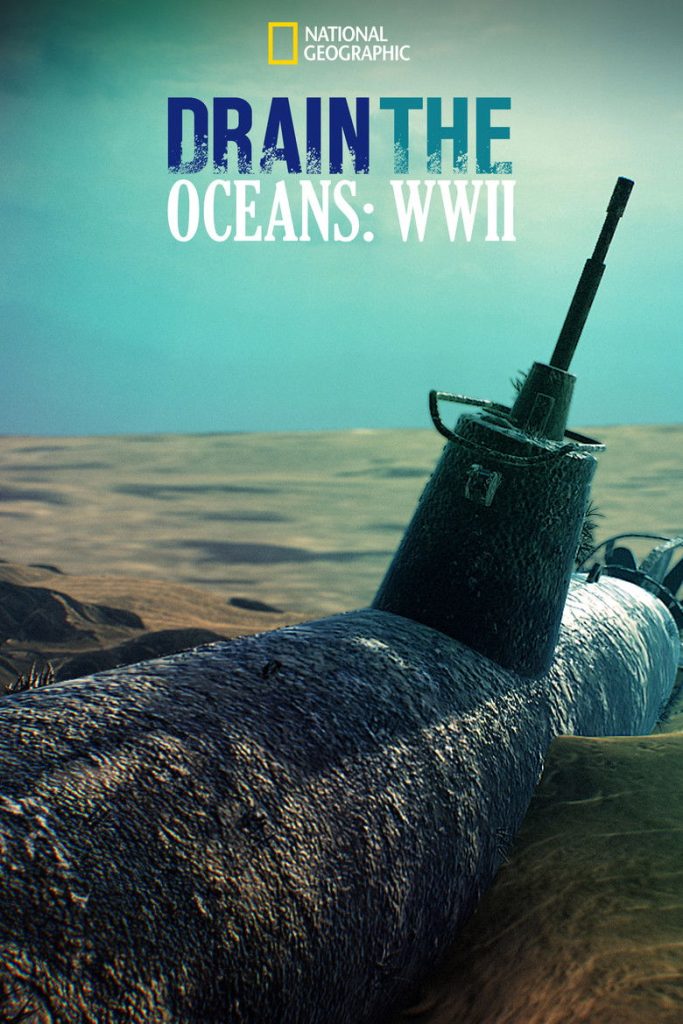
This documentary uses advanced 3D technology to virtually 'drain' the ocean and reveal sunken World War II ships and submarines. It explores historical wrecks like the USS Arizona at Pearl Harbor, the German battleship Bismarck, merchant ships attacked off U.S. coasts, D-Day inventions, and the troopship Leopoldville tragedy. The presentation focuses on archaeological discovery, historical facts, and technological visualization rather than graphic combat footage.
Parent Guide
Educational documentary suitable for school-aged children interested in history and technology. Uses 3D visualizations rather than graphic footage to explore WWII shipwrecks.
Content breakdown
Discussions of wartime destruction and ship sinkings, but no graphic violence shown. 3D reconstructions show damaged ships without human elements. References to deaths are historical and factual rather than visual.
Some scenes of sunken ships in dark ocean depths might be slightly unsettling for very young children. Discussions of wartime tragedies (like 400 deaths on Leopoldville) are presented factually without sensationalism.
No offensive language. Educational documentary narration with historical terminology.
No sexual content or nudity.
No substance use depicted or discussed.
Historical discussions of war and loss are presented with educational detachment. The focus is on discovery and technology rather than emotional storytelling. Some children might find the subject matter sobering but not overwhelming.
Parent tips
This documentary presents war history through scientific visualization rather than graphic violence. The 3D reconstructions show ships and submarines in detail, but there are no depictions of human casualties or combat violence. Discussions of wartime deaths are factual and historical rather than sensationalized. The tone is educational and investigative, suitable for children learning about WWII history. Parents may want to discuss the historical context and the technological methods used in the film.
Parent chat guide
Parent follow-up questions
- Did you like seeing the big ships?
- What was your favorite part of the movie?
- Can you tell me about one thing you saw underwater?
- What did you learn about World War II from this movie?
- How do you think they made those 3D pictures of the ships?
- Why do you think it's important to study sunken ships?
- What historical events mentioned in the documentary were most significant?
- How does technology change how we understand history?
- What ethical questions might arise when studying war wrecks?
- How does this documentary's approach differ from traditional war documentaries?
- What historical perspectives might be missing from this technological presentation?
- How should we balance historical preservation with respect for war graves?
🎭 Story Kernel
The film's true subject isn't naval warfare, but the process of historical memory becoming geology. By digitally 'draining' the ocean, it performs an archaeological autopsy on the war, revealing how human conflict is absorbed and transformed by the natural world. The wrecks are not mere relics; they are active sites where steel becomes ecosystem, and human intent is overwritten by geological time. The driving force is a forensic curiosity—not about who won, but about how violence settles, literally, into the seabed, creating new, unintended monuments.
🎬 Visual Aesthetics
The visual language is a hybrid of forensic scan and elegiac tableau. The CGI 'drain' effect is the central aesthetic device, functioning less as a spectacle and more as a conceptual X-ray, peeling back the ocean to expose a submerged museum. The color palette is dominated by the cold blues and grays of deep water and corroded metal, punctuated by the sudden, vivid bursts of life—coral gardens and fish schools colonizing gun turrets. The camera often adopts a slow, gliding, almost funereal movement over the wrecks, treating them like memorial sites rather than objects of exploration.
🔍 Details & Easter Eggs
💡 Behind the Scenes
The production relied heavily on data from organizations like NOAA and various maritime archaeology institutes. The 'drained' ocean visualizations are not artistic guesses but are built from precise multibeam sonar bathymetry and 3D photogrammetry models of the actual wreck sites. Much of the 'new' footage of wrecks like the USS Arizona or Japanese carriers comes from recent ROV (Remotely Operated Vehicle) surveys that provided higher resolution data than ever before, allowing the digital models to be terrifyingly accurate.
Where to watch
Choose region:
- Disney Plus