
Dune: Part Two (2024)
Story overview
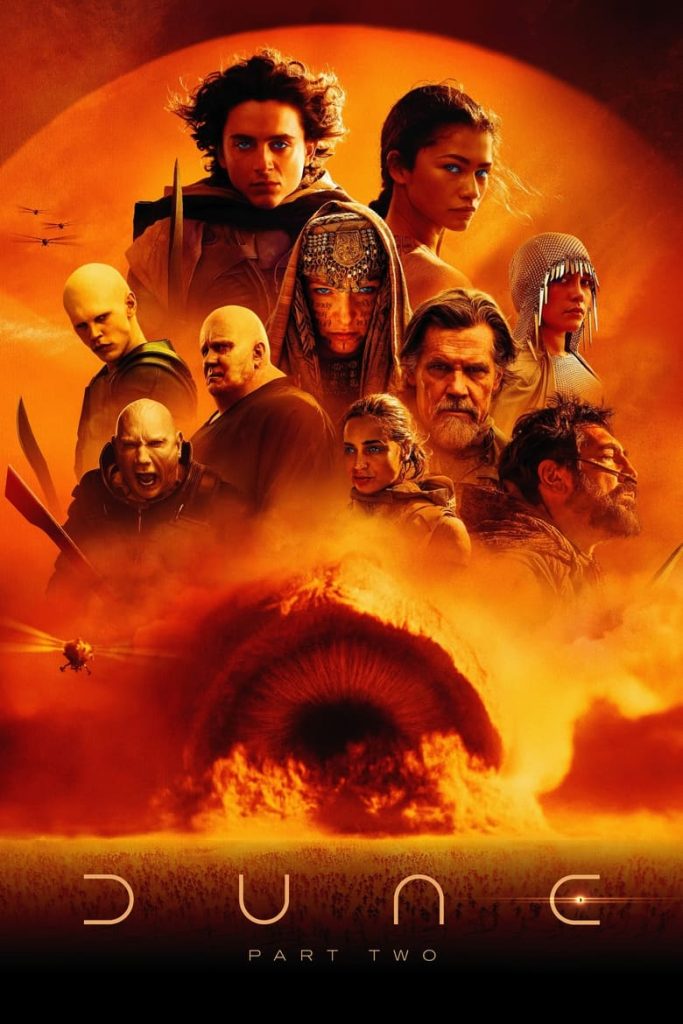
Dune: Part Two continues the epic science fiction saga of Paul Atreides, who joins forces with the Fremen people on the desert planet Arrakis. He faces a monumental choice between personal love and the destiny of the entire universe, while seeking justice for his family. The film explores themes of prophecy, power, and sacrifice in a visually stunning interstellar setting.
Parent Guide
A visually spectacular but intense sci-fi epic with complex themes best suited for mature teens.
Content breakdown
Contains sci-fi combat, battles with futuristic weapons, hand-to-hand fighting, and perilous situations. Violence is stylized but frequent in action sequences.
Includes intense scenes of peril, large-scale destruction, and some disturbing imagery related to the harsh desert environment and conflict.
May contain occasional mild profanity or intense dialogue, consistent with PG-13 rating.
May include romantic themes and brief suggestive content, but no explicit sexual scenes or nudity.
No notable depiction of substance use.
Features themes of loss, revenge, destiny, and difficult moral choices that create emotional weight throughout the narrative.
Parent tips
This PG-13 rated film contains intense sequences of sci-fi violence, peril, and some disturbing images that may be too strong for younger viewers. The 167-minute runtime requires sustained attention, and the complex political and philosophical themes may be challenging for children under 13 to fully grasp. Parents should consider their child's sensitivity to violence and ability to follow intricate narratives before viewing.
Parent chat guide
Parent follow-up questions
- What was your favorite part of the movie?
- How did the desert planet look different from Earth?
- What animals did you see in the movie?
- How did the characters help each other?
- What makes someone a good leader in the story?
- Why is water so important on the desert planet?
- How do the characters show bravery?
- What would you do if you had to make a really hard choice?
- How does the movie show different cultures working together or in conflict?
- What does it mean to have a 'destiny' or special purpose?
- How do characters balance what they want with what they think is right?
- What makes science fiction stories different from other kinds of stories?
- How does the film explore the relationship between power and responsibility?
- What commentary might the story offer about prophecy and belief systems?
- How are themes of revenge and justice portrayed in the narrative?
- What visual or musical elements stood out to you and why?
🎭 Story Kernel
Dune: Part Two is a profound deconstruction of the 'Hero’s Journey,' shifting from a tale of vengeance to a tragedy of religious manipulation. It explores how the Bene Gesserit’s 'Missionaria Protectiva' planted seeds of superstition that Paul Atreides eventually harvests to secure political power. The film focuses on the tension between Paul’s desire to protect the Fremen and his realization that his ascension will ignite a genocidal holy war across the universe. Chani acts as the narrative’s moral anchor, representing the secular skepticism of a people being exploited by a manufactured prophecy. Ultimately, the story expresses the danger of charismatic leadership, suggesting that when religion and politics are used as tools for power, the result is an inescapable, violent destiny that strips individuals of their agency.
🎬 Visual Aesthetics
Cinematographer Greig Fraser employs a masterful contrast in visual palettes to define the film's warring ideologies. Arrakis is rendered in tactile, sweltering oranges and ochres, emphasizing the harsh naturalism of the desert. In stark contrast, the sequences on Giedi Prime utilize specialized infrared cameras to create a 'black sun' effect, stripping the world of color and rendering the Harkonnen society in a haunting, monochromatic high-contrast. This visual choice symbolizes the parasitic and dehumanized nature of their fascist regime. The scale is consistently monumental; Villeneuve uses IMAX framing to dwarf the human characters against colossal spice harvesters and vast landscapes, reinforcing the theme that these individuals are merely small parts of a massive, ancient, and indifferent machinery of history and ecology.
🔍 Details & Easter Eggs
💡 Behind the Scenes
To maintain a sense of grounded realism, Denis Villeneuve opted for extensive location filming in the deserts of Jordan and Abu Dhabi rather than relying solely on soundstages. Composer Hans Zimmer, a devoted fan of the novel, continued to push sonic boundaries by creating custom instruments to ensure the score felt truly extraterrestrial. Austin Butler’s portrayal of Feyd-Rautha involved months of physical training and voice coaching to mimic Stellan Skarsgård’s Baron Harkonnen, creating a chilling familial resemblance. The film's release was delayed from late 2023 to March 2024 due to the SAG-AFTRA strike, which ultimately allowed for more refined post-production work.
Where to watch
Choose region:
- HBO Max
- HBO Max Amazon Channel
- Amazon Video
- Apple TV
- Google Play Movies
- YouTube
- Fandango At Home
- Spectrum On Demand
- Plex
Trailer
Trailer playback is unavailable in your region.