
Duniya (1984)
Story overview
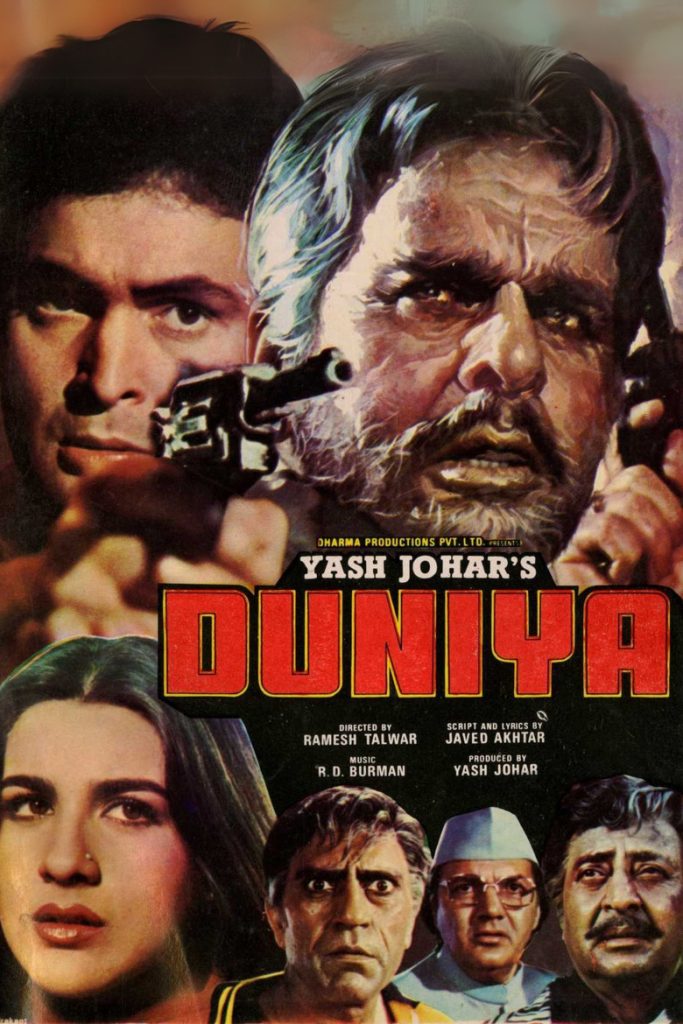
Duniya is a 1984 Indian action-drama film directed by Ramesh Talwar. The story follows Mohan Kumar, a man who is wrongfully convicted of a crime he did not commit. After losing his wife, son, and freedom, he serves time in prison. Upon his release, he is driven by a deep desire for revenge against those who framed him, navigating a world of injustice and personal turmoil.
Parent Guide
Duniya is an action-drama with moderate violence and emotional intensity, suitable for ages 8 and up with parental guidance. It deals with mature themes like wrongful imprisonment and revenge, but lacks explicit content. Parents should be prepared to discuss justice and emotional responses.
Content breakdown
Includes action sequences with fights, chases, and confrontations typical of 1980s Bollywood films. There is no graphic gore, but scenes of peril and physical violence occur, such as characters being framed and imprisoned. Some moments may be intense for younger viewers.
Themes of wrongful conviction, loss of family, and imprisonment can be emotionally disturbing. Scenes set in prison and dramatic confrontations may create tension. No supernatural or horror elements, but the storyline involves tragedy and revenge that might unsettle sensitive children.
No strong profanity or offensive language is present, typical of family-oriented Bollywood films of the era. Dialogue may include mild expressions of anger or frustration in context.
No sexual content, nudity, or romantic scenes beyond mild implications. The focus is on drama and action, with no explicit material.
No depiction of alcohol, drugs, or smoking is noted in the film. The content avoids substance-related themes.
High emotional moments include the loss of family, imprisonment, and revenge-driven plot. Characters experience grief, anger, and determination, which may resonate strongly with viewers. The runtime of 169 minutes adds to the dramatic buildup.
Parent tips
Duniya contains themes of wrongful imprisonment, loss, and revenge, which may be intense for younger viewers. The film includes action sequences with violence, such as fights and confrontations, though typical of 1980s Bollywood style without graphic gore. Emotional scenes involving family tragedy and prison life could be disturbing. There is no explicit sexual content or strong language, but some tense moments and dramatic intensity are present. Recommended for ages 8 and up with parental guidance to discuss themes of justice and consequences.
Parent chat guide
Parent follow-up questions
- What did you think about the family in the movie?
- How did Mohan feel when he was in prison?
- What was your favorite part of the story?
- Why do you think Mohan wanted revenge?
- How did the movie show good and bad characters?
- What would you do if you were treated unfairly like Mohan?
- What does the movie say about justice and revenge?
- How did the prison scenes make you feel?
- Can you think of real-life examples of wrongful convictions?
- Analyze the moral dilemmas in Mohan's quest for revenge.
- How does the film portray the Indian justice system of the 1980s?
- Discuss the emotional impact of loss and imprisonment on the characters.
🎭 Story Kernel
At its core, 'Duniya' explores the seductive yet destructive nature of power within organized crime, framed as an inevitable cycle rather than a simple rise-and-fall narrative. The protagonist's drive isn't just ambition or survival, but a deep-seated need to rewrite his own narrative of powerlessness, making his descent into the underworld feel like a tragic homecoming. The film suggests that in this world, identity is a currency spent on reputation, and every alliance is a loan with brutal interest. It's less about choosing a life of crime and more about recognizing that, for some, the system offers no other viable path to self-determination.
🎬 Visual Aesthetics
The cinematography masterfully uses Mumbai's contrasting landscapes as a character itself. Sweeping, sun-drenched shots of the city's skyline and beaches are juxtaposed with claustrophobic, shadow-drenched interiors of gambling dens and tenements, visually mapping the protagonist's psychological journey from wide-eyed aspiration to entrapped reality. The color palette drains from warm, hopeful ambers and golds in early scenes to a pervasive, sickly green and concrete grey in the latter half, mirroring the corruption of his soul. The camera often adopts a restless, handheld urgency during confrontations, making the violence feel immediate and unglamorous, while static, composed shots of the cityscape serve as cold, indifferent witnesses to the human drama below.
🔍 Details & Easter Eggs
💡 Behind the Scenes
The film's authenticity is bolstered by shooting in real Mumbai locations, including the dense lanes of Dongri, with minimal set dressing. Lead actor Kumar Gaurav, primarily known for romantic roles at the time, underwent a significant physical transformation and spent weeks observing the mannerisms of local figures to prepare for his gritty role. A notable challenge was filming the elaborate chase sequence through the Crawford Market, which required intricate coordination with local authorities and vendors to capture its chaotic energy without disrupting daily life, resulting in a visceral, documentary-like feel for the sequence.
Where to watch
Choose region:
- Netflix
- Amazon Prime Video
- Netflix Standard with Ads
- Amazon Prime Video with Ads