
Einstein and Eddington (2008)
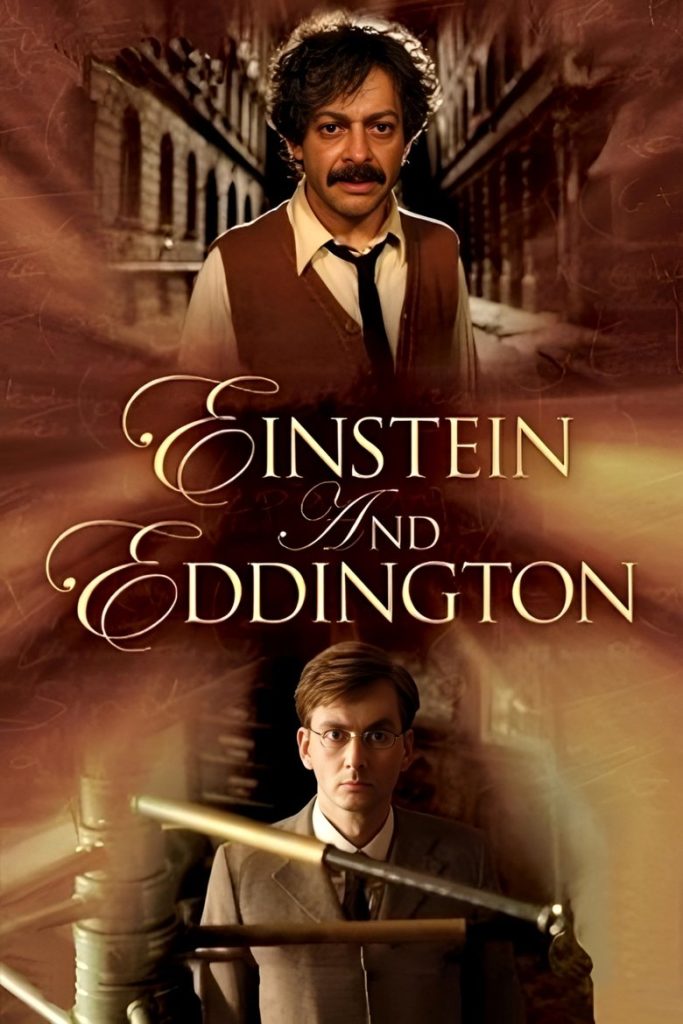
Story overview
This historical drama portrays the friendship between Albert Einstein and Arthur Eddington during World War I, focusing on their scientific collaboration that led to the development of the theory of relativity. Set against the backdrop of war, it explores themes of intellectual pursuit, international cooperation, and overcoming prejudice.
Parent Guide
Educational historical drama suitable for middle school children and up. Contains mature themes about war and scientific discovery but presented in an age-appropriate manner.
Content breakdown
References to World War I including discussions of casualties and war impacts. No graphic violence shown. Some tense moments related to wartime dangers and scientific challenges.
Mildly disturbing themes about war, prejudice, and the challenges of scientific discovery. Some emotional scenes showing the impact of war on families and communities.
No offensive language. Professional and academic dialogue throughout.
No sexual content or nudity. Focus is on professional relationships and intellectual collaboration.
No substance use shown. Social scenes may include background characters with drinks in formal settings.
Moderate emotional intensity related to wartime separation, scientific frustration, and overcoming prejudice. Characters experience professional and personal challenges but resolve them constructively.
Parent tips
This film is suitable for children ages 8 and up with parental guidance. The content is primarily intellectual and historical, with minimal concerning elements. Parents should be prepared to discuss the historical context of World War I, scientific concepts, and themes of friendship across enemy lines.
Parent chat guide
Parent follow-up questions
—
- What did you learn about scientists from this movie?
- How were Einstein and Eddington good friends?
- What is a theory in science?
- Why was it difficult for Einstein and Eddington to work together during the war?
- What evidence did Eddington need to prove Einstein's theory?
- How did prejudice affect the characters in the story?
- How does this film portray the relationship between science and politics?
- What ethical questions arise when scientists from warring nations collaborate?
- How accurate do you think the historical portrayal is, and why does that matter?
🎭 Story Kernel
At its core, 'Einstein and Eddington' is less about the physics of relativity and more about the human cost of intellectual courage. It dramatizes the collision between scientific truth and the social, political, and personal identities that resist it. Einstein is driven by an almost reckless compulsion to dismantle Newton's universe, a rebellion rooted in personal nonconformity. Eddington, a Quaker pacifist, is driven by a profound moral duty to seek objective truth, even when it means betraying nationalistic fervor during WWI. Their parallel journeys explore how the pursuit of a fundamental truth about the cosmos forces a painful re-evaluation of one's place in the world, community, and even one's own faith.
🎬 Visual Aesthetics
The film employs a stark visual dichotomy to mirror its thematic conflict. The Cambridge and London scenes are dominated by cool, muted greys, blues, and browns, with rigid, formal compositions reflecting the ordered, Newtonian world and the stifling weight of English tradition and wartime patriotism. In contrast, Zurich and Einstein's world are bathed in warmer, golden-hued light, with more handheld, intimate camerawork that feels chaotic and alive. Key visual metaphors are simple but powerful: the bending of light around the sun is visualized through Eddington's prism and the warped image of stars during the eclipse, serving as a direct visual representation of the theory literally reshaping their view of reality.
🔍 Details & Easter Eggs
💡 Behind the Scenes
David Tennant (Eddington) and Andy Serkis (Einstein) underwent significant preparation, with Serkis studying Einstein's mannerisms and Tennant exploring Quaker pacifism. The film was a BBC-HBO co-production, shot on location in Hungary and Croatia, which stood in for pre-WWI Zurich and Cambridge. Notably, the script takes dramatic license with timelines and personal relationships for narrative compression, such as simplifying the complex peer-review process and intensifying the immediate backlash to Eddington's eclipse findings. The solar eclipse sequences were created using a combination of period-accurate telescope props and digital effects.
Where to watch
Choose region:
- HBO Max
- HBO Max Amazon Channel