Elemental (2023)
Story overview
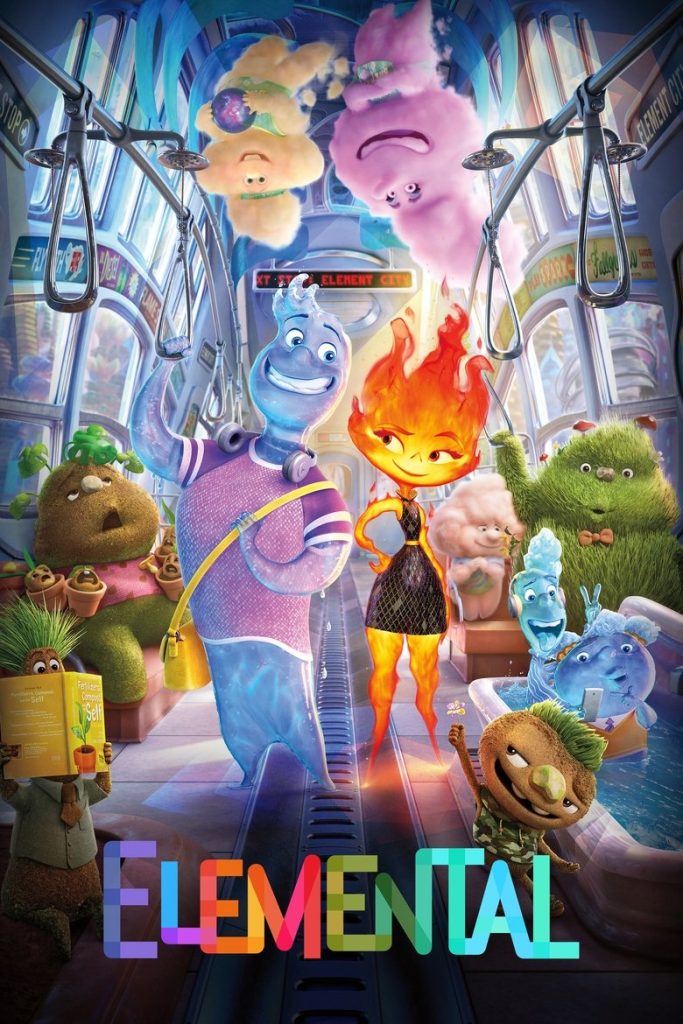
Elemental is a 2023 animated family film set in a vibrant city where residents made of fire, water, land, and air coexist. The story follows a fiery young woman and a laid-back water guy who discover unexpected connections despite their elemental differences. Through their journey, the film explores themes of diversity, acceptance, and finding common ground in a world of contrasts.
Parent Guide
A family-friendly animated film with positive messages about diversity and acceptance, suitable for most children with parental guidance.
Content breakdown
Some mild peril as characters face challenges related to their elemental differences, but no physical violence.
Mildly intense moments when characters face obstacles or emotional conflicts, but nothing truly frightening.
No offensive language or profanity.
No sexual content or nudity; includes mild romantic elements appropriate for family viewing.
No depiction of substance use.
Some emotional moments as characters navigate relationships and cultural differences, but handled gently.
Parent tips
Elemental is a charming animated film with a PG rating that makes it suitable for most children. The movie contains some mild peril and emotional moments as characters face challenges related to their elemental differences, but these are handled in a family-friendly way. Parents should be aware that the film explores themes of prejudice and cultural differences through its elemental metaphor, which could prompt discussions about acceptance and diversity.
Parent chat guide
Parent follow-up questions
- What was your favorite character?
- Did you like the colorful city?
- What was the funniest part?
- How did the characters help each other?
- Would you want to visit Element City?
- What did you learn about how different people can get along?
- How did the main characters overcome their differences?
- What challenges did the characters face because they were different?
- What does friendship mean in the movie?
- How did the characters show kindness to each other?
- What does the movie say about prejudice and stereotypes?
- How do the elemental differences represent real-world diversity?
- What sacrifices did characters make for their relationships?
- How does the film balance family expectations with personal dreams?
- What message about community did you take from the story?
- How does the film use metaphor to discuss social issues?
- What commentary does the movie make about intergroup relationships?
- How are generational differences portrayed in the film?
- What does the story suggest about balancing tradition with personal identity?
- How effectively does the film address themes of inclusion and belonging?
🎭 Story Kernel
Elemental is fundamentally a poignant allegory for the second-generation immigrant experience, wrapped in a vibrant rom-com shell. Beyond the surface-level romance between Ember Lumen and Wade Ripple, the narrative interrogates the weight of filial piety and the sacrificial debt children feel toward their parents. Ember’s struggle isn't just about controlling her temper; it’s about the internal combustion that occurs when personal desire clashes with the perceived duty to preserve a family legacy—represented by her father’s shop, the Fireplace. The film masterfully explores the 'elements don't mix' social dogma as a proxy for systemic segregation and xenophobia. By centering the story on the friction between Fire and Water, director Peter Sohn illustrates that integration isn't about losing one’s properties, but about creating a new, shared chemistry that allows for mutual flourishing without the erasure of cultural identity.
🎬 Visual Aesthetics
Visually, the film represents a monumental technical achievement for Pixar, moving away from traditional rigging toward complex, physics-based character models. Ember is not a character on fire; she is fire, a constant simulation of gaseous light and heat that reacts to her emotional state. This fluidity is mirrored in Wade’s refractive, translucent body, which requires intricate light-tracing to maintain its watery essence. Element City itself functions as a character, with its architecture reflecting a hierarchy where water-based infrastructure dominates, forcing the Fire residents into a marginalized, industrial ghetto. The use of color theory is deliberate: the warm, saturated oranges of Fire Town contrast sharply with the cool, transparent blues of the city center, visually reinforcing the social divide. The animation style uniquely blends 3D depth with a 2D-inspired aesthetic in the characters' expressive facial movements.
🔍 Details & Easter Eggs
💡 Behind the Scenes
Director Peter Sohn drew heavy inspiration from his own upbringing in the Bronx as the son of Korean immigrants, specifically reflecting on his parents' grocery store. The film’s development took seven years, largely due to the immense computational power required to render characters made entirely of volumetric effects. Pixar had to upgrade its render farm significantly, as Ember and Wade required over 150,000 cores to process. To achieve the unique look of the fire, the production team utilized machine learning to 'stylize' the simulation, ensuring Ember looked like an appealing character rather than a realistic, terrifying blaze.
Where to watch
Choose region:
- Disney Plus
- Amazon Video
- Apple TV
- Google Play Movies
- YouTube
- Fandango At Home
- Spectrum On Demand
Trailer
Trailer playback is unavailable in your region.