
Encanto (2021)
Story overview
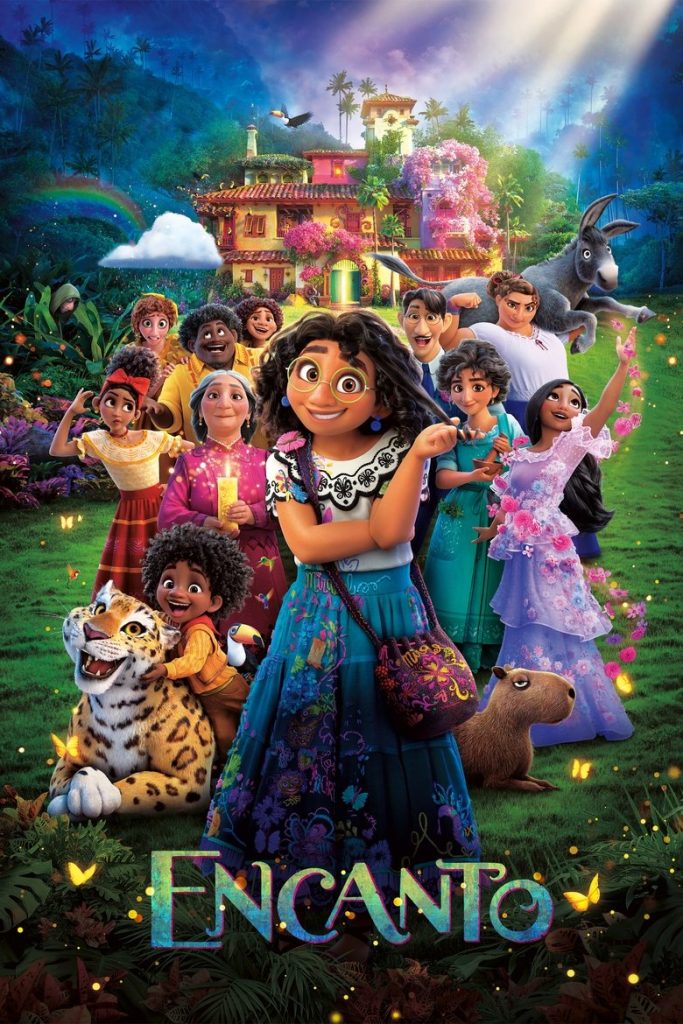
Encanto tells the story of the magical Madrigal family living in a hidden Colombian town. Each family member except Mirabel has received a unique magical gift. When the family's magic begins to fade, Mirabel must find a way to save her extraordinary family despite being the only ordinary member. The film explores themes of family pressure, self-worth, and embracing one's unique identity.
Parent Guide
Family-friendly animated musical with positive messages about acceptance and self-worth, best for elementary school ages and up.
Content breakdown
Some magical peril when the house cracks and appears unstable, but no physical violence between characters.
Mild tension during magical disruptions and family conflicts; some children might find the cracking house imagery slightly unsettling.
No offensive language; family-appropriate dialogue throughout.
No sexual content or nudity; characters are modestly dressed in family-appropriate clothing.
No depiction of alcohol, drugs, or tobacco use.
Moderate emotional moments related to family conflict, feelings of inadequacy, and pressure to be perfect; some scenes may be emotionally resonant for sensitive viewers.
Parent tips
Encanto is a vibrant, family-friendly film with positive messages about acceptance and family bonds. The PG rating primarily reflects some emotional intensity and moments of family conflict that might be challenging for very young viewers. The film includes magical elements and fantasy sequences that are generally mild but could be confusing or slightly unsettling for preschoolers.
Parents should be aware that the film deals with themes of family pressure, feelings of inadequacy, and intergenerational trauma in an age-appropriate way. There are moments of tension when the magical house cracks and appears to be in danger, and some family arguments that might mirror real-life sibling or parent-child conflicts. The overall tone remains hopeful and ultimately uplifting.
Parent chat guide
For younger children, you might emphasize the colorful animation and musical elements, while older children can explore deeper themes about family expectations and self-worth. The film provides excellent opportunities to discuss how every family member contributes in different ways and how to handle feelings of being different or left out.
Parent follow-up questions
- What was your favorite magical power in the movie?
- How did Mirabel help her family?
- What colors did you like best in the movie?
- How do you think the house felt when it was cracking?
- What made you happy in the story?
- Why do you think Mirabel felt left out sometimes?
- How did the family members learn to work together better?
- What does it mean to be 'special' in different ways?
- How did the characters show they cared about each other?
- What would you do if you felt different from your family?
- What pressures do you think the Madrigal family members felt to be perfect?
- How does the film show that everyone has strengths, even without magic?
- What lessons about family communication did the characters learn?
- How did the setting of Colombia influence the story?
- What does the film say about accepting people for who they are?
- How does the film explore intergenerational trauma and family expectations?
- What commentary does the movie make about perfectionism and family pressure?
- How do the magical elements serve as metaphors for family dynamics?
- What cultural values are reflected in the Madrigal family's story?
- How does the resolution challenge traditional notions of 'special' or 'gifted' individuals?
🎭 Story Kernel
Encanto explores intergenerational trauma through the Madrigal family's magical gifts, which function as both blessings and burdens. The real conflict isn't about losing magic, but about the suffocating pressure to maintain perfection that fractures relationships. Mirabel's journey reveals that true strength lies in vulnerability—the family's foundation cracks not from weakness, but from unspoken expectations and emotional suppression. The film critiques how families often value utility over authenticity, showing that healing begins when we acknowledge our broken parts rather than hiding them behind miraculous facades.
🎬 Visual Aesthetics
The animation employs a vibrant Colombian color palette that shifts with emotional tones—the warm golds of Casita contrast with cooler blues during tense moments. Camera movements mimic musical rhythms, with sweeping pans during musical numbers and intimate close-ups during vulnerable conversations. Visual symbolism appears throughout: the cracks in the house mirror emotional fractures, while the candle's flame represents both family legacy and precarious pressure. The magical rooms physically manifest each character's inner world, with Isabela's perfect garden becoming wonderfully chaotic when she embraces her true self.
🔍 Details & Easter Eggs
💡 Behind the Scenes
Lin-Manuel Miranda wrote eight songs in just two weeks after visiting Colombia, incorporating specific regional rhythms like bambuco and vallenato. The animators studied Colombian architecture in Cartagena and Salento for Casita's design. Voice actor Stephanie Beatriz (Mirabel) intentionally sang slightly off-key during 'Waiting on a Miracle' to reflect her character's feeling of not measuring up. The film's magic system was inspired by magical realism traditions of Colombian literature.
Where to watch
Choose region:
- Disney Plus
- fuboTV
- Amazon Video
- Apple TV
- Google Play Movies
- YouTube
- Fandango At Home
Trailer
Trailer playback is unavailable in your region.