
Enchanted (2007)
Story overview
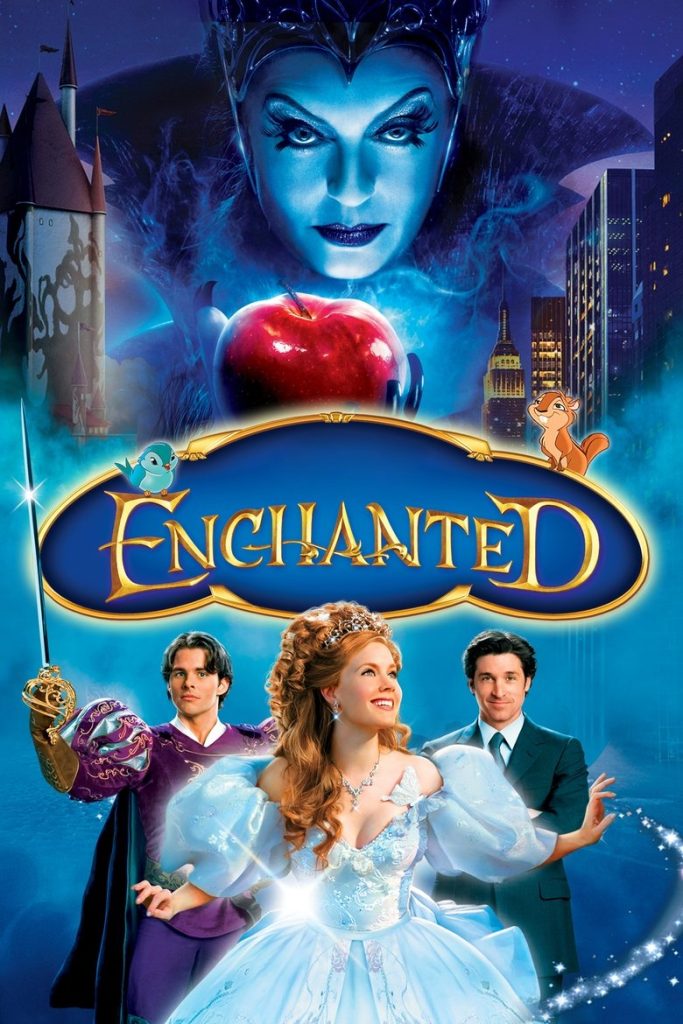
Enchanted (2007) is a delightful family film that blends animated fantasy with live-action comedy. Princess Giselle is banished from her fairy tale world to modern-day Manhattan, where she navigates the real world's complexities while questioning her storybook ideals of love and romance. The film playfully satirizes Disney tropes while celebrating their charm, featuring musical numbers, humor, and a heartwarming message about finding happiness beyond perfect fairy tales.
Parent Guide
Enchanted is a family-friendly film suitable for most ages, with minimal content concerns. It combines light humor, musical fantasy, and positive messages. Best for ages 6 and up due to mild peril and some romantic themes.
Content breakdown
Cartoonish fantasy violence: a dragon chase in Central Park, characters swinging swords, and a brief battle. No graphic injuries; all scenes are playful and non-threatening. Mild peril when characters are in danger (e.g., falling from heights), but resolved safely.
The evil queen transforms into a dragon, which might be slightly intense for very young viewers. Some suspenseful moments during chase scenes. No gore or realistic violence; all elements are fantastical and humorous.
No profanity or offensive language. Dialogue is clean and family-appropriate, with mild insults like 'fool' in a fairy tale context.
Romantic themes include kissing between characters and discussions of love. No nudity or sexual content. Giselle wears a modest wedding-style dress; other attire is typical for a family film.
No depiction of alcohol, drugs, or smoking. Characters drink non-alcoholic beverages in social settings.
Light emotional moments related to romance and family (e.g., Giselle's longing for home, Robert bonding with his daughter). Happy ending with minimal sadness. The tone is generally upbeat and comedic.
Parent tips
Enchanted is excellent for family viewing with minimal concerns. The PG rating primarily reflects mild peril and fantasy violence, such as cartoonish battles with a dragon. The film includes romantic themes (kissing, discussions of love) but no sexual content. Some scenes might be slightly intense for very young children (e.g., the dragon chase). It's a great opportunity to discuss themes like adapting to new environments, realistic vs. idealized love, and kindness. The musical numbers and humor appeal to all ages.
Parent chat guide
Parent follow-up questions
- What animals did Giselle talk to?
- Did you like the singing parts?
- How did Giselle make friends in the city?
- Why was the queen mean to Giselle?
- What was different about New York compared to Andalasia?
- How did Giselle and Robert help each other?
- How does the movie make fun of fairy tale clichés?
- What does 'happily ever after' mean in real life?
- Why did Giselle choose Robert over Edward?
- How does the film critique traditional gender roles in fairy tales?
- What does the blending of animation and live-action symbolize?
- Discuss the theme of 'enchantment' in a modern context.
🎭 Story Kernel
The film's true core is a meta-commentary on the clash between naive idealism and cynical realism, and the synthesis that creates a more mature, grounded form of love. Giselle's journey isn't about finding a prince, but about evolving from a two-dimensional archetype into a complex human being. Her initial belief in 'true love's kiss' as a universal solution is challenged by the messy realities of New York City—divorce, skepticism, and genuine emotional labor. The central conflict is internal: can the purity of animated fantasy survive contact with the real world, or must it adapt? The answer is a resounding 'adapt,' as both Giselle and Robert learn from each other's worlds, creating a new, hybrid definition of happiness that honors both dreams and responsibility.
🎬 Visual Aesthetics
The film's visual language masterfully codes its thematic conflict. Andalasia is rendered in lush, saturated 2D animation, with soft edges, impossible physics, and a constant golden-hour glow, representing a world of pure emotion and narrative simplicity. New York, in stark contrast, is captured in gritty, handheld live-action with a desaturated, blue-gray palette, emphasizing concrete reality and chaos. The transition is jarring, visually underscoring Giselle's disorientation. Symbolism is direct but effective: Giselle's initially garish wedding gown visually pollutes Robert's sleek, monochrome apartment, a clash of values. The climax's visual fusion—a live-action dragon in a real-world Times Square—is the ultimate metaphor: the fantastical must be integrated into, not escape from, reality.
🔍 Details & Easter Eggs
💡 Behind the Scenes
Amy Adams studied classic Disney heroines like Snow White and Cinderella to perfect Giselle's animated mannerisms before 'de-programming' them for the live-action scenes. James Marsden (Prince Edward) performed all his own stunts, including the parkour-esque roof jump. The iconic 'Happy Working Song' sequence required 400 live animals (rats, pigeons, cockroaches) on set, with the cockroaches being specially bred, non-pest species. Director Kevin Lima fought to keep the song's darkly comic lyrics about using bleach, arguing it was essential to the film's edge.
Where to watch
Choose region:
- Disney Plus
- Amazon Video
- Apple TV Store
- Google Play Movies
- YouTube
- Fandango At Home
Trailer
Trailer playback is unavailable in your region.