
Everybody’s Fine (2009)
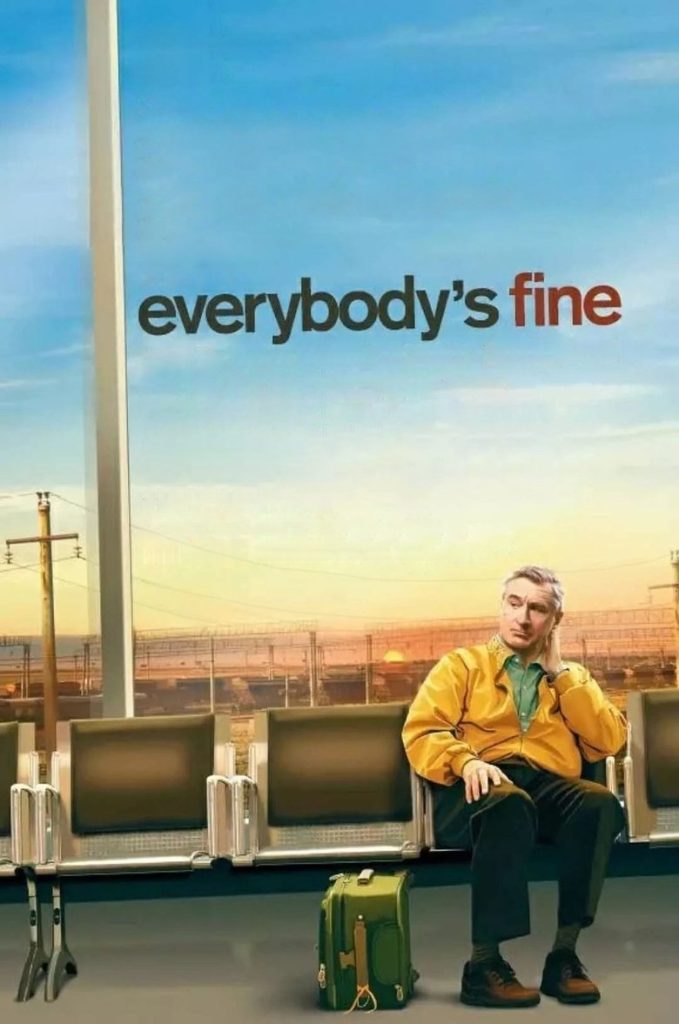
Story overview
A widowed father embarks on a cross-country journey to reconnect with his adult children after they cancel a planned family visit, discovering their lives are more complicated than they've led him to believe.
Parent Guide
A thoughtful family drama about communication, expectations, and aging parents. Most appropriate for mature tweens and teens who can appreciate nuanced emotional themes.
Content breakdown
No violence or physical peril. Some emotional tension as characters confront difficult truths.
Mild emotional intensity related to family conflict and disappointment. Some scenes show characters in emotional distress.
Occasional mild profanity (e.g., 'hell', 'damn'). One use of 's--t' in an emotional moment.
No sexual content or nudity. Some brief references to adult relationships.
Social drinking by adults in restaurants and homes. No drunkenness or substance abuse depicted.
Significant emotional themes including grief, family disappointment, and the gap between expectations and reality. Several emotionally charged scenes as characters confront difficult truths.
Parent tips
This emotional drama deals with family relationships, grief, and honesty. It's suitable for mature children who can handle themes of parental disappointment and adult struggles. The PG-13 rating comes primarily from thematic elements and brief strong language.
Parent chat guide
Parent follow-up questions
—
- Why do you think the children didn't want their dad to visit?
- How did Frank feel when he learned the truth about his children?
- What does this movie say about family expectations versus reality?
- How do the children's different approaches to dealing with their father reflect their personalities?
- How does the film explore the tension between parental expectations and adult children's autonomy?
- What commentary does the movie make about modern family communication and emotional honesty?
🎭 Story Kernel
At its core, 'Everybody's Fine' explores the painful gap between familial expectations and reality. Frank's pilgrimage isn't about visiting his children—it's about confronting the curated versions of themselves they've presented to spare him disappointment. Each child represents a different coping mechanism: David's avoidance, Amy's perfectionism, Robert's superficial success, and Rosie's hidden struggles. The film argues that love often manifests as protective deception, creating emotional distance where intimacy should thrive. Frank's realization that his children's 'fine' masks profound unhappiness becomes a meditation on how parental pride can become a cage, and how truth—however painful—is the only path to genuine connection.
🎬 Visual Aesthetics
The cinematography masterfully mirrors Frank's emotional journey through deliberate visual choices. Early scenes feature symmetrical compositions and controlled color palettes reflecting his orderly, isolated life. As he travels, the camera becomes more handheld and reactive, mirroring his growing disorientation. The American landscape transitions from picturesque postcard views to increasingly bleak industrial backdrops, visually tracking his disillusionment. Notice how Frank is frequently framed through windows, barriers, or at a distance from his children—literal visualizations of emotional separation. The final hospital scene uses stark white lighting and tight close-ups to strip away all artifice, forcing raw confrontation.
🔍 Details & Easter Eggs
💡 Behind the Scenes
Robert De Niro prepared for his role as Frank by spending time with retired factory workers to understand their physicality and speech patterns. The cross-country train sequences were filmed on actual Amtrak routes to capture authentic American landscapes. Director Kirk Jones intentionally cast actors who physically resembled De Niro as his adult children to enhance familial believability. The film is an American remake of Giuseppe Tornatore's 1990 Italian film 'Stanno tutti bene,' with significant cultural adaptations for U.S. audiences while maintaining the core emotional journey.
Where to watch
Choose region:
- Netflix
- fuboTV
- Netflix Standard with Ads
- Amazon Video
- Apple TV Store
- Google Play Movies
- YouTube
- Fandango At Home
Trailer
Trailer playback is unavailable in your region.