
Famous Last Words: Dr. Jane Goodall (2025)
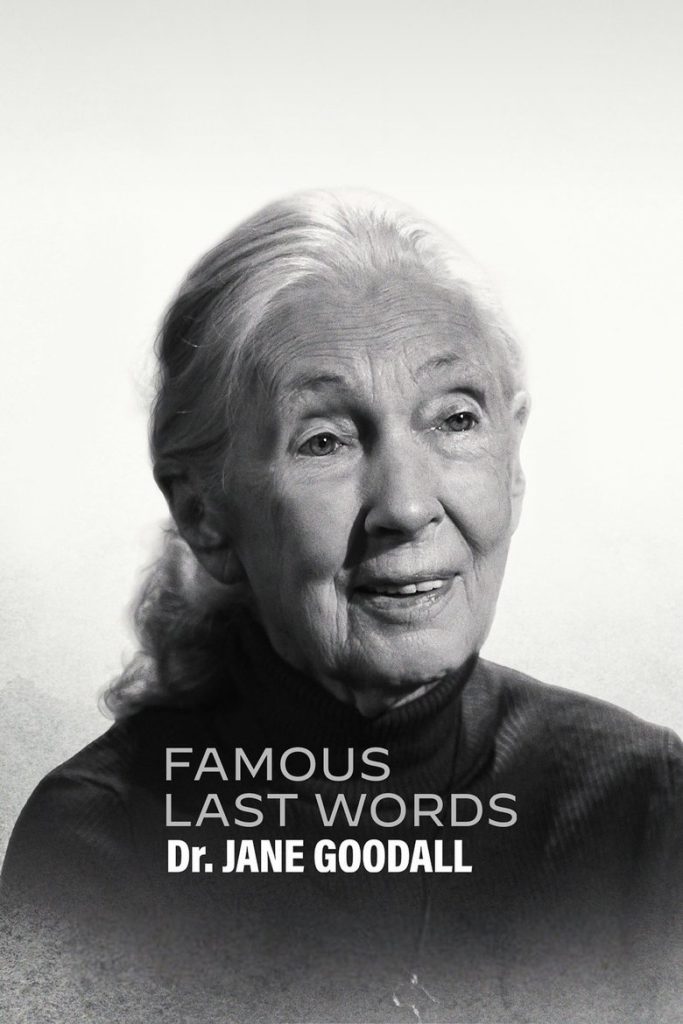
Story overview
This documentary features a personal interview with renowned primatologist and conservationist Dr. Jane Goodall, where she shares her final message to humanity. The film focuses on her lifelong work connecting humans with nature, her scientific discoveries about chimpanzees, and her reflections on environmental stewardship. It presents her insights in a calm, reflective manner without dramatic reenactments or sensationalized content.
Parent Guide
A gentle, educational documentary suitable for all ages. The content is entirely appropriate for children, focusing on scientific discovery, nature appreciation, and environmental stewardship. The interview format is calm and reflective without any concerning elements.
Content breakdown
No violence or peril depicted. The documentary consists of interview footage and archival materials showing peaceful animal behavior and scientific observation.
Nothing scary or disturbing. The tone is consistently calm, educational, and inspirational. Archival footage shows animals in natural settings without any frightening sequences.
No offensive language. The interview features respectful, academic language appropriate for all audiences.
No sexual content or nudity. The documentary focuses entirely on scientific and environmental topics.
No depiction of substance use. The content is purely educational about nature and conservation.
Mild emotional moments when Dr. Goodall discusses environmental concerns or reflects on her life's work, but these are presented in a measured, thoughtful way rather than being emotionally overwhelming.
Parent tips
This documentary is suitable for most children who can sit through a 55-minute interview format. The content is educational and inspirational, focusing on nature, science, and environmental responsibility. Younger children might find the talking-head format less engaging, but the subject matter is universally appropriate. Consider watching together to discuss Dr. Goodall's important messages about conservation.
Parent chat guide
Parent follow-up questions
- Did you like seeing the animals?
- What was your favorite animal in the movie?
- Do you think monkeys are like people?
- How can we be nice to animals?
- What did Dr. Goodall discover about chimpanzees?
- Why is it important to study animals in the wild?
- What tools did she use to study the chimpanzees?
- How did she live in the forest with the animals?
- How did Dr. Goodall's methods change scientific research?
- What challenges did she face as a woman scientist in the 1960s?
- What environmental problems does she discuss?
- How can individuals make a difference in conservation?
- What ethical considerations arise from studying animals in their natural habitat?
- How has our understanding of animal intelligence evolved since Goodall's early work?
- What systemic changes does she suggest for environmental conservation?
- How does her work bridge science and activism?
Where to watch
Choose region:
- Netflix
- Netflix Standard with Ads