
Finding Dory (2016)
Story overview
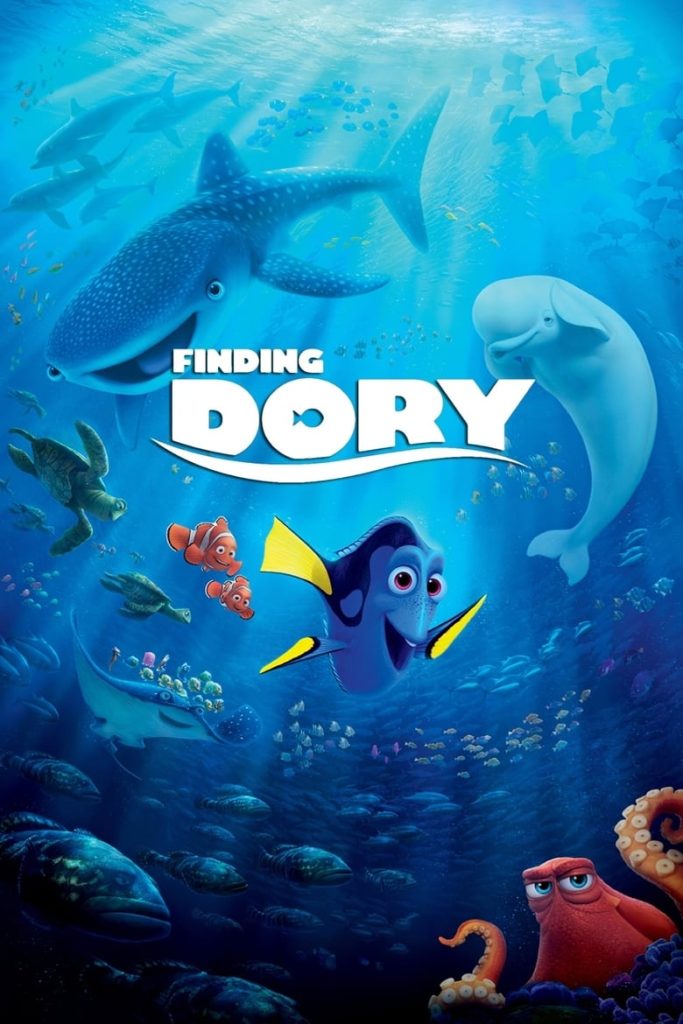
Finding Dory follows the friendly but forgetful blue tang fish Dory as she embarks on a journey to reconnect with her past. With help from her friends Marlin and Nemo, she travels across the ocean to find her family while relying on her unique abilities. The film explores themes of friendship, family bonds, and overcoming challenges through determination and support from loved ones.
Parent Guide
A family-friendly animated adventure with positive messages about friendship and perseverance, though some sequences may be moderately intense for very young viewers.
Content breakdown
Some sequences of marine animals in peril, including being chased, trapped, or in dangerous situations. No graphic violence, but tension is created through these scenarios.
Brief moments that might be startling or concerning for sensitive children, including scenes of separation and disorientation. Nothing graphic or prolonged.
No offensive language. Some mild expressions of frustration appropriate for family viewing.
No sexual content or nudity.
No depiction of substance use.
Themes of separation from family, memory loss, and moments of uncertainty create emotional weight. The overall resolution is positive and uplifting.
Parent tips
Finding Dory is a heartwarming sequel that maintains the positive messages of friendship and perseverance from the original film. Parents should be aware that while most of the content is gentle and appropriate for family viewing, there are some moderately intense sequences involving marine animals in peril, separation anxiety themes, and brief moments of comic tension that might concern very young or sensitive viewers.
The film's PG rating reflects these elements, which are handled with care but could be emotionally impactful for children who identify strongly with the characters' struggles. The overall tone remains hopeful and uplifting, with strong emphasis on family reunion and the importance of accepting differences.
Parent chat guide
After the movie, focus conversations on the positive themes: How did Dory's friends help her? What did you learn about being patient with people who are different? How did the characters show kindness even when things were difficult? These discussions can help reinforce the film's messages about empathy and perseverance.
Parent follow-up questions
- What was your favorite fish in the movie?
- How did Dory's friends help her?
- What made you laugh during the film?
- How did Dory feel when she couldn't remember things?
- What was the happiest part for you?
- Why do you think Dory kept trying even when things were hard?
- How did the different sea creatures work together?
- What did you learn about being a good friend from this movie?
- How did the characters show they cared about each other?
- What would you do if you couldn't find your family like Dory?
- How does the movie show that being different can be a strength?
- What challenges did Dory face because of her memory, and how did she overcome them?
- How did the theme of family go beyond just biological relatives in this story?
- What did you think about the way the characters handled scary situations?
- How does this film compare to other stories about finding where you belong?
- How does the film portray disability or difference in a positive way?
- What commentary does the movie make about institutional systems (like the aquarium)?
- How do the themes of memory and identity connect in Dory's journey?
- In what ways does the film use humor to address serious topics?
- How does the ocean setting serve as more than just a backdrop for the story?
🎭 Story Kernel
Finding Dory subverts the typical hero's journey by centering a protagonist whose disability—short-term memory loss—isn't cured but integrated into her heroism. While Finding Nemo explored parental anxiety, Dory examines identity formation when one's own mind feels like a foreign country. The film argues that our essence isn't stored in memories but in persistent character traits that survive memory gaps. Dory's journey isn't about remembering but about recognizing patterns of behavior that define her across time. Her parents' shell trail represents not just a physical path home but a philosophy: when memory fails, create systems that honor who you are at your core.
🎬 Visual Aesthetics
Pixar's aquatic palette evolves from Nemo's vibrant reef to Dory's muted institutional blues and grays at the Marine Life Institute, visually representing her disorientation. The camera adopts Dory's perspective during memory flashes—swirling, fragmented shots that mimic her cognitive experience. The octopus Hank's camouflage isn't just spectacle but visual metaphor for adaptability. Most striking is the kelp forest sequence, where towering plants create both maze and sanctuary, shot with ominous verticality that contrasts with the ocean's usual horizontality. The institute's sterile tanks versus the ocean's organic chaos visually reinforces the film's tension between institutional safety and wild self-discovery.
🔍 Details & Easter Eggs
💡 Behind the Scenes
Ellen DeGeneres reportedly waited 13 years to voice Dory again, joking she'd 'been waiting longer than Dory remembers.' The Marine Life Institute was modeled after Monterey Bay Aquarium, where animators studied real octopus locomotion for Hank. Director Andrew Stanton reversed his Nemo approach: instead of researching fish then creating characters, he developed Dory's emotional journey first, then built the aquatic world around it. The memory flash sequences required new rendering techniques to achieve their watery, unstable quality.
Where to watch
Choose region:
- Disney Plus
- fuboTV
- Amazon Video
- Apple TV
- Google Play Movies
- YouTube
- Fandango At Home
Trailer
Trailer playback is unavailable in your region.