
Flight of the Navigator (1986)
Story overview
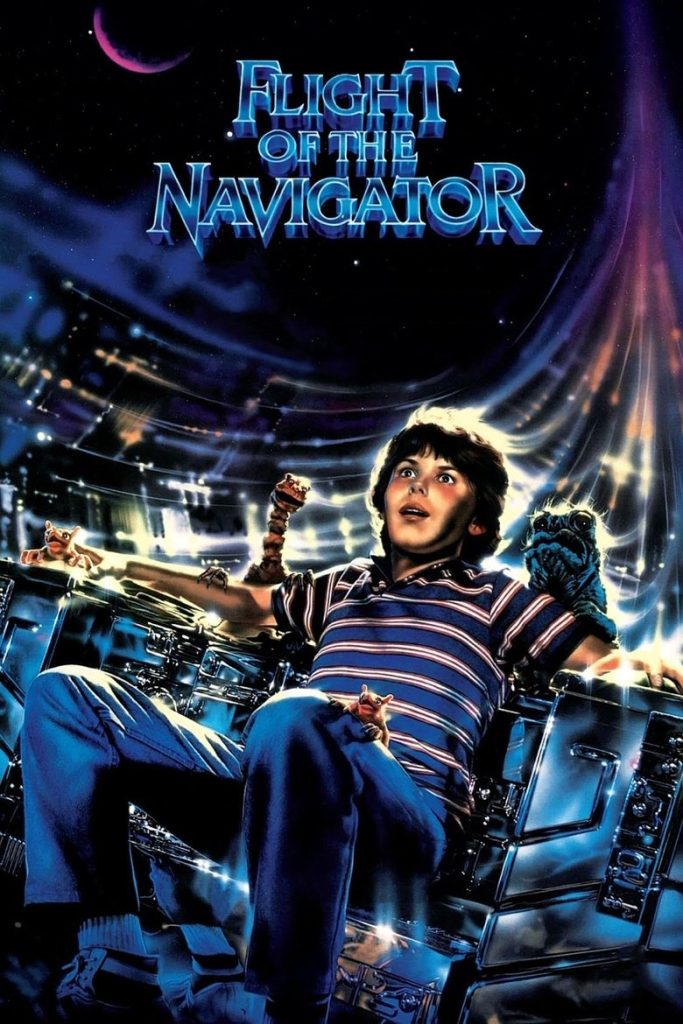
Flight of the Navigator is a 1986 family sci-fi adventure about 12-year-old David who wakes up after being knocked unconscious to find that eight years have passed, yet he hasn't aged. With his family confused but overjoyed, David discovers a connection to a nearby UFO and embarks on a journey with a friendly alien AI named Max to solve the mystery of his lost time and return to his rightful place in the timeline.
Parent Guide
A family-friendly sci-fi adventure with mild peril and positive messages about curiosity and family. Suitable for most children with some guidance for younger viewers on time-travel concepts.
Content breakdown
Some chase scenes with government agents, David being pursued and hiding. Mild tension when David is lost in time and separated from family. No physical violence or injuries shown.
Brief moments when David wakes up in a changed world and doesn't recognize his family. The alien spaceship design is friendly, not frightening. Some suspense during escape sequences but resolved quickly.
No offensive language. Clean family-appropriate dialogue throughout.
No sexual content or nudity. Family relationships are portrayed platonically.
No depiction of alcohol, drugs, or smoking.
Emotional moments when David reunites with his family and deals with being out of time. Some confusion and displacement feelings, but overall positive resolution.
Parent tips
This classic 80s sci-fi film offers positive themes of family bonds, curiosity, and friendship with alien technology. The time-travel concept may be confusing for younger viewers, but the adventure is generally lighthearted. Some mild peril scenes involve government agents chasing the protagonist and brief moments of tension as David navigates being displaced in time. The friendly alien ship and its humorous AI provide comic relief. Good for family discussions about time, space, and belonging.
Parent chat guide
Parent follow-up questions
- Did you like the spaceship? What was your favorite part?
- Was David brave when he flew in the spaceship?
- How did David's family feel when he came back?
- Why do you think David didn't age when eight years passed?
- What would you do if you found a friendly alien spaceship?
- How did Max the computer help David?
- What does the movie show about how people treat things they don't understand?
- How did David handle being out of place in time?
- What responsibilities come with advanced technology like the spaceship?
- How does the film portray government interest in alien technology?
- What ethical questions does the time displacement raise?
- How does the 1980s setting influence the story's approach to sci-fi themes?
🎭 Story Kernel
At its heart, 'Flight of the Navigator' explores the profound dislocation of being out of sync with your own life. David Freeman's eight-year disappearance isn't just a sci-fi plot device; it's a metaphor for the jarring experience of childhood's end. While physically unchanged, he returns to a world where his little brother is now taller, his parents have aged, and his childhood dog is gone. The film suggests that growing up itself can feel like an alien abduction—you wake up one day in a familiar place that has become foreign. David's journey isn't about escaping Earth, but about reclaiming his place in a timeline that moved on without him, ultimately finding that connection, not chronology, defines home.
🎬 Visual Aesthetics
The film masterfully uses visual contrast to underscore its themes of displacement. David's 1978 suburban Florida is bathed in warm, sun-drenched colors—a nostalgic, almost tangible summer. This sharply contrasts with the sleek, cool blues and sterile whites of the NASA facility and the interior of the Trimaxion ship. The camera often adopts David's low-angle perspective, emphasizing his smallness against adult institutions and technology. The ship itself, with its organic, almost living interior of pulsating lights and smooth curves, feels more like a sanctuary than a machine, visually opposing the harsh, angular, and invasive environment of the human scientists trying to dissect it.
🔍 Details & Easter Eggs
💡 Behind the Scenes
The voice of Max, the ship's AI, was provided by Paul Reubens, best known as Pee-wee Herman, who recorded his lines in just four hours. The iconic silver suit worn by David was not just for show; it contained cooling tubing to combat the heat from the set lights inside the full-scale ship model. The film was a pioneer in CGI, with the 'jump to light speed' sequence being one of the first uses of 3D computer graphics in a live-action film. Interestingly, the young actor, Joey Cramer, who played David, had no prior acting experience and was discovered by a casting director at his school.
Where to watch
Choose region:
- Disney Plus
- Apple TV Store
- Fandango At Home
Trailer
Trailer playback is unavailable in your region.