Flow (2024)
Story overview
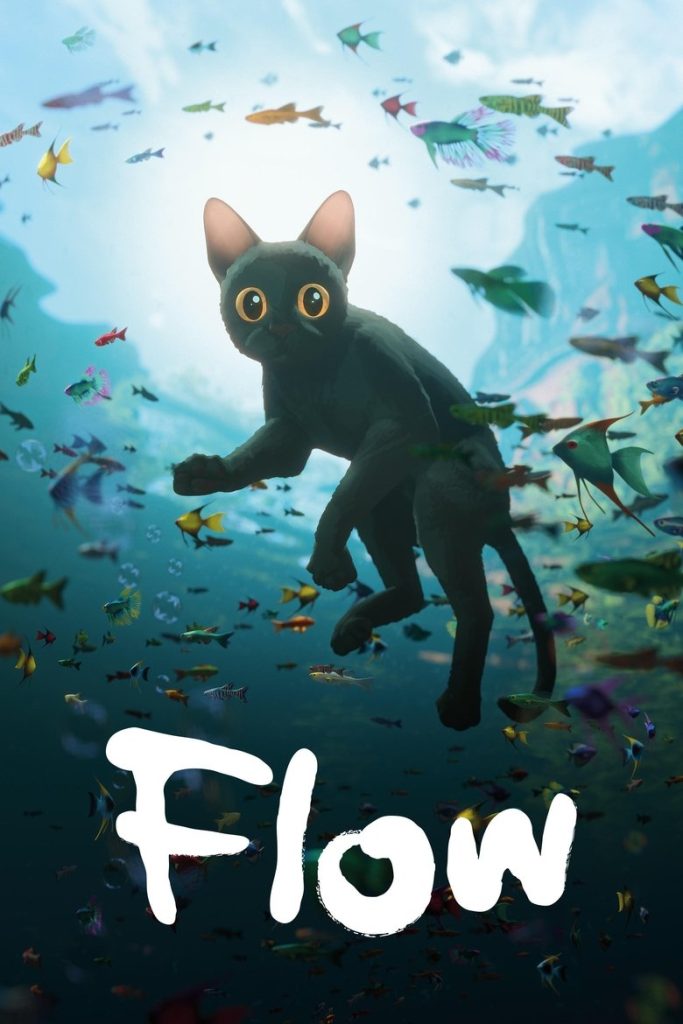
Flow is an animated adventure about a cat who loses its home in a massive flood. The cat finds safety on a boat with other animals and must learn to survive in a changed world. Together, they face challenges and discover the importance of cooperation and adaptation.
Parent Guide
A gentle animated adventure about animals adapting to environmental changes, suitable for most children with some mild emotional moments.
Content breakdown
Some scenes of animals in peril due to flooding and survival challenges, but no graphic violence.
The flood and displacement might be slightly unsettling for very young viewers, but presented in a non-graphic way.
The film has no dialogue, so no language concerns.
No sexual content or nudity.
No substance use depicted.
Some emotional moments related to loss of home and adaptation, but generally gentle and hopeful.
Parent tips
Flow is a gentle, dialogue-free animated film that explores themes of displacement, resilience, and community. The PG rating likely reflects some mild peril and emotional moments related to the flood and survival challenges. The film's visual storytelling makes it accessible to younger viewers while offering thoughtful themes for discussion about environmental changes and helping others.
Parent chat guide
Parent follow-up questions
- How did the cat feel when it lost its home?
- What animals did the cat meet on the boat?
- How did the animals help each other?
- What was your favorite part of the movie?
- Would you like to be friends with the cat?
- Why do you think the cat was alone at first?
- How did the animals work together to survive?
- What challenges did they face in the new world?
- What did the cat learn from its journey?
- How would you feel if your home changed suddenly?
- What does this film show about adapting to change?
- How did the flood affect the animals' lives?
- What does the story suggest about community and cooperation?
- How might this relate to real-world environmental changes?
- What strengths did the cat develop during its journey?
- What themes about displacement and resilience does this film explore?
- How does the visual storytelling convey emotions without dialogue?
- What commentary might the film offer about environmental adaptation?
- How do the characters' relationships evolve throughout their journey?
- What broader messages about interdependence does the story suggest?
🎭 Story Kernel
At its core, Flow is a survivalist fable that strips away the crutch of human language to explore the raw mechanics of empathy and cooperation. When a catastrophic flood erases the boundaries of the known world, a solitary, fiercely independent black cat is forced into an uneasy alliance with a motley crew of animals—a zen-like capybara, a hoarding lemur, a cheerful golden retriever, and a wounded secretary bird. The film moves beyond a simple ecological warning, delving into the psychological shift from self-preservation to collective responsibility. It examines how trauma and environmental collapse can dissolve natural hierarchies, forcing disparate souls to navigate a literal and metaphorical current where the only alternative to unity is extinction. It is a story about finding a new definition of home when the physical world is washed away.
🎬 Visual Aesthetics
Zilbalodis employs a breathtaking, fluid cinematography style that mimics a restless, handheld camera, creating an immersive sensation that tethers the viewer to the animals' eye level. The aesthetic eschews hyper-realism for a painterly, stylized 3D look where light and water physics dictate the emotional temperature of every scene. The absence of anthropomorphic dialogue forces the visual storytelling to rely on subtle body language and environmental cues. Symbolism is woven into the landscape, with the remnants of human architecture serving as haunting, silent monuments to a vanished world. The use of scale—placing small creatures against vast, churning horizons—emphasizes the vulnerability of life, while the vibrant color palette shifts from the lush greens of a dying world to the ethereal, misty blues of the unknown, creating a dreamlike yet perilous atmosphere.
🔍 Details & Easter Eggs
💡 Behind the Scenes
Following the success of his debut feature Away, which he famously animated entirely by himself, Gints Zilbalodis expanded his scope for Flow by collaborating with a small team of animators and a co-writer, Matīss Kaža. Despite the larger production scale, Zilbalodis maintained his unique workflow, acting as director, cinematographer, and composer. The film made a significant impact at the 2024 Cannes Film Festival in the Un Certain Regard section, where it was praised for its technical innovation and emotional depth. It was subsequently selected as Latvia's official entry for the Best International Feature Film at the 97th Academy Awards.
Where to watch
Choose region:
- HBO Max
- HBO Max Amazon Channel
- Amazon Video
- Apple TV
- Google Play Movies
- YouTube
- Fandango At Home
Trailer
Trailer playback is unavailable in your region.