
Flowers and Trees (1932)
Story overview
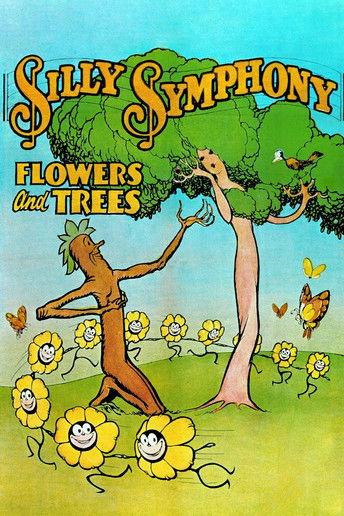
Flowers and Trees is a classic animated short film from 1932 that tells a simple nature-themed story. It depicts a forest setting where two trees fall in love, but a jealous stump tries to interfere by starting a fire. The conflict resolves when rain extinguishes the flames, allowing the forest to recover and celebrate with a wedding. This early Disney production combines music, romance, and light comedy in a brief eight-minute runtime.
Parent Guide
A gentle, classic animated short with mild peril and positive resolution, suitable for most children with parental guidance for very young viewers.
Content breakdown
Brief forest fire scene shows peril to trees, but no characters are harmed and rain resolves the situation.
The fire scene might be slightly intense for very sensitive children, but it's stylized and quickly resolved.
No dialogue or written language in this musical animation.
No sexual content; romantic elements are portrayed through trees dancing and celebrating.
No depiction of substance use.
Mild emotional moments related to jealousy and peril, balanced with joyful celebration.
Parent tips
This short film is generally appropriate for most children, featuring mild peril when the forest fire occurs. The animation style is vintage and may appear dated to modern viewers, but the story remains accessible. Parents should note that the fire scene, while brief and stylized, could be slightly intense for very young or sensitive children, though it resolves positively with rain saving the forest.
Parent chat guide
Parent follow-up questions
- What was your favorite part of the forest?
- How did the rain help the trees?
- What colors did you see in the flowers?
- Why do you think the stump was jealous?
- How did the trees show they cared about each other?
- What did you notice about how the forest changed?
- What message do you think the film gives about handling jealousy?
- How does the music help tell the story without words?
- What makes this animation style different from modern cartoons?
- How does this early animation reflect storytelling values of its time?
- What environmental themes might be interpreted from the forest fire and recovery?
- How does the film use personification to create emotional connections with nature?
🎭 Story Kernel
At its core, 'Flowers and Trees' explores the primal struggle between beauty and destruction, using anthropomorphized flora to depict a timeless battle. The driving force isn't complex character motivation but elemental conflict: life versus decay, harmony versus chaos. The young tree's courtship of the female tree represents natural order and renewal, while the gnarled old stump embodies entropy and resentment. This isn't merely a love story but an ecological allegory where survival depends on collective action against a common threat. The film suggests that even in nature's peaceful realm, vigilance and unity are necessary to preserve beauty against destructive forces.
🎬 Visual Aesthetics
As the first full-color cartoon in the Technicolor three-strip process, 'Flowers and Trees' revolutionized animation aesthetics. The color palette bursts with vibrant greens, pinks, and blues that create emotional resonance—warm hues during romantic sequences, ominous dark tones as the fire approaches. The camera language employs sweeping pans across the forest canopy and intimate close-ups on expressive floral faces. Action unfolds through graceful ballet-like movements during courtship scenes, contrasted with frantic, jagged animation as fire spreads. Symbolism emerges through visual contrasts: the straight, healthy trees versus the twisted, decaying stump; the gentle swaying of blossoms versus the violent crackling of flames.
🔍 Details & Easter Eggs
💡 Behind the Scenes
Produced by Walt Disney Productions in 1932, 'Flowers and Trees' was originally being created in black-and-white when Disney saw tests of the new three-strip Technicolor process. He ordered the nearly completed film scrapped and completely re-animated in color, despite significant cost overruns. This gamble paid off when it won the first Academy Award for Best Animated Short Film. The musical score incorporates classical pieces by Mendelssohn and Schubert, adapted by composer Frank Churchill. The film's success single-handedly convinced Disney to produce all future Silly Symphonies in color, fundamentally changing animation history.
Where to watch
Choose region:
- Disney Plus