
For the Birds (2000)
Story overview
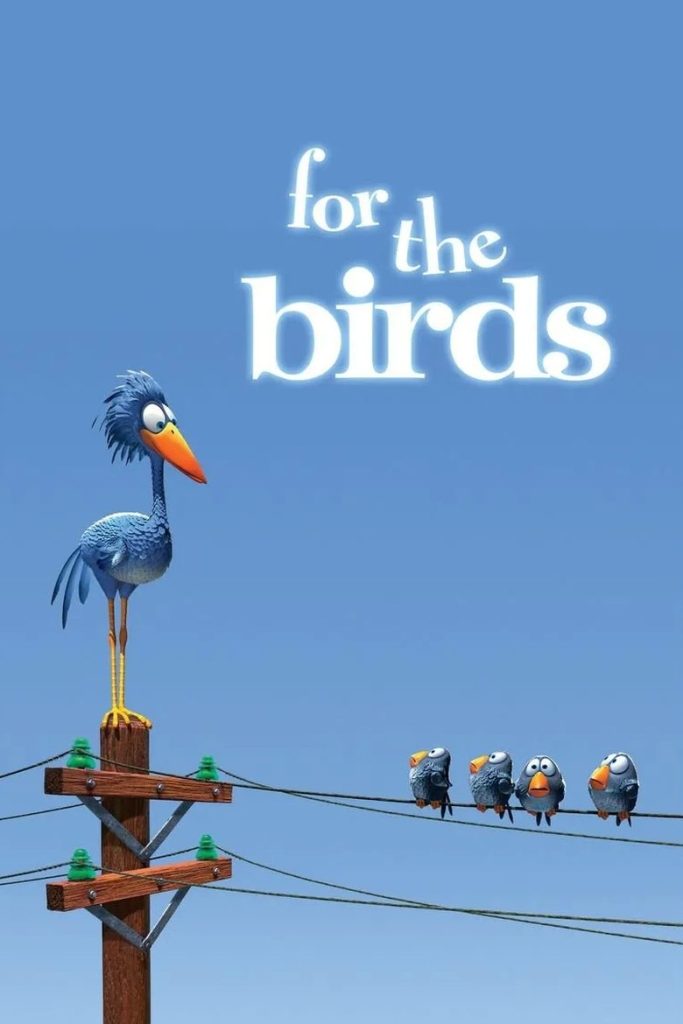
This short animated film follows a flock of small birds perched on a telephone wire. When a larger, awkward bird attempts to join them, the smaller birds mock and exclude him due to his differences. The story humorously explores themes of social exclusion and bullying, showing how the small birds' unkind behavior ultimately leads to their own embarrassment. Through visual comedy and expressive animation, it delivers a simple yet meaningful lesson about acceptance and the consequences of teasing others.
Parent Guide
A gentle, humorous short film about bullying and acceptance that's appropriate for all ages.
Content breakdown
No physical violence, but birds peck at each other and there's brief peril when birds fall from the wire.
Nothing scary or disturbing; all content is presented in a comedic, cartoonish manner.
No dialogue or language of any kind.
No sexual content or nudity; characters are animated birds.
No substance use of any kind.
Mild emotional moments related to exclusion and embarrassment, resolved positively.
Parent tips
This G-rated Pixar short is appropriate for all ages and runs only 4 minutes, making it an excellent choice for brief family viewing. The film presents bullying behavior in a clear, non-graphic way that children can easily understand, with the bullies receiving natural consequences for their actions. Parents can use this as a gentle introduction to discussions about kindness, inclusion, and how we treat those who are different from us.
Parent chat guide
Parent follow-up questions
- How did the big bird feel when the little birds didn't want to play with him?
- What happened when the birds were mean to each other?
- How can we be nice to friends who look or act differently?
- What do you think the birds learned at the end?
- Have you ever felt left out like the big bird?
- Why do you think the small birds didn't want the big bird to join them?
- What could the small birds have done differently to include the big bird?
- How does the film show that bullying doesn't pay off?
- What does this story teach us about judging people by how they look?
- Have you ever seen someone being excluded at school or play?
- What social dynamics does this film illustrate about group behavior?
- How does the film use humor to deliver a serious message about bullying?
- What are some real-world parallels to the birds' exclusionary behavior?
- Why do you think people sometimes mock those who are different?
- How can bystanders help when they see exclusion happening?
- How does this simple story effectively convey complex social concepts?
- What commentary does the film make about clique mentality and social conformity?
- How might this story apply to social media or online interactions?
- What psychological factors contribute to group exclusion behavior?
- How can communities promote inclusion while still acknowledging differences?
🎭 Story Kernel
At its core, 'For the Birds' is a masterful exploration of social exclusion and the absurdity of groupthink. The short film presents a microcosm of society where conformity is enforced through ridicule, and difference is met with immediate hostility. The small birds' initial unity against the large, awkward bird reveals how fragile social bonds can be when built on shared prejudice rather than genuine connection. Their collective downfall—literally stripped of their feathers when their plan backfires—serves as a perfect karmic punishment for their cruelty. The film suggests that communities that define themselves by who they exclude are ultimately hollow and self-destructive, while the outsider, though initially rejected, remains intact by simply being himself.
🎬 Visual Aesthetics
Pixar's animation uses exaggerated squash-and-stretch physics not just for comedy, but to visually represent social dynamics. The small birds are rendered with sharp, angular lines and rapid, synchronized movements that mirror their hive-mind mentality. In contrast, the large bird is all soft curves and clumsy, isolated motion. The color palette is deliberately muted—browns, grays, and dull blues of the telephone wire and sky—making the eventual visual punchline of the naked, pink birds all the more startling. The camera often frames the group as a single, chittering entity, while the large bird is shot in isolating wide shots, emphasizing his loneliness before the tables turn.
🔍 Details & Easter Eggs
💡 Behind the Scenes
This Oscar-winning short (2000) was directed by Ralph Eggleston and originated from a simple animation test of bird physics at Pixar. The team studied real bird behavior and flock mechanics, but exaggerated everything for comic effect. The iconic, high-pitched bird voices were created by sound designer Gary Rydstrom using processed recordings of his own voice. The entire short runs just over three minutes and was created with Pixar's Marionette animation system, serving as a technical showcase for rendering complex feather and cloth simulation during the denuding sequence.
Where to watch
Choose region:
- Disney Plus
- Apple TV
- Google Play Movies
- YouTube
- Fandango At Home
Trailer
Trailer playback is unavailable in your region.