
Godzilla: The Planet Eater (2018)
Story overview
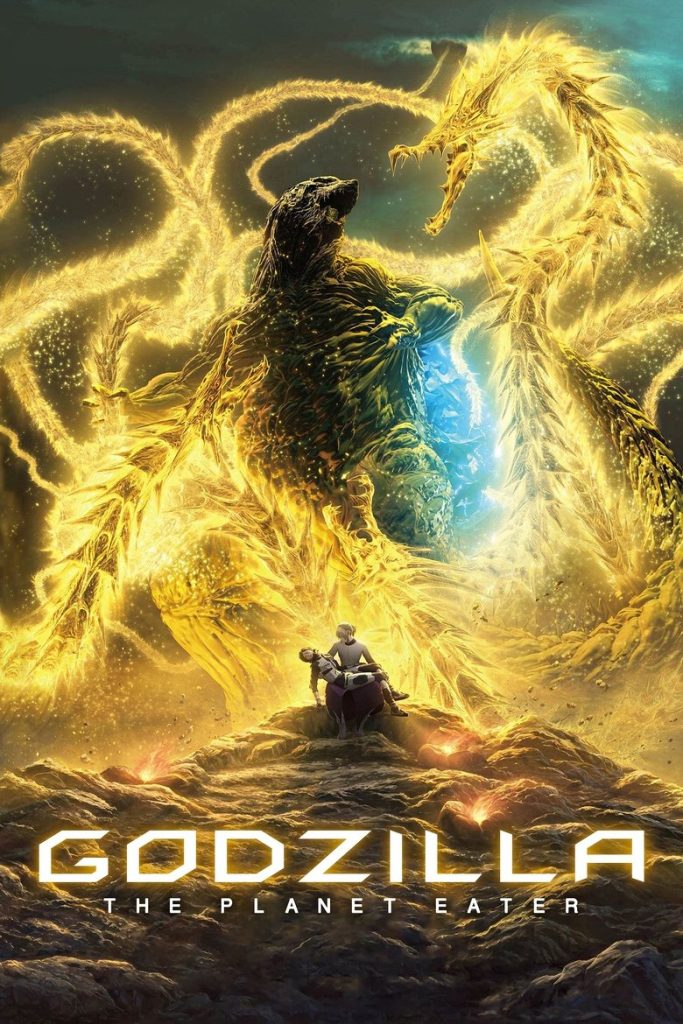
In this animated sci-fi film, humanity faces extinction as Godzilla Earth dominates the planet. When King Ghidorah, a golden three-headed dragon from another dimension, arrives to challenge Godzilla, the conflict escalates to cosmic proportions, shaking the very foundations of reality as these titans battle for supremacy.
Parent Guide
Animated monster film with intense action and cosmic themes. While not graphically violent, the scale of destruction and existential threats may be intense for sensitive viewers. The TV-14 rating reflects the mature themes and intense sequences.
Content breakdown
Large-scale monster battles with buildings destroyed and cities threatened. No blood or gore, but intense peril as humanity faces extinction. Combat involves energy beams, physical attacks between giant creatures, and dimensional disturbances.
Giant monsters, apocalyptic scenarios, and cosmic threats. King Ghidorah's three-headed design and dimensional powers could be unsettling. Themes of human extinction and hopelessness may disturb sensitive viewers.
No strong profanity expected in the English adaptation. Some tense dialogue about survival and desperation.
No sexual content or nudity present.
No depiction of substance use.
High stakes with humanity's survival at risk. Characters experience desperation, fear, and determination. The cosmic scale of conflict creates a sense of overwhelming odds.
Parent tips
This animated film features intense monster battles with apocalyptic stakes. While there's no graphic violence, the scale of destruction and existential themes may be overwhelming for younger viewers. The story deals with humanity's desperation and survival against overwhelming odds. Best suited for children who can handle sci-fi action and abstract threats.
Parent chat guide
Parent follow-up questions
- Which monster looked the coolest?
- What colors did you see in the movie?
- How did the people try to stay safe?
- Why do you think the monsters were fighting?
- What would you do if you saw a giant monster?
- How did the characters work together?
- What does the movie say about humanity's relationship with nature?
- How are the two monsters different in how they fight?
- What does 'higher dimension' mean in the story?
- How does the film use monster battles to explore philosophical concepts?
- What commentary might be made about humanity's self-destructive tendencies?
- How does the animation style enhance the cosmic scale of the conflict?
🎭 Story Kernel
The film's core is a brutal exploration of nihilism versus faith. It's not really about Godzilla versus Ghidorah, but about Haruo Sakaki's internal battle. After years of fighting for survival, he's confronted with the possibility that his entire struggle—and humanity's existence—might be meaningless. The Exif religion offers seductive certainty through worship of Ghidorah, presenting annihilation as transcendence. Haruo's ultimate choice isn't to destroy Godzilla, but to reject both absolute power (the Mechagodzilla offer) and nihilistic worship, choosing instead to preserve Earth's natural order, even if it means humanity remains subordinate. The real conflict is between finding purpose in struggle versus surrendering to cosmic indifference.
🎬 Visual Aesthetics
The visual language shifts dramatically from the previous films' sci-fi realism to abstract, symbolic horror. Ghidorah's introduction is masterful—initially just golden light and shadows, then impossible non-Euclidean geometries that break physics. The color palette drains of warmth, leaving stark blacks, metallic grays, and Ghidorah's unnatural gold. Action becomes psychological; the final 'battle' is mostly static, with Godzilla motionless as Ghidorah's shadowy forms phase through him. The most striking visual is Ghidorah's true form—not a monster, but a Lovecraftian constellation of golden rings and darkness, making Godzilla seem physically tangible by comparison. The camera often frames characters small against cosmic scales.
🔍 Details & Easter Eggs
💡 Behind the Scenes
This trilogy finale was directed by Kobun Shizuno and Hiroyuki Seshita, who intentionally shifted from the mecha-action of the second film to philosophical horror. Ghidorah's unique design—deliberately avoiding a traditional three-headed dragon—required new animation techniques to create its non-corporeal, physics-defying movements. The English dub features voice actors from the previous films, with Kyle Hebert returning as Haruo. The production team studied real astrophysical phenomena for Ghidorah's cosmic effects, blending science with supernatural horror. At 88 minutes, it's the shortest of the trilogy, focusing on thematic resolution over spectacle.
Where to watch
Choose region:
- Netflix
- Netflix Standard with Ads