Godzilla vs. Biollante (1989)
Story overview
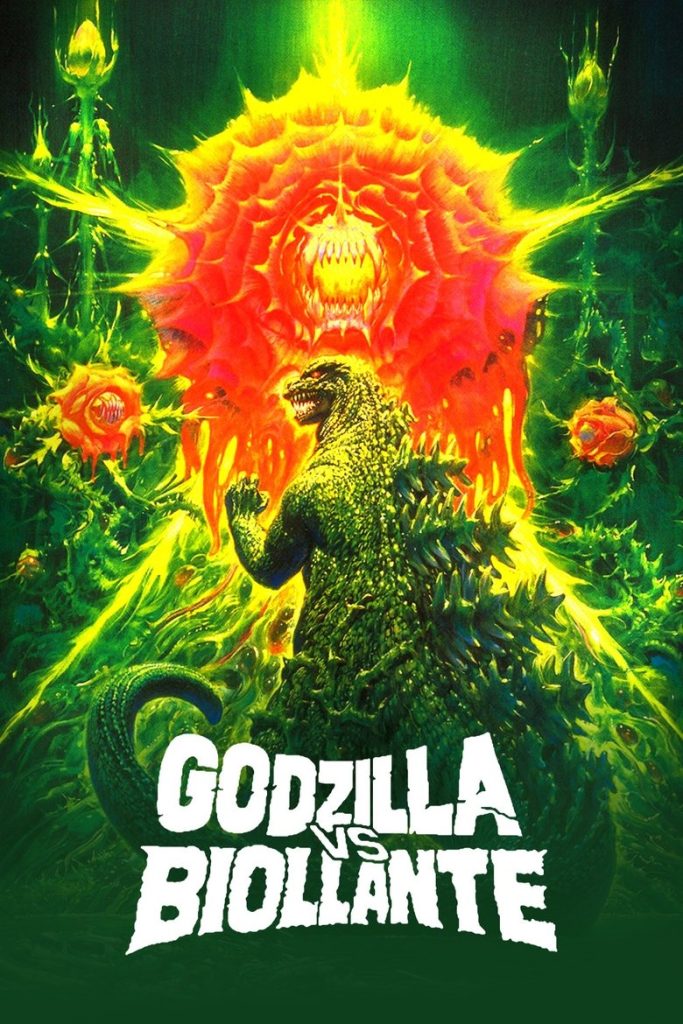
In this 1989 Japanese monster film, following Godzilla's previous attack, a scientific arms race emerges as various groups seek to collect Godzilla's cells. The Japanese government, fearing Godzilla's return, develops a bio-weapon called ANEB (Anti-Nuclear Energy Bacteria) using these cells. They enlist geneticist Genshiro Shiragami, whose experiments accidentally create a new monstrous mutation named Biollante, leading to a climactic battle between the two giant creatures.
Parent Guide
A classic Japanese monster movie with scientific themes and creature battles. Suitable for most children 8+, though younger or sensitive viewers might find the monster designs and destruction scenes intense.
Content breakdown
Monster battles involving physical combat, destruction of buildings and military vehicles, explosions, and military action against the creatures. No graphic human violence or blood.
Large monster designs (particularly Biollante's plant-monster appearance) might be unsettling. Scenes of urban destruction and tense moments as monsters threaten humans. Some scientific experimentation scenes could be conceptually disturbing.
No strong language noted. Typical dramatic dialogue for a monster movie. If watching with subtitles, translation may vary.
No sexual content or nudity present.
No depiction of substance use.
Tense monster battles, scenes of urban destruction, and scientific ethical dilemmas create moderate emotional intensity. Some characters face peril, but the tone remains within typical monster movie conventions.
Parent tips
This film features intense monster battles with destruction of buildings and military action. While not graphic, the monster designs (particularly Biollante's plant-like appearance) might be unsettling for younger children. The scientific themes involving genetic experimentation could prompt discussions about ethics in science. The Japanese cultural context and subtitles (if watching in original language) may require explanation for younger viewers.
Parent chat guide
Parent follow-up questions
- Which monster did you like better?
- What was your favorite part?
- How did the monsters look different from each other?
- Why were the scientists collecting Godzilla's cells?
- What do you think Biollante was made from?
- How did the people try to stop the monsters?
- What ethical issues did the scientists face in their experiments?
- How does this film compare to other Godzilla movies?
- What message might the film be sending about scientific responsibility?
- How does this film reflect Japan's cultural relationship with nuclear technology?
- What political commentary might be embedded in the monster conflict?
- How does the film explore themes of nature vs. science?
🎭 Story Kernel
At its core, 'Godzilla vs. Biollante' is less about monster combat and more a cautionary tale about the commodification of life itself. The driving force isn't primal rage, but corporate espionage and scientific hubris. Characters are motivated by grief (Dr. Shiragami fusing his daughter's cells with a rose), nationalistic pride (the JSDF and foreign agents), and pure profit (the Bio-Major corporation seeking Godzilla cells). The film posits that the greatest threat isn't the atomic lizard, but humanity's willingness to weaponize and patent nature without considering the consequences, turning mourning and scientific curiosity into weapons of mass destruction.
🎬 Visual Aesthetics
The film employs a stark visual contrast between the sterile, cold blues and grays of laboratories and military command centers, and the vibrant, almost sickly greens and organic textures of Biollante. Godzilla is shot with weighty, ground-level perspectives that emphasize his scale as a force of nature. Biollante's sequences use more fluid, almost dreamlike camera movements, especially in her final, tragic form as a giant ethereal rose reaching for the stars. The action avoids pure city-stomping spectacle, instead framing battles as chaotic collisions in industrial zones, emphasizing the environmental and collateral damage of corporate and military overreach.
🔍 Details & Easter Eggs
💡 Behind the Scenes
The story originated from a public screenplay contest winner, dentist Shinichiro Kobayashi, making it one of the few Heisei Godzilla films with a non-industry writer. The Biollante suit, a complex hybrid of plant and creature, was notoriously difficult for suit actor Kenpachiro Satsuma to maneuver, requiring multiple operators for the vine tentacles. The film's ending initially had Biollante's spores drifting toward space, setting up a potential sequel that was never produced. It was also the first Godzilla film to heavily incorporate genetic engineering as a central plot device, reflecting late-80s scientific anxieties.
Where to watch
Choose region:
- HBO Max
- HBO Max Amazon Channel
- Criterion Channel
- Cinemax Amazon Channel
- Cinemax Apple TV Channel
- Amazon Video
- Apple TV Store
- Google Play Movies
- YouTube
- Fandango At Home
Trailer
Trailer playback is unavailable in your region.