
Green Snake (2021)
Story overview
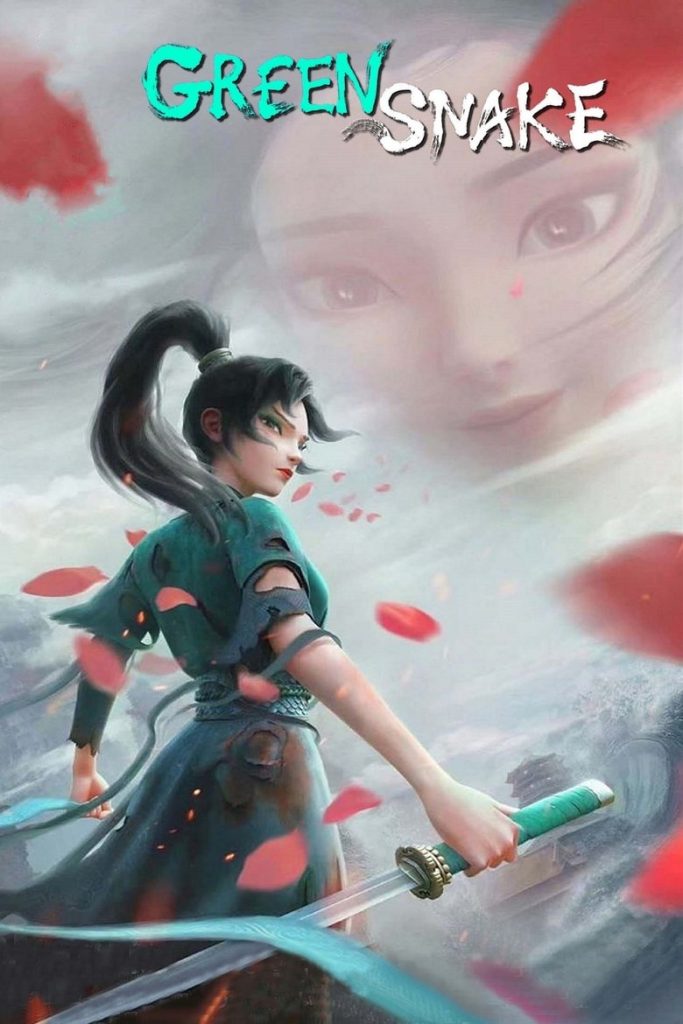
Green Snake is a 2021 Chinese animated fantasy film following Xiao Qing as she attempts to rescue her sister from the powerful monk Fahai. During her quest, she finds herself transported to a strange dystopian city where she encounters a mysterious man suffering from amnesia about his past life. The story blends traditional Chinese mythology with futuristic elements as Xiao Qing navigates this unfamiliar world while trying to complete her mission.
Parent Guide
An animated fantasy adventure with moderate action and some intense sequences, best for older children familiar with fantasy storytelling.
Content breakdown
Contains magical combat, characters in peril, and confrontations with supernatural beings. Action sequences are stylized but may include chasing, capturing, and magical attacks.
Includes dystopian cityscapes, supernatural threats, and tense situations. Some scenes may be intense for sensitive viewers, particularly involving captivity and memory loss themes.
No concerning language noted in the provided information.
No sexual content or nudity indicated in the provided information.
No substance use indicated in the provided information.
Features themes of family separation, memory loss, and confronting powerful adversaries. Characters experience frustration, determination, and concern for loved ones.
Parent tips
This animated fantasy film features moderate action sequences with magical combat and perilous situations as characters face supernatural threats. The dystopian city setting includes some dark, futuristic visuals that might be intense for younger viewers. At 132 minutes, the film has a substantial runtime that requires sustained attention.
Parents should note that while this is an animated film, it deals with themes of captivity, memory loss, and confronting powerful adversaries. The blend of traditional mythology with dystopian elements creates a unique but potentially confusing narrative for children unfamiliar with Chinese folklore. The 'Not Rated' designation means parents should preview or research content to determine appropriateness for their family.
Parent chat guide
After the film, ask what they thought about the different worlds shown in the movie and how the characters handled difficult situations. Discuss the themes of helping family members and dealing with memory loss. For older children, you might explore how the film adapts traditional stories into new settings.
Parent follow-up questions
- What was your favorite part of the movie?
- How did the characters help each other?
- What colors did you see in the different places?
- Was there anything that surprised you?
- How would you help someone who was lost?
- What was the main problem the characters had to solve?
- How were the two different worlds in the movie different from each other?
- What made some parts of the movie exciting or scary?
- Why do you think the man couldn't remember his past?
- What would you do if you found yourself in a strange new place?
- How did the film blend traditional mythology with futuristic elements?
- What challenges did Xiao Qing face in trying to rescue her sister?
- How did the setting affect the story and characters?
- What did you think about the theme of memory and identity?
- How did the characters show bravery or determination?
- How effectively did the film adapt traditional Chinese folklore into a modern context?
- What commentary might the dystopian setting provide about society or memory?
- How did the animation style contribute to the storytelling?
- What themes about family, duty, or identity did you notice?
- How did the film balance action sequences with character development?
🎭 Story Kernel
At its core, 'Green Snake' is less about forbidden romance and more about the radical act of defining one's own identity outside prescribed roles. While White Snake pursues a conventional human life with Xu Xian, Green Snake's journey questions whether assimilation is liberation or another cage. The film's true conflict isn't between humans and demons, but between authentic existence and performative conformity. Green Snake's ultimate choice—to reject both human morality and celestial law—represents a third path: creating one's own morality. The sisters represent two responses to oppression: White Snake seeks acceptance within the system, while Green Snake realizes the system itself must be rejected to be free.
🎬 Visual Aesthetics
The film's visual language creates a lush, watercolor dreamscape where reality constantly dissolves. Director Tsui Hark employs flowing, serpentine camera movements that mirror the snakes' physicality, with particular brilliance in the underwater sequences where the sisters move with aquatic grace. The color palette shifts dramatically: warm golds and reds for human domesticity, cool blues and greens for supernatural realms, and stark whites during spiritual confrontations. The action sequences aren't just spectacle—they're emotional exposition, with Green Snake's combat style being more improvisational and fluid compared to White Snake's elegant precision, visually reinforcing their differing approaches to existence.
🔍 Details & Easter Eggs
💡 Behind the Scenes
Maggie Cheung (White Snake) and Joey Wong (Green Snake) were already established stars when cast, but their off-screen friendship translated into remarkable on-screen chemistry. The iconic underwater scenes were filmed in a specially constructed tank with heated water to prevent hypothermia during long shoots. Director Tsui Hark drew inspiration from traditional Chinese ink paintings rather than Western fantasy aesthetics, deliberately avoiding CGI in favor of practical effects and wirework to maintain an organic feel. The temple set where the final confrontation occurs was built at full scale rather than using miniatures, contributing to the film's tangible, immersive quality.
Where to watch
Choose region:
- Netflix
- Netflix Standard with Ads
Trailer
Trailer playback is unavailable in your region.