
Groundhog Day (1993)
Story overview
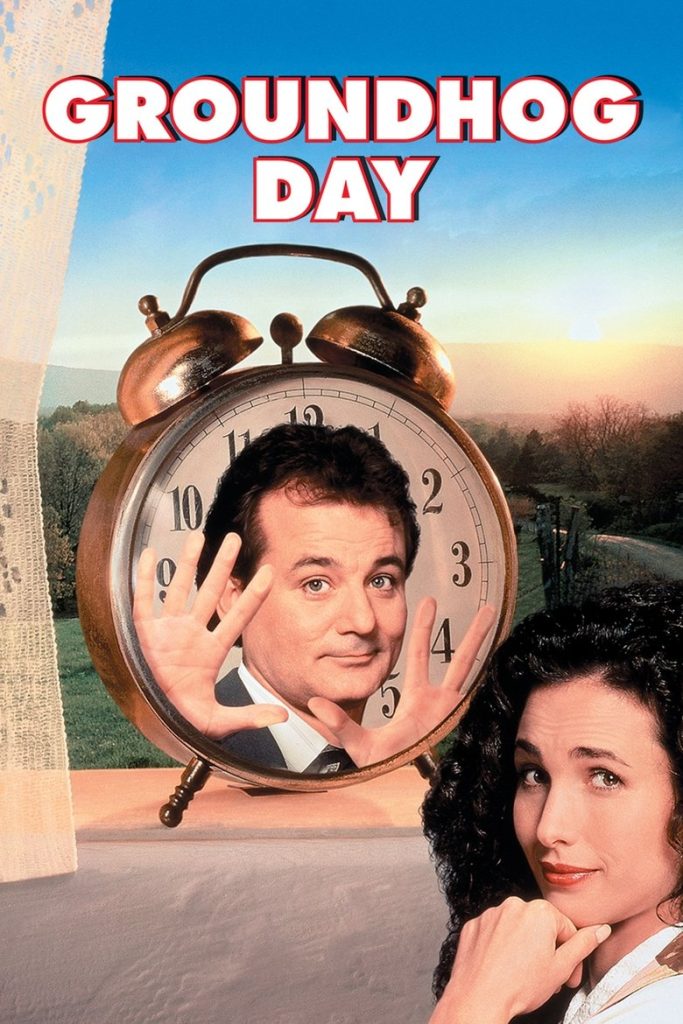
Groundhog Day is a 1993 romantic fantasy comedy film about a cynical weatherman who finds himself trapped in a time loop, reliving the same day over and over again. As he experiences the endless repetition, he gradually learns to appreciate life and become a better person. The film explores themes of personal growth, redemption, and finding meaning in everyday moments through its humorous and heartwarming premise.
Parent Guide
A thoughtful comedy about personal growth with mild thematic elements suitable for most families.
Content breakdown
Some comedic peril including a character driving into a ditch and minor physical comedy. No serious violence.
The time loop concept might be confusing or slightly unsettling for very young viewers, but presented in a comedic context.
Occasional mild language and sarcastic remarks consistent with PG rating.
Brief romantic situations and kissing. Some mild innuendo presented in comedic context.
Social drinking in bars and restaurants, consistent with adult social situations.
Mild frustration and existential themes as character deals with being trapped in time loop, balanced by humor.
Parent tips
Groundhog Day is a classic comedy with a PG rating that makes it suitable for most families. The film's fantasy premise and comedic tone help balance its more mature themes about life choices and personal transformation. While younger children might not grasp all the philosophical undertones, they can enjoy the humorous situations and the character's journey.
Parent chat guide
Parent follow-up questions
- What was your favorite funny part in the movie?
- How would you feel if you had to do the same day over and over?
- What nice things did the main character learn to do for others?
- Why do you think the main character was unhappy at the beginning?
- What are some things you would do differently if you could repeat a day?
- How did the main character change by the end of the movie?
- What does this movie teach us about making good choices?
- How does repeating the same day help the character understand himself better?
- What are some ways we can break out of negative patterns in our own lives?
- What philosophical questions does the time loop premise raise about free will?
- How does the film use comedy to explore serious themes about personal growth?
- What does the movie suggest about finding meaning and purpose in life?
🎭 Story Kernel
The film explores existential transformation through enforced repetition. Phil Connors isn't just stuck in a day—he's trapped in his own narcissism. The real plot isn't about escaping February 2nd, but about escaping his own ego. Each cycle represents a different philosophical approach to life: hedonism, despair, manipulation, and finally genuine connection. The breakthrough comes not when he masters the day's events, but when he stops trying to control them and starts serving others. The movie argues that meaning emerges not from extraordinary circumstances, but from how we engage with the ordinary. Phil's journey from cynical observer to active participant mirrors the human struggle to find purpose in repetition.
🎬 Visual Aesthetics
Director Harold Ramis uses visual repetition with subtle variations to mirror Phil's emotional journey. The same establishing shots of Punxsutawney appear throughout, but their emotional weight changes as Phil's perspective shifts. The color palette evolves from cold blues and grays during Phil's cynical early cycles to warmer tones as he embraces the town. Notice how the camera initially keeps Phil isolated in frames, then gradually includes more townspeople as he connects with them. The film's visual rhythm—waking up to 'I Got You Babe,' the clock flipping to 6:00 AM—creates a hypnotic quality that makes Phil's disorientation feel visceral rather than just narrative.
🔍 Details & Easter Eggs
💡 Behind the Scenes
Bill Murray and director Harold Ramis famously clashed during production over the film's tone—Murray wanted it more philosophical, Ramis more comedic. The tension reportedly ended their longtime collaboration. Punxsutawney's town square was recreated in Woodstock, Illinois because the real location lacked the required architectural charm. Stephen Tobolowsky's Ned Ryerson was largely improvised, with his relentless 'Bing!' becoming one of the film's most memorable moments. The script went through multiple revisions that gradually reduced supernatural explanations, focusing instead on character transformation.
Where to watch
Choose region:
- Netflix
- AMC
- Philo
- Amazon Video
- Apple TV
- Google Play Movies
- YouTube
- Fandango At Home
- Spectrum On Demand
Trailer
Trailer playback is unavailable in your region.