
Gunjan Saxena: The Kargil Girl (2020)
Story overview
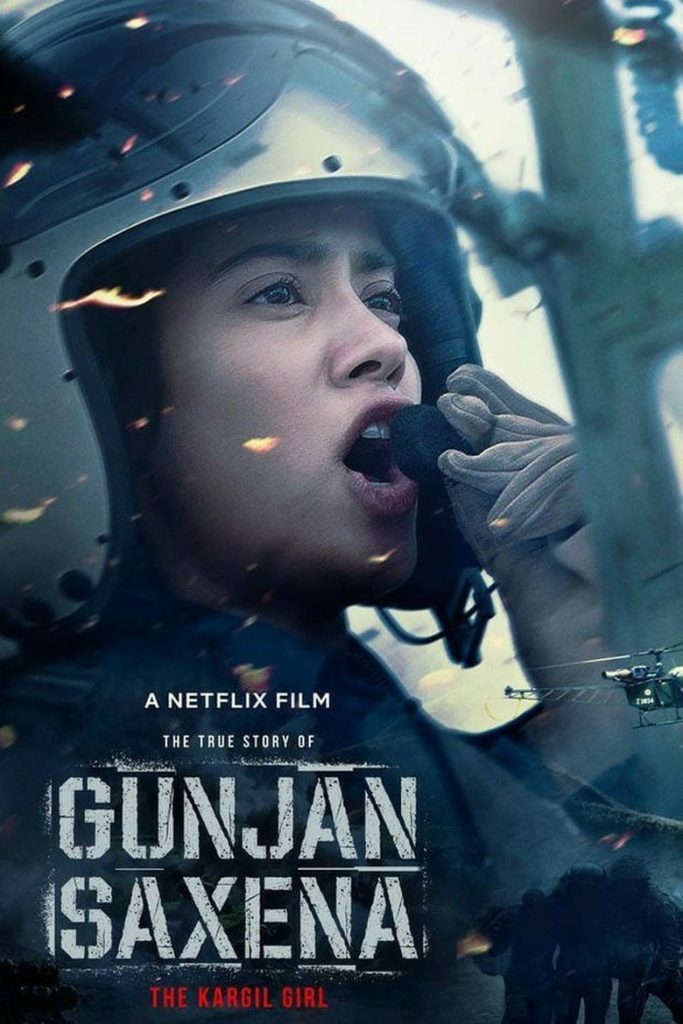
Gunjan Saxena: The Kargil Girl is a 2020 Indian biographical drama film based on the life of Gunjan Saxena, one of the first female pilots in the Indian Air Force. The movie follows her journey as she overcomes gender-based challenges and societal expectations to pursue her dream of becoming a pilot. It highlights her determination and courage during the 1999 Kargil War, where she played a significant role in rescue operations. The film combines elements of action and drama to inspire viewers with a story of perseverance and breaking barriers.
Parent Guide
A biographical drama with action elements, focusing on inspiration and overcoming adversity, suitable for older children and teens with parental guidance for younger viewers due to thematic intensity.
Content breakdown
Includes wartime action sequences with peril, such as aircraft in combat zones and rescue missions, but without graphic violence or gore.
Some scenes may be tense or emotionally charged due to war settings and gender-based discrimination, but not overly frightening.
May contain occasional mild language or heated dialogues, but no strong profanity.
No sexual content or nudity present.
No depiction of substance use.
Emotional moments related to struggle, discrimination, and wartime stress, which might be impactful for sensitive viewers.
Parent tips
This film is suitable for children aged 8 and up, with a TV-14 rating indicating it may contain material that parents might find unsuitable for younger viewers. It focuses on themes of gender equality, resilience, and patriotism, which can spark meaningful discussions about pursuing dreams despite obstacles. Parents should note that while the movie includes action sequences related to wartime scenarios, it is not overly graphic, but younger or sensitive viewers might find some scenes intense. Overall, it serves as an empowering and educational watch for families.
Parent chat guide
Parent follow-up questions
- What did you like most about Gunjan?
- How did Gunjan feel when she was flying?
- Can you draw a picture of something brave you saw in the movie?
- Why do you think Gunjan wanted to be a pilot?
- How did Gunjan's family support her dreams?
- What was the hardest part of Gunjan's journey?
- What challenges did Gunjan face because she was a girl?
- How did Gunjan show courage during the war?
- What can we learn from Gunjan about never giving up?
- How does the film address gender stereotypes in society?
- What impact did Gunjan have on the Indian Air Force and beyond?
- Discuss the balance between patriotism and personal ambition in the movie.
🎭 Story Kernel
At its core, 'Gunjan Saxena: The Kargil Girl' is less about military heroism and more about the quiet, persistent rebellion required to carve space in a world designed to exclude you. The film expresses the exhausting reality of being a 'first'—where every professional achievement is shadowed by the emotional labor of proving your basic right to exist in that space. Gunjan's drive isn't fueled by a desire for glory, but by a childlike, unwavering belief in a promise she made to herself, which the patriarchal structure of the Indian Air Force constantly tries to break. Her father, Anup, becomes the emotional anchor, representing the supportive male ally whose belief is a necessary but insufficient counterweight to institutional sexism. The antagonist isn't a foreign enemy but the entrenched, condescending resistance within her own ranks, making her eventual flight during the Kargil War a triumphant breach of an internal barrier, not just a military operation.
🎬 Visual Aesthetics
The film employs a grounded, almost documentary-like visual aesthetic for its earth-bound struggles, using a muted, realistic color palette of khakis, greys, and beiges within the IAF base to emphasize institutional rigidity and monotony. This starkly contrasts with the sequences of flight, which open up into expansive, sun-drenched shots with vibrant blues and golds, visually representing freedom, aspiration, and Gunjan's true element. The camera often places Gunjan in the center of frames crowded with skeptical male colleagues, visually isolating her. The action during the Kargil rescue sequences avoids over-the-top heroics, instead focusing on the tense, procedural reality of flying under fire, which reinforces the film's theme of competence over spectacle. Symbolism is straightforward but effective: the recurring motif of her childhood paper plane foreshadows her destiny, while the physical barriers—gates, doors, the cockpit itself—represent the systemic obstacles she must pass through.
🔍 Details & Easter Eggs
💡 Behind the Scenes
Janhvi Kapoor, who plays Gunjan Saxena, underwent rigorous training to portray the pilot, including flight simulations and understanding cockpit procedures to ensure authenticity. The film was shot in real Indian Air Force bases like Hindon Air Force Station to capture the genuine environment, with active IAF personnel often in the background. Director Sharan Sharma intentionally avoided casting a major male star in a supporting role to keep the narrative focus squarely on Gunjan's journey. Notably, the real Gunjan Saxena was consulted during production, and the film incorporates specific details from her experiences, such as the initial lack of a women's washroom at the operational base.
Where to watch
Choose region:
- Netflix
- Netflix Standard with Ads