Harold and the Purple Crayon (2024)
Story overview
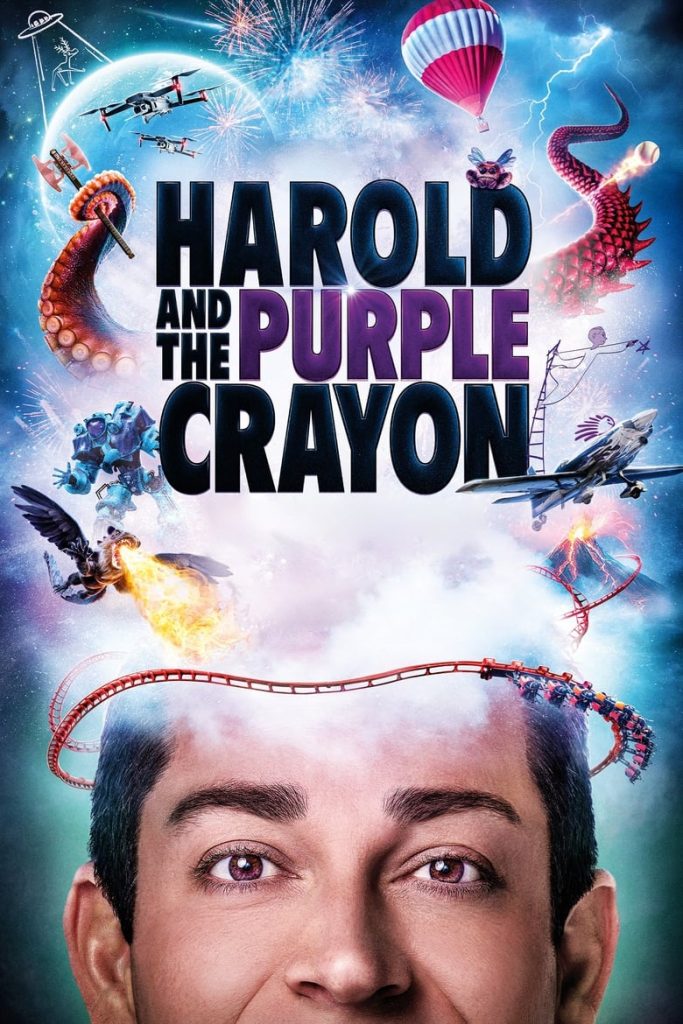
Harold and the Purple Crayon is a 2024 family adventure film directed by Carlos Saldanha. Based on the classic children's book, it follows Harold, a boy who can bring anything he draws to life inside his magical book. When he draws himself out of the book and into the real world as an adult, he must navigate the complexities of reality while learning important lessons about creativity, responsibility, and growing up. The film blends fantasy elements with comedic moments as Harold discovers that real life doesn't always work like his drawings.
Parent Guide
A family-friendly fantasy adventure with positive messages about creativity and growing up. Mild fantasy peril and emotional moments make it best for children ages 6 and up, though some younger children may enjoy it with parental guidance.
Content breakdown
Fantasy peril includes characters in mild danger situations such as falling from heights, being chased by imaginary creatures, and navigating unstable environments created by drawings. No real violence or physical harm occurs to characters.
Some scenes may be intense for very young viewers, including moments where characters appear to be in danger or when Harold's drawings create unexpected challenges. Imaginary creatures and fantasy situations could be momentarily frightening to sensitive children.
No offensive language. Clean family-appropriate dialogue throughout.
No sexual content or nudity. Family-friendly relationships and interactions.
No depiction of alcohol, drugs, or tobacco use.
Moderate emotional moments related to growing up, responsibility, and the transition from childhood imagination to adult reality. Some scenes show characters feeling overwhelmed or uncertain, but these are resolved positively.
Parent tips
This PG-rated film is generally appropriate for most children but contains some mild fantasy peril and emotional moments. Consider these tips: 1) The film explores themes of growing up and responsibility that may resonate differently with various age groups. 2) Some scenes involve characters in mild danger situations (falling, being chased) that could be intense for very young viewers. 3) The transition from childhood to adulthood is a central theme - younger children may need help understanding this concept. 4) The fantasy elements are clearly presented as imaginary creations. 5) There are positive messages about creativity, problem-solving, and learning from mistakes.
Parent chat guide
Parent follow-up questions
- What was your favorite thing Harold drew?
- How did Harold's purple crayon work?
- Was it funny when Harold's drawings came to life?
- What color would your magic crayon be?
- Why did Harold want to leave his book?
- What was hardest for Harold to learn in the real world?
- How did Harold use his drawings to help others?
- What would you do differently if you had Harold's crayon?
- What does the film say about the difference between imagination and reality?
- How did Harold's understanding of responsibility change throughout the story?
- What challenges did Harold face that couldn't be solved with drawings?
- How does the film show the transition from childhood to adulthood?
- How does the film explore the theme of creative potential versus practical limitations?
- What commentary does the film make about nostalgia for childhood?
- How does Harold's journey reflect common coming-of-age experiences?
- What does the purple crayon symbolize in terms of personal agency and control?
🎭 Story Kernel
The film explores the transition from childhood innocence to adult responsibility through the lens of creative manifestation. Harold, now a grown man, enters the real world seeking his creator, only to discover that the power of imagination isn't just about drawing objects into existence, but about shaping one's own narrative. It grapples with the loss of a father figure and the realization that 'The Old Man'—author Crockett Johnson—lives on through the legacy of his work. The story serves as a meta-commentary on the relationship between an author and their creation, emphasizing that while the world can be cynical and restrictive, the 'purple crayon' of the mind is the ultimate tool for navigating grief and finding one's place in a reality that lacks the simple logic of a picture book.
🎬 Visual Aesthetics
Carlos Saldanha utilizes a live-action/CGI hybrid style that juxtaposes the vibrant, glowing purple of Harold’s creations against the muted, often mundane palette of the real world. The visual effects team focuses on the tactile nature of the crayon’s lines, which shimmer with a neon-like energy before solidifying into physical matter. This contrast highlights the intrusion of fantasy into reality. The cinematography often uses wide shots to emphasize the scale of Harold’s drawings—like the airplane or the giant spider—within urban environments. Symbolically, the purple crayon represents the untainted spark of creativity; its fading or breaking reflects Harold’s internal crisis of faith. The transition from 2D animation in the prologue to 3D realism serves as a visual metaphor for the complexity and weight of the physical world compared to the two-dimensional safety of the original book.
🔍 Details & Easter Eggs
💡 Behind the Scenes
This project spent decades in development hell before finally reaching the screen. At various points, directors like Spike Jonze and actors like Will Ferrell were attached to the adaptation. Carlos Saldanha, known for his work on 'Ice Age' and 'Rio,' took the helm to create a live-action debut that maintained his animation roots. The film stars Zachary Levi, who brings a 'Big'-esque energy to the role of an adult Harold. Interestingly, the movie serves as a sequel to the original 1955 children's book rather than a direct adaptation, imagining what happens when the boy finally grows up.
Where to watch
Choose region:
- Netflix
- Amazon Video
- Apple TV Store
- Google Play Movies
- Fandango At Home
- Plex
Trailer
Trailer playback is unavailable in your region.