
Heat (1995)
Story overview
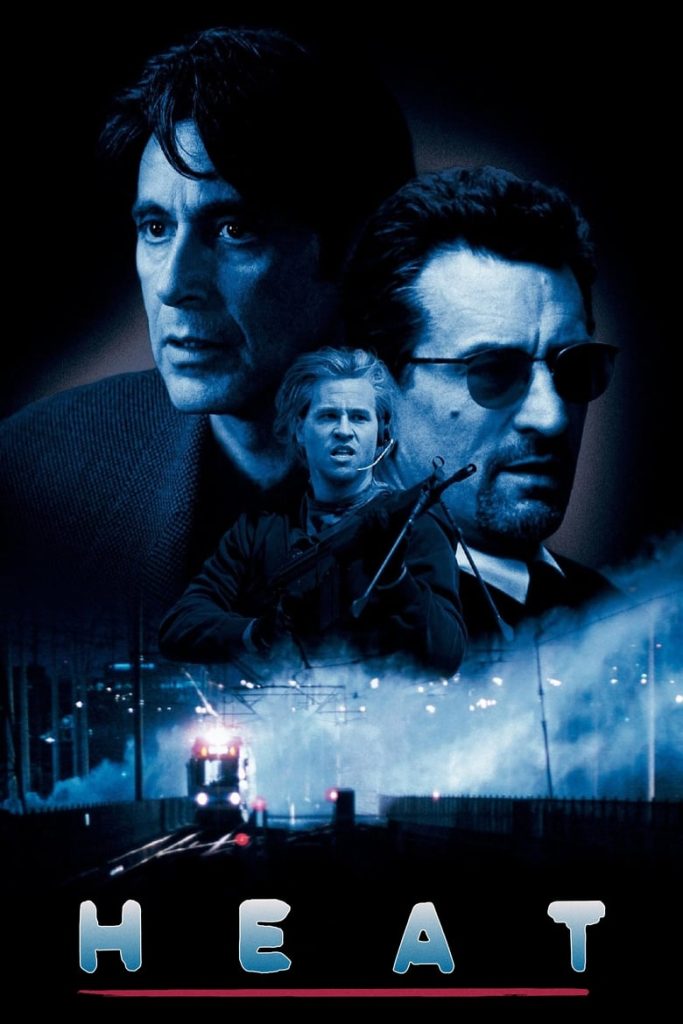
Heat is a 1995 crime drama about the intense cat-and-mouse game between a skilled thief and a dedicated detective. Both men are professionals who respect each other's abilities while knowing their conflict could end violently. The film explores themes of obsession, duty, and the blurred lines between law enforcement and criminality.
Parent Guide
Mature crime drama with intense violence and strong language suitable only for older teens.
Content breakdown
Frequent gun violence, armed robberies, and intense confrontations between criminals and police.
Tense crime situations and the constant threat of violence create sustained suspense.
Frequent strong profanity throughout the film.
Brief sexual references and implied relationships without explicit content.
Characters shown drinking alcohol in social and tense situations.
High-stakes situations, moral conflicts, and intense professional rivalries create emotional tension.
Parent tips
This R-rated film contains strong violence, frequent profanity, and intense crime-related situations. The nearly three-hour runtime and complex themes make it unsuitable for younger viewers. Parents should consider the mature content and emotional intensity before allowing teenagers to watch.
Parent chat guide
Parent follow-up questions
- What do police officers do to help people?
- Why is it important to follow rules?
- How can we tell if someone is making good choices?
- What makes someone a good leader?
- Why do people sometimes break rules?
- How do movies make characters seem exciting even when they're doing wrong things?
- What responsibilities do police officers have to the community?
- How can dedication to a job become unhealthy obsession?
- What are the real consequences of crimes that movies might not show?
- How does the film explore the similarities between the criminal and detective?
- What commentary does the movie make about work-life balance and obsession?
- How do media portrayals of crime influence public perception of law enforcement?
🎭 Story Kernel
At its core, 'Heat' is about the gravitational pull of obsession and the cost of living by a personal code. Neil McCauley and Vincent Hanna are mirror images, both defined by their inability to connect with anything outside their work. Neil's rule—'Don't let yourself get attached to anything you are not willing to walk out on in 30 seconds flat if you feel the heat around the corner'—isn't just a survival tactic; it's a philosophy of emotional detachment that ultimately fails him. The film posits that true freedom is impossible because we are all, inevitably, attached to something—a person, a principle, a need for the game. Their drive isn't for money, but for the identity and purpose their respective 'jobs' provide, making the final confrontation less about cops and robbers and more about two men meeting the only other person who truly understands their isolation.
🎬 Visual Aesthetics
Michael Mann's visual language is one of cool, detached observation and explosive intimacy. The iconic blue-steel color palette—dominated by cool blues, grays, and sterile fluorescents—creates a world that feels both sleek and emotionally frigid. The camera often operates as a distant observer in wide shots of LA's concrete sprawl, then violently crashes into extreme close-ups during moments of tension, like Hanna's panicked face during the bank heist. The action is brutally tactile; the downtown shootout's sound design is legendary for its chaotic, deafening realism, placing the viewer in the center of the sonic maelstrom. This isn't stylized violence but a horrifying, messy consequence, visually cementing the film's theme that every action has a devastating, tangible reaction.
🔍 Details & Easter Eggs
💡 Behind the Scenes
The legendary downtown LA shootout sequence used live, blank-firing weapons to capture the authentic, concussive sound, which was so loud it set off car alarms for blocks. Robert De Niro spent time with ex-con and technical advisor Edward Bunker to master Neil's calm precision, while Al Pacino based Hanna's intense energy on real LAPD detective Charlie Adamson. The iconic coffee shop scene was the first time De Niro and Pacino shared a frame in a film (they were in different scenes in 'The Godfather Part II'), and much of their dialogue was improvised, capturing a genuine, spontaneous rivalry. The film's title has a triple meaning: the police pressure, the literal heat from gunfire, and the emotional heat of the characters' lives.
Where to watch
Choose region:
- fuboTV
- Paramount+ Amazon Channel
- Paramount+ Roku Premium Channel
- Paramount Plus Essential
- Paramount Plus Premium
- Amazon Video
- Apple TV
- Google Play Movies
- YouTube
- Fandango At Home
- Plex Channel
Trailer
Trailer playback is unavailable in your region.