
Here We Are: Notes for Living on Planet Earth (2020)
Story overview
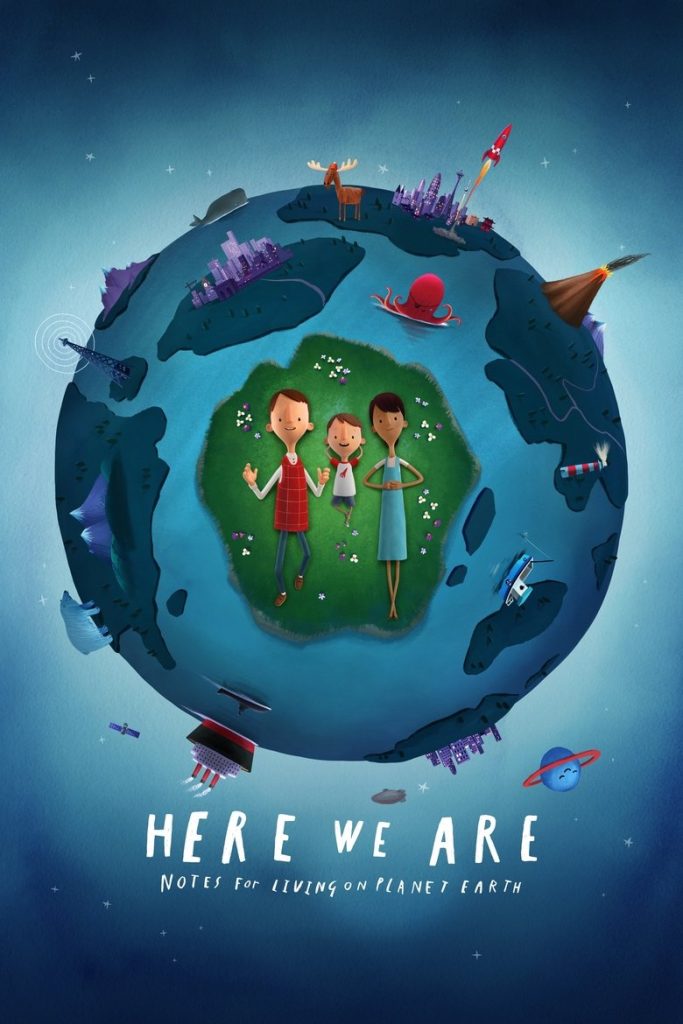
This animated family film follows a young boy as he learns about the wonders of planet Earth through a special journey. It explores themes of nature, family, and our place in the world with gentle storytelling. The movie encourages curiosity and appreciation for our environment through colorful animation and heartfelt moments.
Parent Guide
A gentle, educational animated film suitable for family viewing with positive messages about nature and family.
Content breakdown
No violence or dangerous situations present.
No scary or disturbing content.
No inappropriate language.
No sexual content or nudity.
No substance use depicted.
Mild emotional moments related to family connections and wonder about nature.
Parent tips
This TV-G rated film is appropriate for all ages with its educational focus on Earth's natural wonders. Parents can use this movie to spark conversations about environmental awareness and family connections. The gentle pacing and positive themes make it suitable for young viewers who might enjoy learning about nature.
Parent chat guide
Parent follow-up questions
- What was your favorite animal or plant in the movie?
- How did the characters help each other?
- What colors did you see in nature?
- What sounds from nature did you hear?
- What would you like to learn more about on Earth?
- What did the main character learn about taking care of Earth?
- How did the movie show that we're all connected to nature?
- What part of nature would you like to explore more?
- How can we appreciate Earth's beauty in our daily lives?
- What family moments in the movie reminded you of our family?
- What message about environmental responsibility did the film convey?
- How did the animation style help tell the story about Earth?
- What scientific concepts about our planet were introduced?
- How can we balance enjoying nature with protecting it?
- What did you think about how the characters showed curiosity?
- How effectively did the film communicate its environmental themes?
- What artistic choices enhanced the storytelling about our planet?
- How does this film compare to other nature documentaries or stories?
- What practical steps can we take based on the film's messages?
- How did the film balance education with entertainment value?
🎭 Story Kernel
The film's core isn't about environmentalism as a political stance, but about environmental consciousness as an act of familial love. Eliot's journey through Earth's ecosystems parallels his father's patient guidance—both are about learning to see connections. The real conflict isn't human vs. nature, but distraction vs. presence. When Eliot's father gently redirects his son's attention from screens to soil, he's teaching him to read Earth's subtle language. The ending's power comes not from solving ecological crises, but from Eliot recognizing his backyard as part of the same system he marveled at in the museum. The film argues that true environmentalism begins not with grand gestures, but with noticing the spiderweb on your porch.
🎬 Visual Aesthetics
The animation employs a deliberate visual dichotomy: museum exhibits burst with vibrant, almost psychedelic colors (bioluminescent oceans glow with electric blues, rainforests pulse with saturated greens), while Eliot's home maintains a softer, earth-toned palette. This isn't just aesthetic—it visually argues that wonder exists in both the extraordinary and the ordinary. Camera movements mimic a child's perspective: low-angle shots when Eliot examines insects, slightly shaky handheld feeling during discoveries. Most telling are the transitions between ecosystems—they don't cut abruptly, but dissolve through organic patterns (leaf veins becoming river deltas), visually reinforcing interconnection. The spiderweb scene uses extreme close-up to transform something mundane into architectural marvel.
🔍 Details & Easter Eggs
💡 Behind the Scenes
The film was created by the same studio that produced the Oscar-winning short 'Hair Love,' bringing their signature blend of emotional storytelling with diverse family representation. Voice actor Jacob Tremblay recorded his lines while actually drawing pictures of animals to maintain authentic childlike wonder in his performance. Animators studied time-lapse photography of real ecosystems for the growth sequences, particularly fungal networks and coral polyps. The score incorporates actual field recordings from the Amazon rainforest and Sonoran desert, layered beneath the orchestral music. Director's commentary reveals the father character was deliberately written as patient but not perfect—he checks his phone twice, making his final choice to be fully present more meaningful.
Where to watch
Choose region:
- Apple TV
- Apple TV Amazon Channel
Trailer
Trailer playback is unavailable in your region.